How to Prepare for a Menopause Telehealth Visit
A short symptom summary, relevant health history, and clear priorities can help you use a virtual menopause appointment well.
Before the visit, jot down what has changed, when symptoms happen, how they affect your day, and what you most want help with. Keep your health history and current medicines handy, especially if this isn’t your usual clinician. Ask how your history shapes the options, what assessment is needed, and whether an exam or lab test would be more useful in person. 12

Start with what you want help with
You don’t need a perfect account of every change. Pick the concerns that matter most right now: perhaps hot flashes that disrupt sleep, changes in your periods, vaginal or urinary symptoms, or mood changes. Write down when each began, how often it happens, and what it gets in the way of. If symptoms vary, a recent example can make the pattern easier to explain.
Add one sentence about your goal. For example: “I want fewer night sweats,” “I’d like to talk about discomfort during sex,” or “I want to understand what could be causing this before choosing a treatment.” Naming a priority helps keep the visit focused while leaving room for other concerns.
Put your history within reach
Have a list of medicines and supplements, relevant health conditions, and any previous menopause treatments or tests nearby. If you’re seeing someone who doesn’t have your full medical record, they may not know your history; telehealth can sometimes leave care coordination to you. 1
You might also note what you’ve already tried and what happened. You don’t have to decide in advance whether you want hormone therapy, a nonhormonal option, or no treatment. Your preferences are useful information, not a commitment.
Ask how the assessment will work
A virtual conversation may be enough to discuss symptoms and possible next steps, but it doesn’t guarantee that every question can be settled on video or by phone. Depending on the concern, the clinician may need an in-person examination or a lab test. 1
You can ask:
- “What possibilities are you considering for these symptoms?”
- “Is there anything in my history that changes what you’d assess or recommend?”
- “Can we answer this by telehealth, or would an exam or test add something important?”
- “If we start with a virtual visit, how will I find out about any next steps?”
This keeps the conversation open without assuming that symptoms alone confirm a particular explanation.
Make treatment questions personal
Menopause care isn’t one-size-fits-all. The balance of benefits and risks with hormone therapy depends on factors including the type, route, timing, and duration of treatment and whether a progestogen is used. The Menopause Society recommends individualizing treatment and revisiting its benefits and risks over time. 2
If symptoms are bothering you, try asking what options are aimed at your main concern, what tradeoffs matter given your health history, and how you’ll know whether an option is helping. Evidence-based nonhormonal choices for hot flashes and night sweats include several prescription and behavioral approaches; which, if any, makes sense depends on the individual situation. 3
A useful question is: “What are the reasonable options for the symptom I most want to improve, and what would make you favor one over another for me?” You can also ask what to expect from follow-up and what to do if the first plan doesn’t help.
Make the technology one less thing to manage
Before the appointment, check how to join and keep your notes, medicine list, and questions where you can see them. If the connection fails or the conversation feels rushed, say so and ask how to reconnect or continue the discussion. Technical problems can interrupt telehealth, and good communication matters just as much in a virtual visit as in an office visit. 1
You can end by summarizing what you understood: the next step, who will arrange it, and when you should expect follow-up. That gives you a clear plan whether the visit ends with advice, a test, or an in-person appointment.
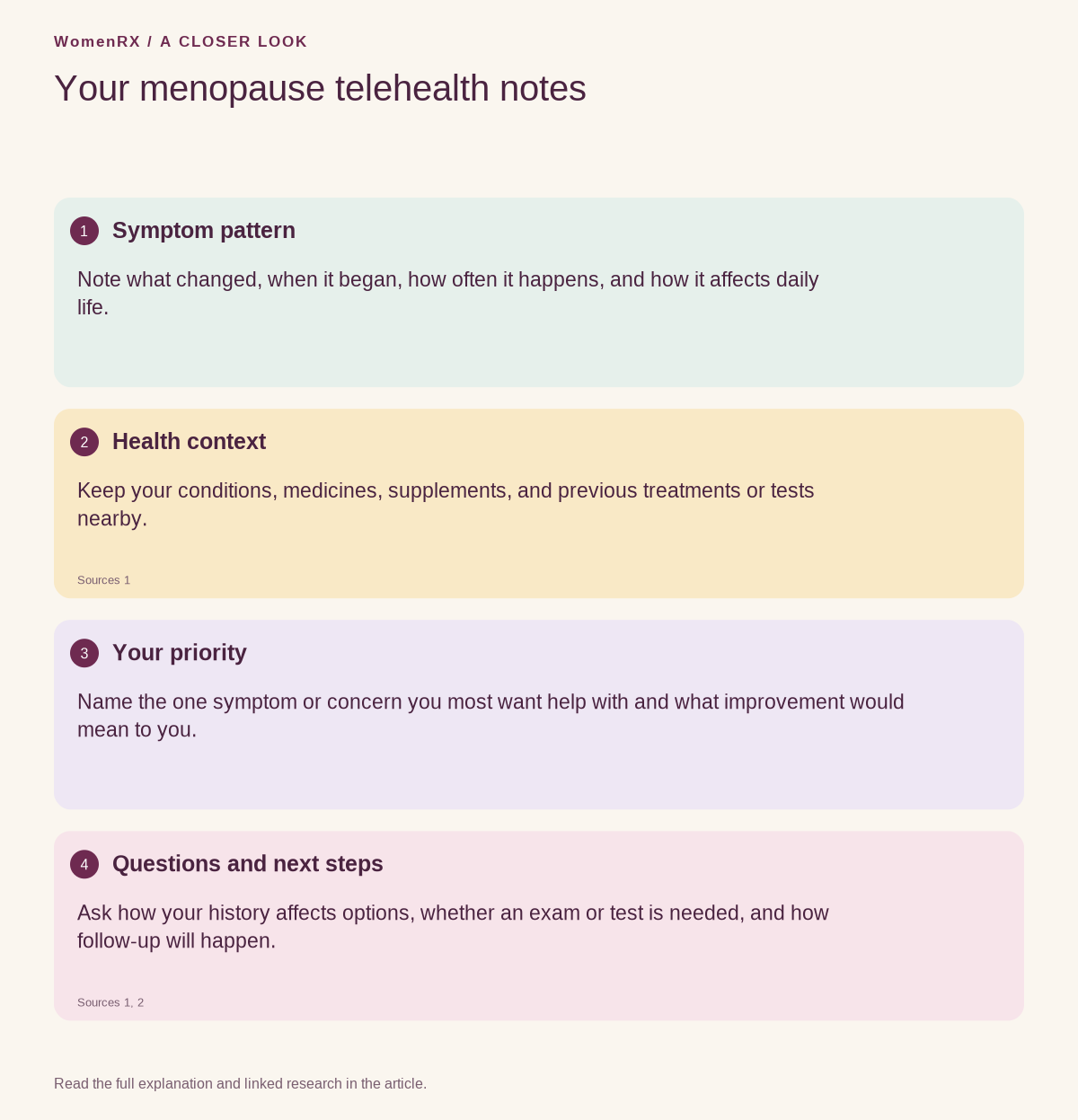
Your menopause telehealth notes
Symptom pattern: Note what changed, when it began, how often it happens, and how it affects daily life.
Health context: Keep your conditions, medicines, supplements, and previous treatments or tests nearby.1
Your priority: Name the one symptom or concern you most want help with and what improvement would mean to you.
Questions and next steps: Ask how your history affects options, whether an exam or test is needed, and how follow-up will happen.12
Read the figure as text
Use these four prompts to bring your main concerns, context, and questions into the visit.- Symptom pattern: Note what changed, when it began, how often it happens, and how it affects daily life.
- Health context: Keep your conditions, medicines, supplements, and previous treatments or tests nearby.1
- Your priority: Name the one symptom or concern you most want help with and what improvement would mean to you.
- Questions and next steps: Ask how your history affects options, whether an exam or test is needed, and how follow-up will happen.12
More questions, answered
What if I’m not sure which symptom matters most?
Choose the change that most affects your comfort, sleep, daily activities, or relationships, then mention any other concerns you don’t want to leave out. You can ask the clinician to help set priorities.
Can I ask to continue in person?
Yes. If an examination or lab test is needed, a clinician may ask you to come in; MedlinePlus notes that some concerns can’t be fully assessed remotely. Ask what the in-person step is meant to clarify. 1
Sources you can check
- Telehealth: MedlinePlusAccessed 2026-09-25Return to first citation
- The 2022 hormone therapy position statement of The North American Menopause Society.“The 2022 Hormone Therapy Position Statement of The North American Menopause Society” Advisory Panel. · Menopause (New York, N.Y.) · 2022Return to first citation
- The 2023 nonhormone therapy position statement of The North American Menopause Society.Menopause (New York, N.Y.) · 2023Return to first citation