What Telehealth Can Handle, and When You Need More Care
A remote visit can help clarify the next step, even when the answer is an exam, a test, or urgent care.
Telehealth can be a useful place to discuss symptoms, review information, and decide what should happen next. It isn’t a substitute for a blood test, a hands-on exam, or immediate treatment when those are needed. For example, a conversation about heavy periods may lead to testing for anemia, while new pelvic pain may need further evaluation to find its cause.32 The deciding question is what your clinician needs to do, not whether a condition appears on a telehealth-friendly list.
Start with the task, not the diagnosis
A telehealth visit can do more than give you a yes-or-no answer about staying home. A clinician can hear how a symptom started and changed, consider information you already have, and help determine whether another kind of care is needed. Research on tele-triage supports its use in directing people to an appropriate level of care, though much of that research studied services used during the COVID-19 pandemic.5 Research on remote specialist consultations also shows that reviewing clinical information can help with care decisions; those programs are not the same thing as a video visit from home.4
That distinction matters. A remote conversation may be the first part of care without being the whole of care. If you’re deciding whether to book one, consider what question you need answered and what information the clinician would need to answer it.
When a conversation can move care forward
Some decisions begin with a clear account of what’s happening. Take heavy periods as an example: how often you need to change a period product, whether bleeding keeps you from usual activities, and whether you also have pain or bleeding between periods all help describe the problem. Heavy bleeding can occur around the start of periods, after pregnancy, or as menopause approaches, but it can also have other causes.3
A remote discussion may help organize those details and plan what comes next. It cannot tell from the conversation alone whether you have iron-deficiency anemia. Blood tests may be used to check for anemia or another underlying condition, and further tests or specialist assessment may be needed if a condition is suspected.3 The useful outcome of a first visit may therefore be a plan for testing, rather than an immediate diagnosis.
The same principle applies to follow-up: discussing symptoms or information already collected is different from obtaining a new sample or performing an examination. The format of the visit should match the question still unanswered.
When the missing piece is an exam or test
Pelvic pain shows why a symptom list doesn’t settle where care should happen. Pain in the lower abdomen can come from the bowel, bladder, an infection, or reproductive organs. Similar symptoms can have different causes, and finding the cause may take time or require tests or a specialist assessment.2 A call can help describe where the pain is, how suddenly it began, and what else is happening. It cannot collect a sample or perform a hands-on examination.
Pregnancy changes the significance of pelvic pain because ectopic pregnancy is one possible serious cause. That does not mean every pain in pregnancy has that cause. It does mean a remote conversation shouldn’t be treated as proof that a concerning new pain is harmless.2 If pregnancy is possible, say so when you seek care, even if you haven’t had a confirmed pregnancy test.
This is why blanket lists such as “pelvic pain is treatable online” or “pelvic pain always needs an office visit” aren’t very helpful. The next step depends on the symptoms and on what must be checked to make a safe decision.2
When not to wait for an ordinary video visit
Some symptoms call for prompt assessment rather than a routine telehealth appointment. Severe difficulty breathing, a heavy or tight feeling in the chest, pain spreading to the arm, back, neck, or jaw, or sudden confusion warrant emergency care. Breathlessness with pain or swelling in one leg also needs urgent assessment.1
Telehealth can still play a role in urgent-care systems. But evidence from emergency-department trials mainly supports remote approaches for noncritical cases and is less clear for high-acuity care. Those trials often involved equipment or staff on site, so they don’t show that a home video visit can provide the same assessment.6
If the situation is not an emergency but symptoms are new, worsening, or affecting daily life, don’t let the convenience of a remote appointment delay needed testing or examination. A productive telehealth visit may end with a clear recommendation to be seen in person. That’s not a failed visit. It’s the point at which the next clinical task has changed.23
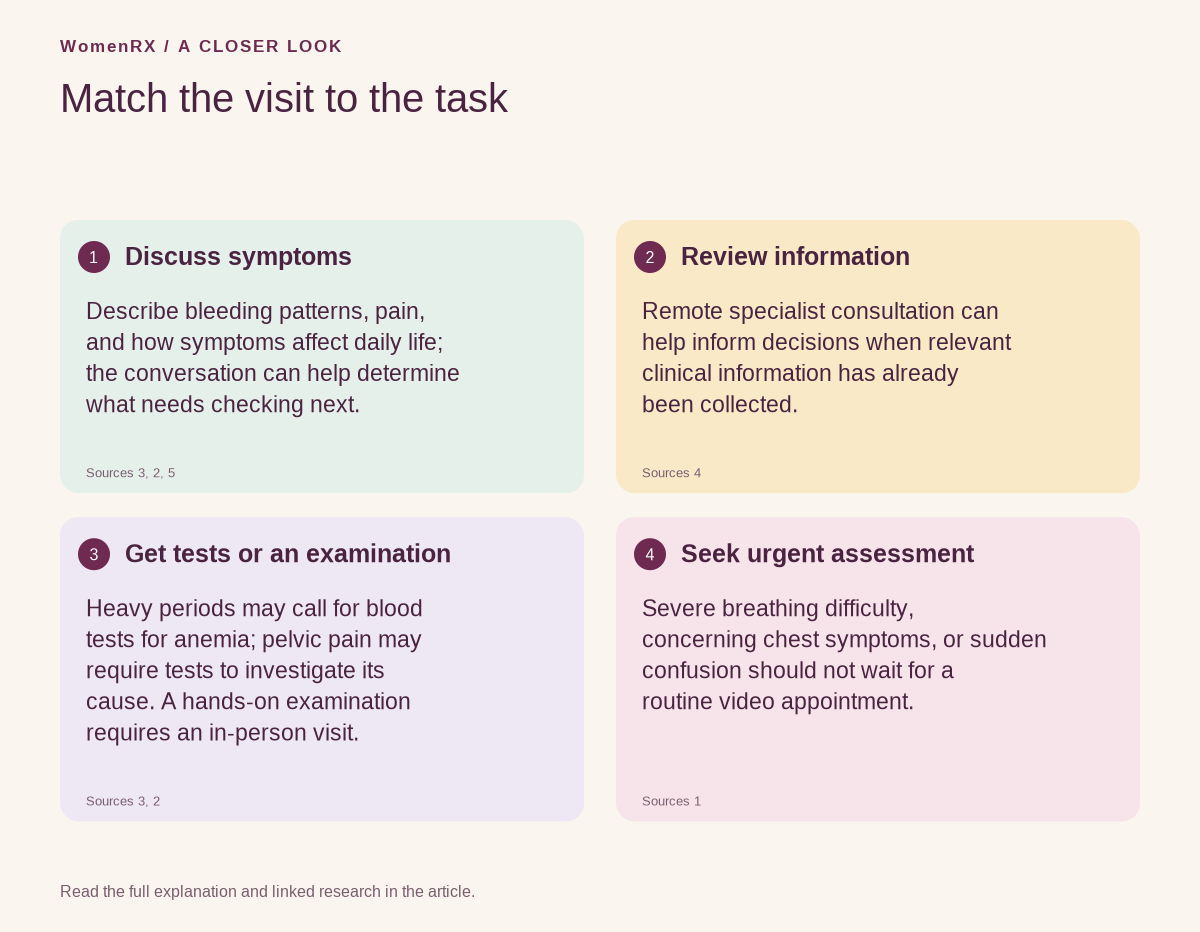
Match the visit to the task
Discuss symptoms: Describe bleeding patterns, pain, and how symptoms affect daily life; the conversation can help determine what needs checking next.325
Review information: Remote specialist consultation can help inform decisions when relevant clinical information has already been collected.4
Get tests or an examination: Heavy periods may call for blood tests for anemia; pelvic pain may require tests to investigate its cause. A hands-on examination requires an in-person visit.32
Seek urgent assessment: Severe breathing difficulty, concerning chest symptoms, or sudden confusion should not wait for a routine video appointment.1
Read the figure as text
A remote visit can begin care, but the next step depends on what information or action is still needed.- Discuss symptoms: Describe bleeding patterns, pain, and how symptoms affect daily life; the conversation can help determine what needs checking next.325
- Review information: Remote specialist consultation can help inform decisions when relevant clinical information has already been collected.4
- Get tests or an examination: Heavy periods may call for blood tests for anemia; pelvic pain may require tests to investigate its cause. A hands-on examination requires an in-person visit.32
- Seek urgent assessment: Severe breathing difficulty, concerning chest symptoms, or sudden confusion should not wait for a routine video appointment.1
More questions, answered
Does needing a test mean a telehealth visit was pointless?
No. A conversation can help identify what needs checking. For example, discussing heavy periods may lead to blood tests for anemia or further assessment for an underlying cause; the tests answer questions that conversation alone cannot.3
Sources you can check
- Shortness of breath - NHSAccessed 2026-09-25Return to first citation
- Pelvic pain - NHSAccessed 2026-09-25Return to first citation
- Heavy periods - NHSAccessed 2026-09-25Return to first citation
- Telemedicine in neurosurgery: A systematic review of global implementation, outcomes, and barriers to access.Palmiero HOM, Figueiredo EG. · Journal of telemedicine and telecare · 2026Return to first citation
- The effectiveness of tele-triage during the COVID-19 pandemic: A systematic review and narrative synthesis.Farzandipour M, Nabovati E, Sharif R. · Journal of telemedicine and telecare · 2024Return to first citation
- The Role of Telemedicine in Emergency Department Triage and Patient Care: A Systematic Review.Ahmed AA, Mojiri ME, Daghriri AA, Hakami OA, Alruwaili RF, Khan RA, Madkhali HA, Almania MM, Hakami ZT, Mashraqi KO, Adawi KA, Alqattan SA, Alharbi AN, Albahlol MA, Moafa AI. · Cureus · 2024Return to first citation