When Telehealth Should Lead to In-Person or Urgent Care
A virtual visit can be a good start, and an exam, test, or more urgent assessment may be the next part of good care.
A telehealth clinician may recommend in-person care when an examination, lab test, or other information is needed to assess your concern. 1 Ask how soon to act and where to go. If you’re directed to urgent or emergency assessment, follow that direction. If an emergency arises during or outside a visit, use local emergency guidance rather than waiting for virtual care.
A virtual visit isn’t a lesser version of care when it gives your clinician enough information to make a plan. But a video call has limits: a clinician may not be able to examine you or arrange a needed test during the visit. In those cases, recommending an in-person assessment is a change in care setting, not a sign that the visit failed. 1
Telehealth can work for some urgent-care concerns, including some urinary tract infections and rashes. The question isn’t whether a condition can ever be discussed online. It’s whether the clinician has enough information to decide what’s going on and what to do next. 1
What an in-person recommendation can mean
A clinician may ask you to be seen in person because a physical finding could change the assessment, or because a lab test is needed. For example, a clinician might be able to discuss a concern by video but still need an examination or test before settling on the next step. 1
Sometimes the remote assessment itself is the limit. A study of a collaborative eye-care service in rural Western Australia found that clinicians saw face-to-face care as most useful when the diagnosis remained uncertain, while the telehealth specialist relied on an optometrist’s in-person examination. It’s a specific eye-care model, not a rule for every virtual visit, but it illustrates why remote advice can depend on what someone can examine or measure locally. 3
A referral for an exam or test does not, by itself, tell you how soon you need to be seen. Ask the clinician what timing they mean and where they want you to go. “Arrange an appointment” and “go for an urgent assessment” are different instructions.
Planned follow-up, urgent care, or emergency help?
If the clinician recommends routine or planned follow-up, make sure you know what needs to happen next and how soon. Ask whether they’re arranging the appointment or test, or whether you need to contact another office. This matters because a virtual visit with someone who doesn’t know your history may leave you coordinating care with your regular clinician. 1
If you’re advised to get same-day or urgent assessment, ask where to go and whether the clinician expects you to go now. If you can’t reach the recommended service, contact the virtual-care team or your regular clinic for a workable next step rather than assuming the recommendation no longer applies.
An emergency-department recommendation is different from a plan to book an appointment. Follow the clinician’s direction rather than substituting a routine follow-up. If you believe you’re facing an emergency during a visit or when no visit is underway, use local emergency guidance immediately rather than waiting for a virtual appointment or callback. In one US telephone follow-up program for people recently discharged with COVID-19, callers with warning signs were escalated to a physician, and some were advised to return to the emergency department. That’s an example of how a remote encounter can lead to a change in care setting, not a symptom checklist for other conditions. 6
A pregnancy-related concern may also need an individualized next step rather than an assumption that remote care is enough. For example, remote glucose monitoring for gestational diabetes works best with clinician review, feedback, and a way to escalate care when needed. 5 If a concern is severe or rapidly worsening, seek prompt assessment rather than waiting for routine virtual follow-up. As one specific example, guidance on period pain recommends urgent assessment for severe or worse-than-usual pelvic or period pain that has not improved with pain medicine. 2
Make the handoff specific
Before ending the visit, try to leave with clear answers to three questions:
- What is the next step? An examination, a test, urgent assessment, or planned follow-up?
- When should it happen? Ask for a timeframe in plain language.
- What if the plan is unclear? Ask whom to contact if you’re unsure where to go or who is arranging the next step.
If the connection drops, the clinician can’t see or hear enough, or a key part of the assessment is missing, say so. Technology problems and missing medical history can make a virtual assessment less complete. 1
A virtual visit can be one step in care
In-person follow-up isn’t always needed after telehealth. A systematic review of seven randomized trials involving 692 patients after gynecological surgery found similar reported complications and unplanned care in telehealth and in-office follow-up, but the review rated the evidence as low certainty. Those results apply to postoperative follow-up, not every new or changing concern. 4
The useful takeaway is simple: let the next step match what still needs to be learned. When an exam, test, or closer assessment is needed, moving from screen to in-person care is part of the care plan.
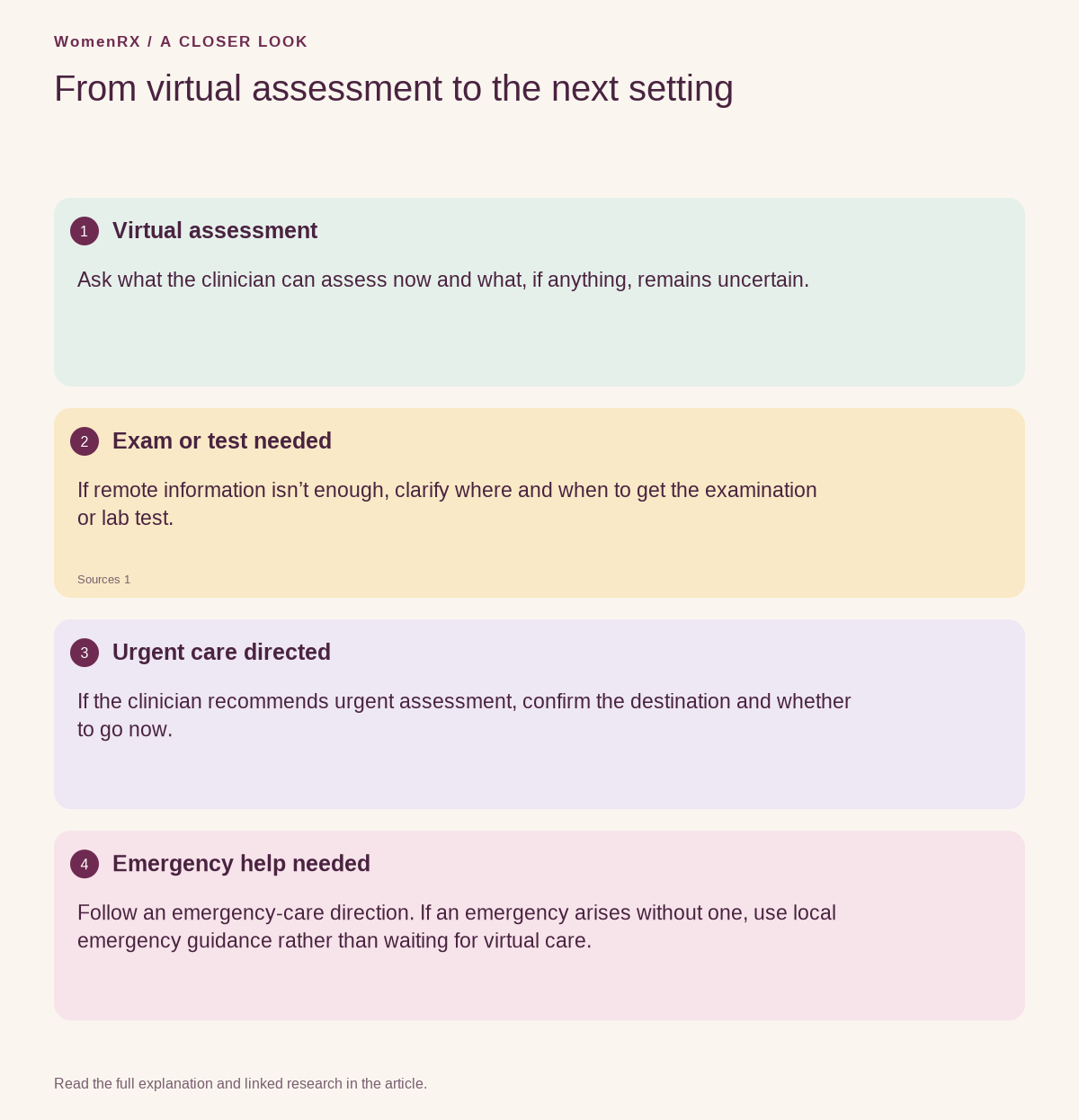
From virtual assessment to the next setting
Virtual assessment: Ask what the clinician can assess now and what, if anything, remains uncertain.
Exam or test needed: If remote information isn’t enough, clarify where and when to get the examination or lab test.1
Urgent care directed: If the clinician recommends urgent assessment, confirm the destination and whether to go now.
Emergency help needed: Follow an emergency-care direction. If an emergency arises without one, use local emergency guidance rather than waiting for virtual care.
Read the figure as text
Start with what the clinician can establish remotely, then follow the recommended setting and timing for anything still needed.- Virtual assessment: Ask what the clinician can assess now and what, if anything, remains uncertain.
- Exam or test needed: If remote information isn’t enough, clarify where and when to get the examination or lab test.1
- Urgent care directed: If the clinician recommends urgent assessment, confirm the destination and whether to go now.
- Emergency help needed: Follow an emergency-care direction. If an emergency arises without one, use local emergency guidance rather than waiting for virtual care.
More questions, answered
Does an in-person referral mean the virtual visit was pointless?
No. The visit may have helped identify what information is missing and where to get it. A physical examination or lab test may be necessary to complete the assessment. 1
What should I clarify if I’m told to get urgent care?
Ask which service to use, how soon to go, and whether the clinician is directing you to emergency care rather than planned follow-up. If the instruction isn’t clear, contact the virtual-care team or your regular clinic for clarification. If you believe it’s an emergency, use local emergency guidance rather than waiting for clarification.
Sources you can check
- Telehealth: MedlinePlusAccessed 2026-09-25Return to first citation
- Period pain - NHSAccessed 2026-09-25Return to first citation
- Evaluation of a Collaborative Telehealth Model for Eye Care Between Ophthalmology and Optometry in Western Australia.Chen J, Alam K, Bartnik SE, Bentley SA, McKendrick AM, Thompson SC, Turner AW. · The Australian journal of rural health · 2026Return to first citation
- Telehealth Versus In-Office Follow-Up after Gynecological Surgery: A Systematic Review and Meta-Analysis.Lemos MJ, Queiroz LF, Diniz AF, Dos Santos PL, da Silva CML, Gomide PO, Ferraz J, Novellino AMM. · Telemedicine journal and e-health : the official journal of the American Telemedicine Association · 2026Return to first citation
- Patient Engagement Strategies for Women with Gestational Diabetes Mellitus in Low-Resource Community Health Settings: A Narrative Review and Clinical Principles.Martin MP, Russin N, Pangasa M. · Healthcare (Basel, Switzerland) · 2026Return to first citation
- Improving the care of patients with COVID-19 with a medical student-run telemedicine clinic.Wees I, Murtuza MI, Mathisen D, Zhang H, Roy M, Phelps E, Reed G. · BMJ open quality · 2022Return to first citation