When a Headache Needs Urgent Care or an Appointment
A familiar migraine pattern can shift around menopause, but a sudden, severe headache or certain accompanying symptoms call for a different response.
A headache that peaks in under a minute, follows a head injury, or comes with a stiff neck, fever, confusion, loss of consciousness, or a seizure needs emergency care. 1 2 5 6 Vision problems, vomiting, worsening with coughing or exertion, jaw pain while eating, or a migraine lasting over 72 hours need urgent assessment. 2 4 For recurring or worsening headaches, arrange an appointment. 2 If a headache is new, distinctly changed, or disrupting daily life, booking an appointment is a practical next step when no urgent warning signs apply.
Start with how the headache began
A headache that becomes severe in an instant is different from a familiar headache that builds gradually. A thunderclap headache reaches maximum intensity in less than a minute. Because this abrupt pattern can have dangerous causes, it needs emergency evaluation, even if you have had migraines before. 5 6
Get emergency help for a headache after a blow to the head, or one accompanied by a stiff neck, fever, confusion, loss of consciousness, or a seizure. 1 2 Don't assume a new or unusually severe headache is hormonal just because you're in perimenopause or menopause.
Know what needs urgent assessment
Seek urgent medical assessment if a headache comes with vision or eye problems, vomiting, or is triggered or made worse by coughing, sneezing, bending, or exercise. Jaw pain when eating or a tender scalp with a headache also warrants urgent attention. 2 If a migraine attack lasts longer than 72 hours, seek urgent assessment rather than waiting for a planned appointment. 4
These signs don't tell you the cause on their own. They help distinguish a headache that should be assessed promptly from one that can be discussed in a planned appointment. If you're unsure which route fits, describe the onset and other symptoms when you contact a local urgent-care service or emergency department.
When a planned appointment makes sense
Arrange a timely appointment if headaches happen regularly, are getting worse, or aren't improving. Migraine attacks that are severe, worsening, lasting longer than usual, or hard to control also merit assessment. An attack lasting over 72 hours belongs in the urgent-assessment route above. 2 4
If a headache is new or distinctly different from your usual pattern, arrange an appointment even if it hasn't become regular. Do the same if headaches are disrupting daily life. Describe what changed and how it's affecting you when you book; if a warning sign above applies, use the more urgent route instead.
Migraine often involves throbbing or pulsing pain, sometimes on one side, with nausea or sensitivity to light and sound. Some people have aura, such as flashing lights or zigzag lines. Those features can help describe a pattern, but they don't rule out other causes of a new or changed headache. 3 4
Menopause may change the pattern, but doesn't explain every headache
Hormonal fluctuations during the menopause transition may coincide with migraine changes for some women. After menopause, migraine may improve for some, but research has not found a consistent pattern. A systematic review of 12 studies found mixed results; most studies were observational, and clinic-based samples may overrepresent more severe cases. So menopause is useful context to mention, not a diagnosis to assume. 7
If you still have periods, note whether headaches cluster before or during bleeding. Menstrual migraine is a recognized pattern, and a headache diary can help show whether attacks recur at a predictable time. 3 4
Make the pattern easier to explain
Jot down when each headache starts, how quickly it peaks, how long it lasts, and whether it feels like your usual headaches. Record cycle or menopause-transition timing if relevant, associated symptoms such as nausea or light sensitivity, possible triggers, and which medicines you used. Migraine guidance supports keeping a log to identify patterns and potential triggers. 3 4
This record can make a planned appointment more useful, especially if the change is subtle: attacks may be more frequent, last longer, or come with symptoms you didn't have before. But don't wait to complete a diary if a headache has an emergency or urgent warning sign.
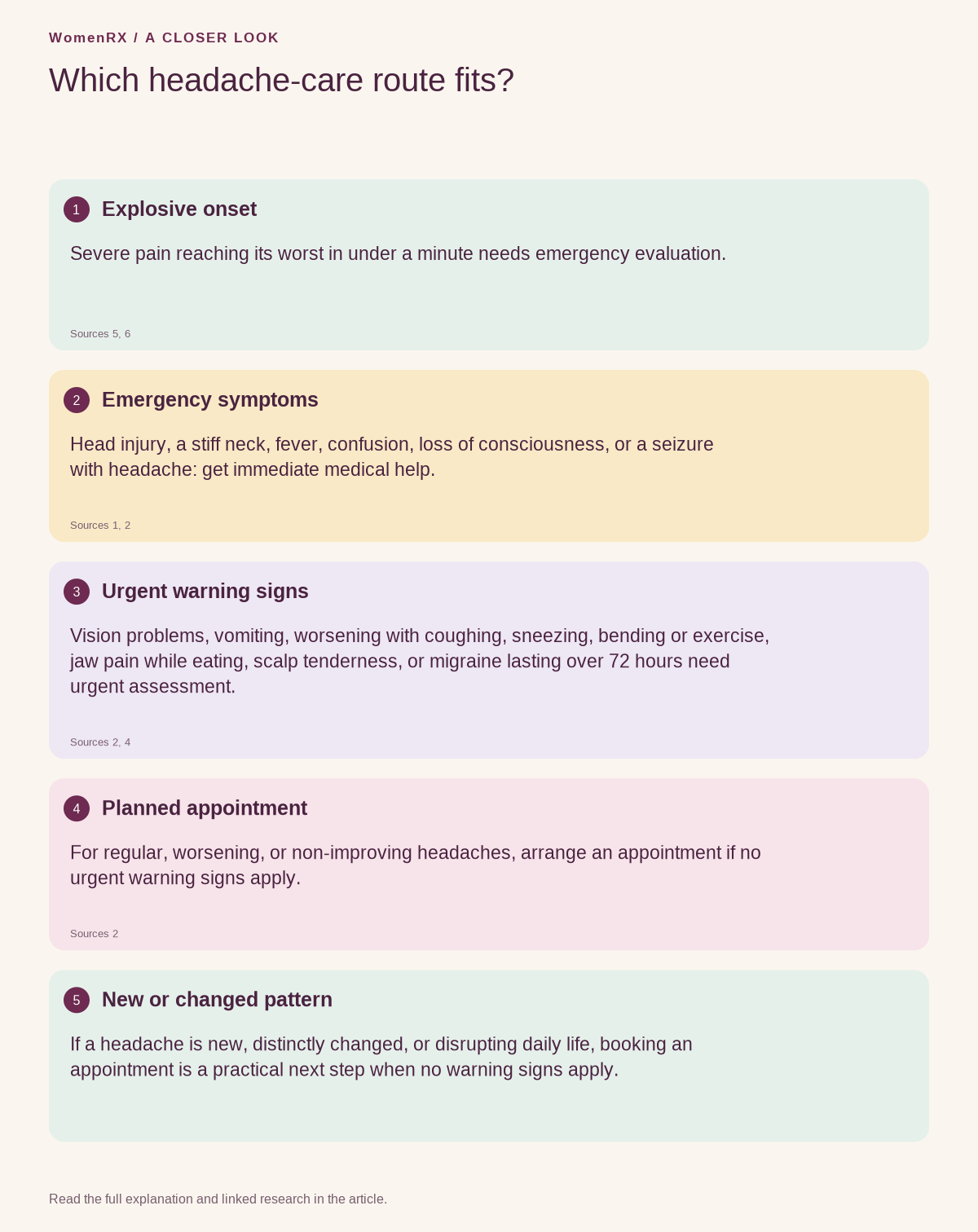
Which headache-care route fits?
Explosive onset: Severe pain reaching its worst in under a minute needs emergency evaluation.56
Emergency symptoms: Head injury, a stiff neck, fever, confusion, loss of consciousness, or a seizure with headache: get immediate medical help.12
Urgent warning signs: Vision problems, vomiting, worsening with coughing, sneezing, bending or exercise, jaw pain while eating, scalp tenderness, or migraine lasting over 72 hours need urgent assessment.24
Planned appointment: For regular, worsening, or non-improving headaches, arrange an appointment if no urgent warning signs apply.2
New or changed pattern: If a headache is new, distinctly changed, or disrupting daily life, booking an appointment is a practical next step when no warning signs apply.
Read the figure as text
Use the onset and accompanying symptoms to distinguish emergency care, urgent assessment, and a planned appointment.- Explosive onset: Severe pain reaching its worst in under a minute needs emergency evaluation.56
- Emergency symptoms: Head injury, a stiff neck, fever, confusion, loss of consciousness, or a seizure with headache: get immediate medical help.12
- Urgent warning signs: Vision problems, vomiting, worsening with coughing, sneezing, bending or exercise, jaw pain while eating, scalp tenderness, or migraine lasting over 72 hours need urgent assessment.24
- Planned appointment: For regular, worsening, or non-improving headaches, arrange an appointment if no urgent warning signs apply.2
- New or changed pattern: If a headache is new, distinctly changed, or disrupting daily life, booking an appointment is a practical next step when no warning signs apply.
More questions, answered
Can menopause make migraines worse?
It may coincide with a change for some women, but the overall research is mixed. A systematic review found inconsistent findings after menopause, with many studies based in headache clinics. A new or severe headache still deserves assessment on its own merits. 7
What should I include in a headache diary?
Note onset and time to peak, duration, symptoms, possible triggers, menstrual timing if relevant, and medicines used. A log can help reveal patterns, but it shouldn't delay urgent care for warning signs. 3 4
Sources you can check
- Headache | MedlinePlusAccessed 2026-09-25Return to first citation
- Headaches - NHSAccessed 2026-09-25Return to first citation
- Migraine | MedlinePlusAccessed 2026-09-25Return to first citation
- Migraine - NHSAccessed 2026-09-25Return to first citation
- Thunderclap headache management among Emergency Department visitors in tertiary care center in Makkah City: Retrospective cohort study.Althobaiti FS, Alsharif SY, Alhazmi MA, BinMelieh AH, Almqaiti AA, Alsaedi ZK, Alkhotani AM, Sef BG. · Neurosciences (Riyadh, Saudi Arabia) · 2025Return to first citation
- Evaluating thunderclap headache.Chen CY, Fuh JL. · Current opinion in neurology · 2021Return to first citation
- Patterns of Migraine in Postmenopausal Women: A Systematic Review.Ornello R, Caponnetto V, Frattale I, Sacco S. · Neuropsychiatric disease and treatment · 2021Return to first citation