Adenomyosis: How Diagnosis and Treatment Fit Your Goals
Heavy or painful periods can prompt an evaluation, but symptoms alone can’t identify adenomyosis.
Adenomyosis is when tissue from the uterine lining grows into the muscle wall. It can cause heavy bleeding and painful periods, but some people have no symptoms, and other conditions can cause similar problems. Evaluation considers your symptoms and may include ultrasound or MRI. Treatment choices depend on whether bleeding, pain, or fertility is the main concern. 1 4
What adenomyosis can feel like
Adenomyosis involves tissue from the uterine lining within the muscle of the uterus. Heavy menstrual bleeding and painful periods are common reasons to seek evaluation; pelvic pain, pain during sex, or fertility concerns may also be part of the picture. Some people have no symptoms. None of these symptoms, on its own, proves adenomyosis. Endometriosis and fibroids can also be relevant, and endometriosis can occur alongside adenomyosis. 1 2 5
If bleeding is affecting your daily life, or you often feel tired or short of breath, it’s worth discussing rather than assuming it’s simply your usual period. Heavy bleeding can have several causes, and an evaluation may include blood tests for iron-deficiency anemia. 2
What an evaluation can tell you
The evaluation starts with the pattern that brought you in: how heavy the bleeding is, how painful your periods are, and whether pain happens at other times. An exam and imaging can help assess possible explanations. Transvaginal ultrasound and MRI are diagnostic options. Imaging supports a diagnosis, but your symptoms and the scan findings need to be considered together. 1 4 5
Because similar symptoms can have different causes, it’s useful to ask what the imaging does and doesn’t explain, and whether another condition should be considered. 1 2
Match the option to the goal
There isn’t one treatment choice that fits everyone. A clinical guideline lists options for bleeding, pain, and fertility concerns, including nonsteroidal anti-inflammatory drugs (NSAIDs), tranexamic acid, hormonal treatments such as progestins or combined oral contraceptives, and a levonorgestrel intrauterine system (IUS). It also lists procedural and surgical options. The point is to weigh the symptom you most want to address against your plans for pregnancy and the type of treatment you’re willing to consider. 4
- For pain: The adenomyosis guidance lists painkillers such as ibuprofen for period or pelvic pain, and the clinical guideline includes NSAIDs among management options. Ask how a proposed treatment is intended to help: pain, bleeding, or both. 1 4
- For bleeding: Tranexamic acid and some hormonal approaches are treatments for heavy periods generally; they also appear among adenomyosis management options. A levonorgestrel IUS is another option to discuss. In the United States, Mirena’s prescribing information includes treatment of heavy menstrual bleeding for people choosing intrauterine contraception. That is not the same as a product indication specifically for adenomyosis. 1 2 3 4
- If considering a hormonal IUS: Mirena’s information says spotting or irregular bleeding may increase during the first three to six months and usually decreases with continued use. Ask what bleeding changes to expect and when to follow up if the pattern concerns you. 3
- For procedures or surgery: The guideline lists uterine artery embolization, endometrial ablation, excision, and hysterectomy as options. They are not interchangeable. Hysterectomy removes the uterus, so it doesn’t preserve the ability to carry a pregnancy. Ask what outcome a procedure is intended to achieve and how it fits your reproductive plans. 2 4
A useful comparison is the goal: relief from pain, reduced bleeding, preserving the uterus, or pursuing pregnancy. 4
If pregnancy or menopause is part of the decision
If you’re trying to become pregnant now, say so before discussing treatments that suppress periods or procedures. The guideline treats fertility as a distinct outcome and recommends tailoring management to symptoms and reproductive goals. If you hope to carry a pregnancy in the future, ask which options preserve the uterus and what is known about their reproductive outcomes. 4
Heavy periods can change as you approach menopause. If that’s happening, explain how your cycle and symptoms have changed and whether you’re looking for symptom relief or considering a procedure. 2 4
Questions that can make a comparison clearer include: “Which symptom is this option meant to improve?” “Could it affect my plans to become pregnant?” and “What should I expect while I’m using it?”
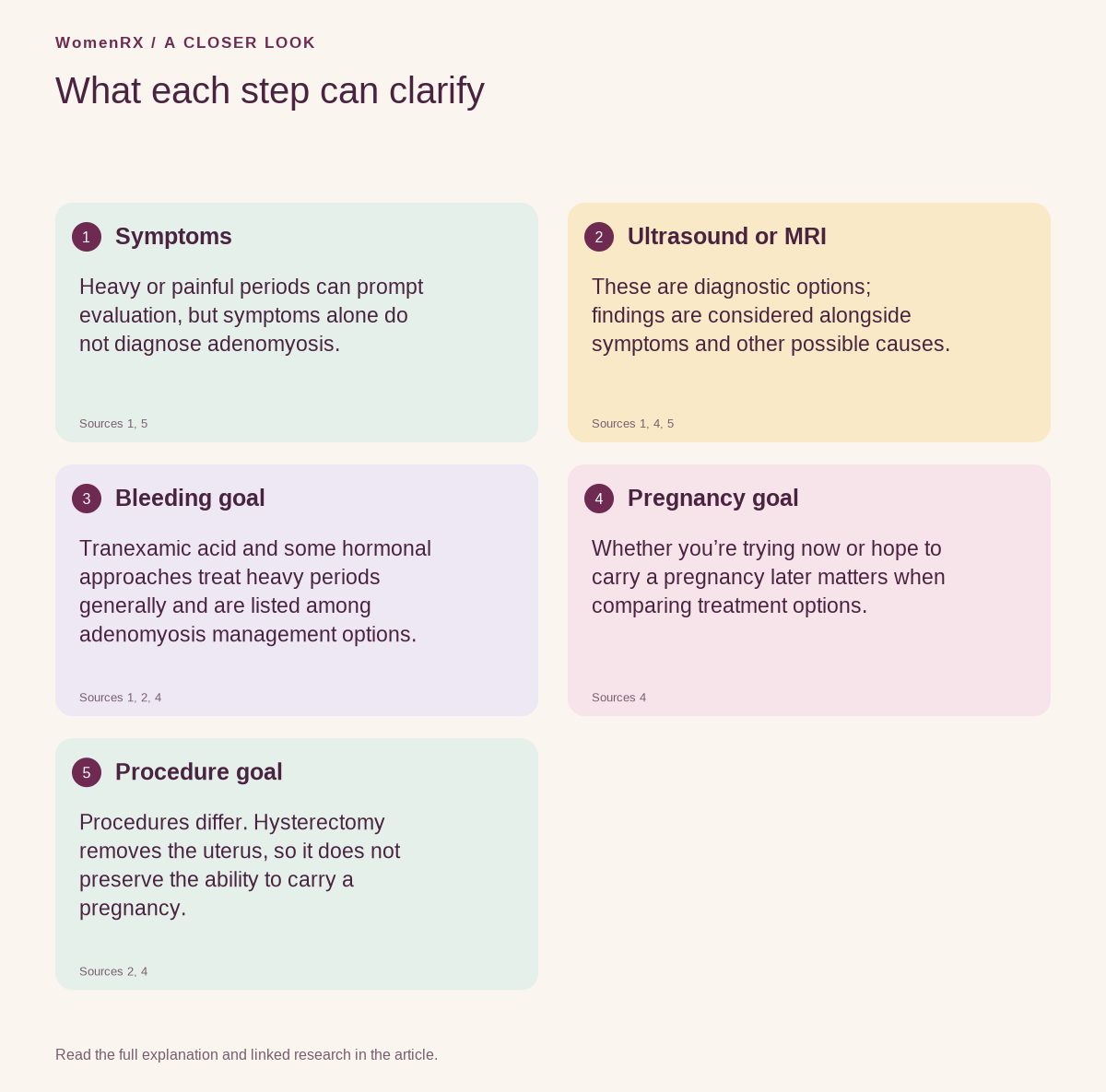
What each step can clarify
Symptoms: Heavy or painful periods can prompt evaluation, but symptoms alone do not diagnose adenomyosis.15
Ultrasound or MRI: These are diagnostic options; findings are considered alongside symptoms and other possible causes.145
Bleeding goal: Tranexamic acid and some hormonal approaches treat heavy periods generally and are listed among adenomyosis management options.124
Pregnancy goal: Whether you’re trying now or hope to carry a pregnancy later matters when comparing treatment options.4
Procedure goal: Procedures differ. Hysterectomy removes the uterus, so it does not preserve the ability to carry a pregnancy.24
Read the figure as text
Symptoms raise the question; examination and imaging help assess possible causes; treatment choices depend on the symptom and reproductive goal.- Symptoms: Heavy or painful periods can prompt evaluation, but symptoms alone do not diagnose adenomyosis.15
- Ultrasound or MRI: These are diagnostic options; findings are considered alongside symptoms and other possible causes.145
- Bleeding goal: Tranexamic acid and some hormonal approaches treat heavy periods generally and are listed among adenomyosis management options.124
- Pregnancy goal: Whether you’re trying now or hope to carry a pregnancy later matters when comparing treatment options.4
- Procedure goal: Procedures differ. Hysterectomy removes the uterus, so it does not preserve the ability to carry a pregnancy.24
More questions, answered
Does heavy bleeding mean I have adenomyosis?
No. Heavy periods can have several causes, including adenomyosis and fibroids, and some people with adenomyosis have no symptoms. Evaluation uses the overall picture rather than treating one symptom as a diagnosis. 1 2
Is a levonorgestrel IUS specifically approved for adenomyosis in the United States?
Mirena’s US prescribing information includes treatment of heavy menstrual bleeding for people choosing intrauterine contraception. That is not a product indication specifically for adenomyosis, even though a clinical guideline lists the levonorgestrel IUS among adenomyosis management options. 3 4
Sources you can check
- Adenomyosis - NHSAccessed 2026-09-25Return to first citation
- Heavy periods - NHSAccessed 2026-09-25Return to first citation
- MIRENA (LEVONORGESTREL) INTRAUTERINE DEVICE [BAYER HEALTHCARE PHARMACEUTICALS INC.] | US prescribing information and patient instructionsAccessed 2026-09-25Return to first citation
- Guideline No. 437: Diagnosis and Management of Adenomyosis.Dason ES, Maxim M, Sanders A, Papillon-Smith J, Ng D, Chan C, Sobel M. · Journal of obstetrics and gynaecology Canada : JOGC = Journal d'obstetrique et gynecologie du Canada : JOGC · 2023Return to first citation
- Adenomyosis: Diagnosis and Management.Schrager S, Yogendran L, Marquez CM, Sadowski EA. · American family physician · 2022Return to first citation