Adenomyosis: What the Evidence Really Supports
Adenomyosis can cause painful periods or heavy bleeding, but symptoms vary, and a diagnosis does not predict the same fertility or treatment path for everyone.
Adenomyosis is tissue from the uterine lining within the muscle wall of the uterus. It can be associated with painful periods, abnormal bleeding, pelvic pain, or no symptoms at all. Ultrasound and MRI can help identify it; a hysterectomy is not the only route to diagnosis. Treatment depends on symptoms and whether preserving the uterus or pursuing pregnancy matters to you. 1 3 6

Claim: Adenomyosis always causes severe symptoms
Not supported. Some people have no symptoms; others have painful periods, pain during sex, pelvic pain, or abnormal bleeding. The condition itself doesn’t tell you how intense your symptoms will be. Heavy or painful periods matter in their own right, especially when they disrupt daily life, whether you’re in your cycling years or approaching menopause. 1 3
What this means: A scan finding alone doesn’t describe your day-to-day experience or establish that every symptom has the same cause. Similar symptoms can also lead clinicians to check for other conditions, including endometriosis. Adenomyosis and endometriosis are different conditions, though they can both be considered when evaluating pelvic or period symptoms. 1
Claim: You need a hysterectomy to diagnose it
Outdated as a blanket statement. Adenomyosis was historically confirmed through examination of uterine tissue after hysterectomy, but imaging has made earlier diagnosis possible. Transvaginal ultrasound and MRI are used to assess for adenomyosis; sometimes further evaluation is needed to distinguish it from other causes of symptoms. No single symptom is specific enough to confirm it by itself. 3 6
What this means: Ask what an imaging result does, and doesn’t, explain about your symptoms. A suspected or imaging-based diagnosis doesn’t automatically mean surgery is needed.
Claim: Adenomyosis means you’ll have infertility
Too certain. Research has linked adenomyosis with infertility and pregnancy complications, but reproductive outcomes vary. A recent review describes possible differences by disease features while also noting inconsistent findings and a need for better prospective studies. A diagnosis by itself can’t say whether you’ll conceive or predict an individual pregnancy outcome. 2 3
What this means: If you’re trying to conceive, fertility goals belong in the treatment discussion from the start. Options aimed at symptom relief may not answer the separate question of which approach, if any, improves your chance of pregnancy. Reviews describe fertility-focused treatment as evolving, not settled. 2 4
Claim: One treatment is best for everyone
Not supported. For symptoms, options include hormonal treatments such as an intrauterine system or other hormonal contraception, and medicines such as tranexamic acid or anti-inflammatory pain relievers. Heat may also help with period or pelvic pain. These options are aimed at easing symptoms; the right choice depends on the symptoms and your goals. 1
Uterus-sparing procedures, including adenomyomectomy and several ablation approaches, are also discussed in research. Reviews report symptom improvement, but comparisons are limited, and more high-quality studies are needed to clarify which approaches work best and for whom. Evidence about safety and usefulness for people who want future pregnancies is also limited. In the US, access to some of these procedures is limited, and some are used off-label. 5 6
A practical distinction is whether you’re choosing treatment mainly for bleeding or pain, or also weighing future pregnancy. Those goals can change which tradeoffs deserve attention. If heavy periods are affecting your life, or pain is severe or worsening, it’s reasonable to seek an evaluation rather than assume it’s just something you have to tolerate. 1
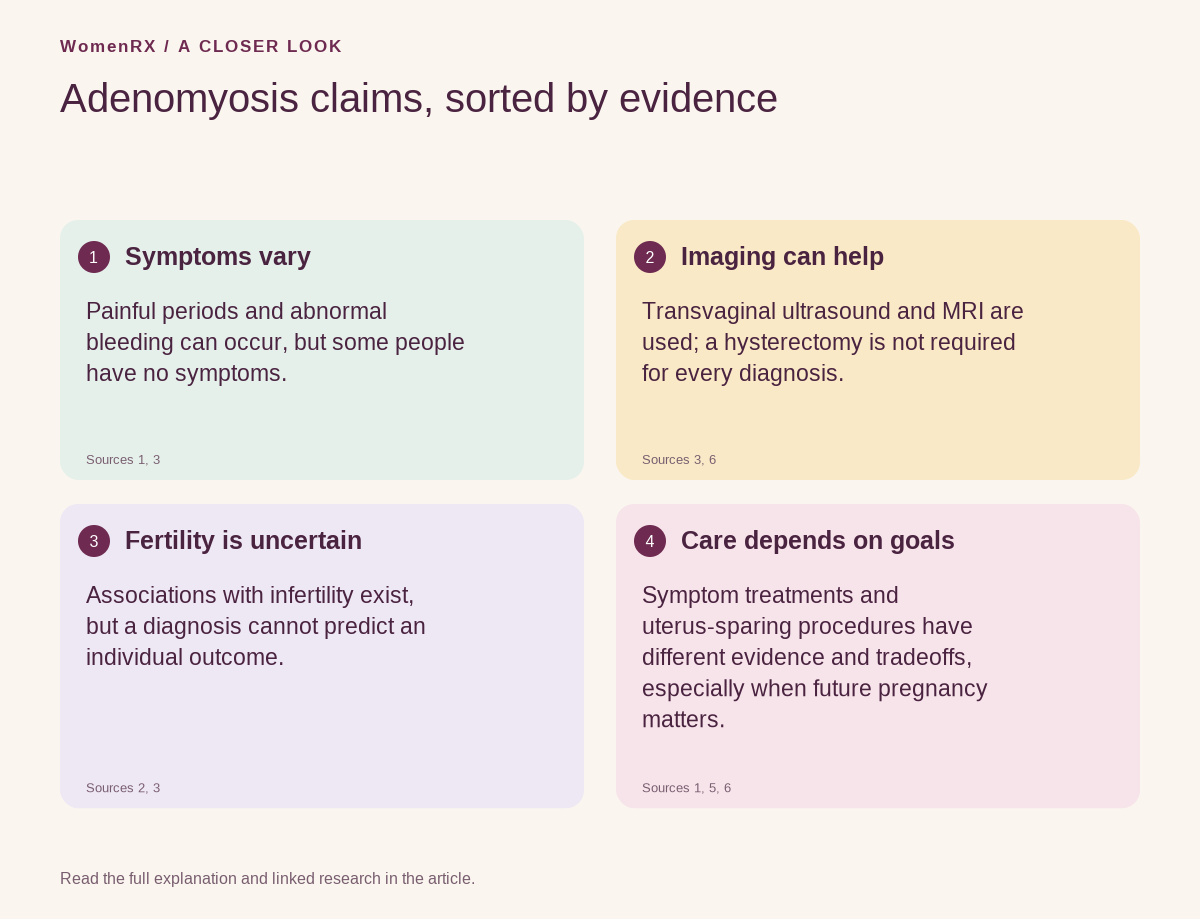
Adenomyosis claims, sorted by evidence
Symptoms vary: Painful periods and abnormal bleeding can occur, but some people have no symptoms.13
Imaging can help: Transvaginal ultrasound and MRI are used; a hysterectomy is not required for every diagnosis.36
Fertility is uncertain: Associations with infertility exist, but a diagnosis cannot predict an individual outcome.23
Care depends on goals: Symptom treatments and uterus-sparing procedures have different evidence and tradeoffs, especially when future pregnancy matters.156
Read the figure as text
These distinctions show what a diagnosis can establish, what it may be associated with, and where treatment decisions still depend on individual goals.- Symptoms vary: Painful periods and abnormal bleeding can occur, but some people have no symptoms.13
- Imaging can help: Transvaginal ultrasound and MRI are used; a hysterectomy is not required for every diagnosis.36
- Fertility is uncertain: Associations with infertility exist, but a diagnosis cannot predict an individual outcome.23
- Care depends on goals: Symptom treatments and uterus-sparing procedures have different evidence and tradeoffs, especially when future pregnancy matters.156
More questions, answered
Is adenomyosis the same as endometriosis?
No. Adenomyosis involves tissue from the uterine lining within the uterine muscle. Endometriosis involves similar tissue growing outside the uterus. They’re distinct conditions, though symptoms can overlap. 1
Sources you can check
- Adenomyosis - NHSAccessed 2026-09-25Return to first citation
- Adenomyosis and fertility: from pathophysiology to optimizing reproductive outcomes.Manem N, Hori K, Aghajanova L. · Current opinion in obstetrics & gynecology · 2026Return to first citation
- Ultrasound signs of adenomyosis in pregnancy and counselling related to infertility and obstetric outcomes.Bertucci E, Ceffa S, Danieli A, Diamanti M, Sileo FG, Tramontano AL, Alboni C, La Marca A. · Minerva obstetrics and gynecology · 2026Return to first citation
- Fertility in adenomyosis: surgery or IVF?Chandra S, Tjahyadi D, Rachmawati A, Syam HH. · Minerva obstetrics and gynecology · 2026Return to first citation
- Conservative Surgical Management of Adenomyosis: Implications for Infertility and Pregnancy Outcomes-A Perspective Review.Ioannidou A, Louis K, Sioutis D, Panagopoulos P, Theofanakis C, Machairiotis N. · Journal of clinical medicine · 2025Return to first citation
- Alternative treatments of adenomyosis - an update in procedural management and clinical outcomes.Zeccola AM, Allen SE. · Current opinion in obstetrics & gynecology · 2024Return to first citation