Adenomyosis and Weight: What’s Actually Connected?
Adenomyosis can make your abdomen feel fuller, but that’s different from showing it causes sustained weight gain.
Adenomyosis can cause abdominal bloating, heaviness, or fullness, which may feel like a change in your body size.3 That’s not the same as evidence that the condition causes sustained weight gain. One study found a BMI difference between two adenomyosis subtypes, but it couldn’t establish which came first or whether adenomyosis changed anyone’s weight.4

Fullness and weight change are different questions
Adenomyosis happens when tissue from the uterine lining grows into the muscle of the uterine wall. Painful or heavy periods are common symptoms, but you can also have pelvic pain and abdominal bloating, heaviness, or fullness at other points in your cycle. Some people have no symptoms at all.3
That distinction matters if your clothes feel tighter. A fuller-feeling abdomen is a recognized adenomyosis symptom; it doesn’t, by itself, tell you that your overall body weight has changed. Conversely, if you’ve noticed a sustained change on the scale, it’s worth considering that as its own question rather than automatically attributing it to adenomyosis.
For example, if the tightness comes and goes alongside pelvic pain or bleeding, describe that pattern as well as any measured weight change. If the change persists without the same symptom pattern, say that too. Neither pattern diagnoses its cause, but they give you and your clinician more useful information than “adenomyosis made me gain weight.”
What the body-weight research can tell us
A retrospective study compared 685 patients who already had adenomyosis. Before the researchers matched patients on characteristics including age and BMI, those with diffuse adenomyosis had a higher BMI than those with focal adenomyosis. The study’s main question was whether the subtypes differed in coexisting endometrial lesions, not whether weight predicts adenomyosis or adenomyosis changes weight.4
That’s an observed difference within a group with adenomyosis. It isn’t a comparison with people who don’t have the condition. It also can’t tell you whether body weight preceded a particular subtype, followed it, or reflected other differences between the groups. Nor does it show that losing weight treats adenomyosis. The more useful conclusion is narrower: BMI appears in adenomyosis research, but this finding doesn’t establish a direction of cause and effect.4
A separate study of women with adenomyosis undergoing fertility treatment included BMI among variables used to predict live birth. That addresses an outcome in a particular treatment setting, not whether adenomyosis caused a weight change.5
Could treatment be part of the timing?
It’s reasonable to look at when a weight concern began relative to treatment. A hormonal intrauterine system such as Mirena is one option used to make adenomyosis-related periods lighter and less painful.3 In Mirena prescribing information, 9% of 362 women who had used it for more than five years reported weight gain as an adverse event. The information explicitly says it’s unknown whether Mirena caused that gain.1 That figure doesn’t describe all Mirena users, and it doesn’t tell us whether adenomyosis causes weight gain.
If your concern began after a treatment change, record that timing without deciding in advance what caused it. The same approach helps if your periods have become less predictable: note changes in bleeding and abdominal symptoms alongside any measured change in weight, rather than treating them as one symptom.
A short record that separates the possibilities
You don’t need a complicated tracking system. For a few weeks, jot down what you’re actually noticing:
- Abdominal sensation: Is it bloating, pressure, or fullness? Does it come and go?
- Bleeding and pain: When do they happen, and have they changed from your usual pattern?
- Weight: If you’re concerned about a sustained change, record comparable measurements rather than relying only on how clothes fit.
- Treatment timing: Note when a hormonal treatment started or changed, if relevant.
This isn’t a test for adenomyosis or a way to prove what caused a weight change. It’s a way to keep two questions separate: “Why does my abdomen feel different?” and “Has my weight changed over time?”
Don’t assume every new abdominal symptom is adenomyosis. Pelvic pain can also have bowel, bladder, or other pelvic causes. Bloating that keeps coming back or doesn’t go away, feeling full quickly, or losing weight without trying deserves a medical assessment. Seek prompt care if pelvic pain is severe or worse than usual, or if it occurs with heavy bleeding, fever, faintness, or a possible pregnancy.23
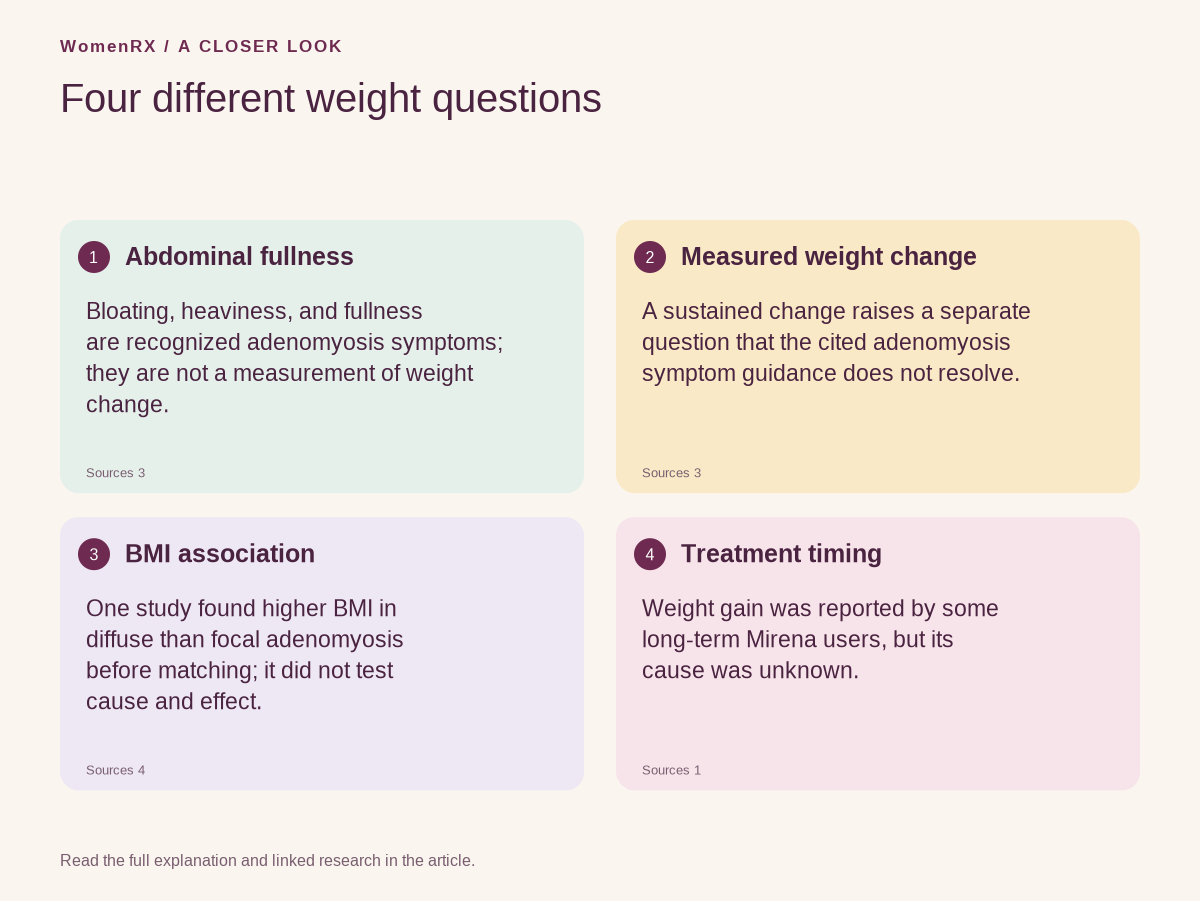
Four different weight questions
Abdominal fullness: Bloating, heaviness, and fullness are recognized adenomyosis symptoms; they are not a measurement of weight change.3
Measured weight change: A sustained change raises a separate question that the cited adenomyosis symptom guidance does not resolve.3
BMI association: One study found higher BMI in diffuse than focal adenomyosis before matching; it did not test cause and effect.4
Treatment timing: Weight gain was reported by some long-term Mirena users, but its cause was unknown.1
Read the figure as text
Similar-sounding concerns point to different kinds of evidence and different details worth noting.- Abdominal fullness: Bloating, heaviness, and fullness are recognized adenomyosis symptoms; they are not a measurement of weight change.3
- Measured weight change: A sustained change raises a separate question that the cited adenomyosis symptom guidance does not resolve.3
- BMI association: One study found higher BMI in diffuse than focal adenomyosis before matching; it did not test cause and effect.4
- Treatment timing: Weight gain was reported by some long-term Mirena users, but its cause was unknown.1
More questions, answered
Does a higher BMI mean adenomyosis will be more severe?
The study comparing diffuse and focal adenomyosis found a BMI difference between those groups before matching, but it was not designed to predict how severe one person’s symptoms would be based on BMI.4
Sources you can check
- MIRENA (LEVONORGESTREL) INTRAUTERINE DEVICE [BAYER HEALTHCARE PHARMACEUTICALS INC.] | US prescribing information and patient instructionsAccessed 2026-09-25Return to first citation
- Pelvic pain - NHSAccessed 2026-09-25Return to first citation
- Adenomyosis - NHSAccessed 2026-09-25Return to first citation
- Association between adenomyosis subtypes and concurrent endometrial lesions: a propensity score-matched retrospective study.Niu X, Wang Y, Zhai Y, Teng Y, Dong Z, Wang L. · Frontiers in endocrinology · 2026Return to first citation
- Nomogram to predict live birth in infertile women with adenomyosis undergoing IVF/ICSI treatment: a retrospective cohort study.Li Z, Chen W, Sun X, Zhao X, Hu J, Ge L, Wang W, Zhang P. · Frontiers in endocrinology · 2025Return to first citation