Insulin Resistance and Weight: What’s Connected and What Isn’t
Insulin resistance and body fat often overlap, but neither a weight change nor a single insulin estimate can tell you what caused it.
Insulin resistance means the body has a reduced response to insulin, the hormone that helps it use glucose. Greater abdominal fat and insulin resistance can occur together, but that doesn’t prove insulin resistance caused your weight change.41 The useful next question is whether you have signs of altered blood glucose or another condition, such as PCOS, that deserves its own assessment.24
Why weight and insulin resistance get linked
Insulin helps your body use glucose for energy. With insulin resistance, the body has a reduced response to a given amount of insulin.4 That describes how the body is responding, not why someone gained weight.
The relationship with body fat is especially relevant around the abdomen. A review describes a plausible pathway in which excess visceral fat, the fat around internal organs, contributes to inflammation and other metabolic changes linked with insulin resistance. Those processes are closely intertwined, which makes a simple cause-and-effect story hard to establish for one person.1 In a small cross-sectional study of adults in South India, the group with metabolic syndrome had both a higher average body mass index and a higher average insulin-resistance estimate than the group without it. Because both were measured at the same time, the study cannot show which came first.4
So if your weight has changed, insulin resistance may be part of a broader metabolic picture. It isn’t, by itself, an answer to why this change happened now. The timing and circumstances still matter: for example, whether the change began during pregnancy, alongside a change in menstrual cycles, or after a change in medication. Those details help frame the question without assuming one explanation.
What a test can tell you
Blood glucose and insulin resistance are related but different questions. A fasting glucose result measures glucose at that point in time; it is not a direct measurement of how responsive your tissues are to insulin. Researchers also use HOMA-IR, a calculation based on fasting glucose and fasting insulin. It is an estimate, not a measurement of every aspect of insulin action.34
That distinction matters if you’ve been given an “insulin-resistance number.” The study of South Indian adults compared calculated estimates alongside fasting glucose, lipids and body measurements, but its findings do not establish a diagnostic cutoff for women in the US.4 Likewise, a pediatric review notes limitations of HOMA-IR, including variation in insulin assays; its proposed uses in children should not be treated as adult screening guidance.3
A more useful conversation than “Is my insulin number normal?” may be: What was measured, what was the result, and what question is it meant to answer? A glucose result can help identify a glucose problem, while an insulin-resistance estimate describes a different aspect of metabolism. Neither result alone establishes the cause of weight gain.34
When another condition changes the picture
If weight change comes with irregular periods, acne, or increased facial or body hair, PCOS may be worth assessing separately. PCOS is characterized by a combination of features involving androgen levels or signs, ovulation, and ovarian appearance. It should not be inferred from weight or an insulin-resistance estimate alone.2
A history of gestational diabetes also matters after pregnancy, though not because it proves the cause of a later weight change. Women with prior gestational diabetes have an increased risk of type 2 diabetes later in life. In a single-center cohort of 715 people with gestational diabetes, 13.3% were diagnosed with type 2 diabetes within five years after delivery; that figure describes this cohort, not any individual’s predicted risk.65 If you had gestational diabetes and aren’t sure whether you had follow-up glucose testing, that’s a specific gap worth raising with your care team.
The distinction is simple but useful: weight change asks what may have changed; metabolic assessment asks what your health looks like now. They overlap, but answering one does not automatically answer the other. If someone has told you that insulin resistance explains your weight, ask what findings support that conclusion and whether symptoms or pregnancy history point to a separate question.246
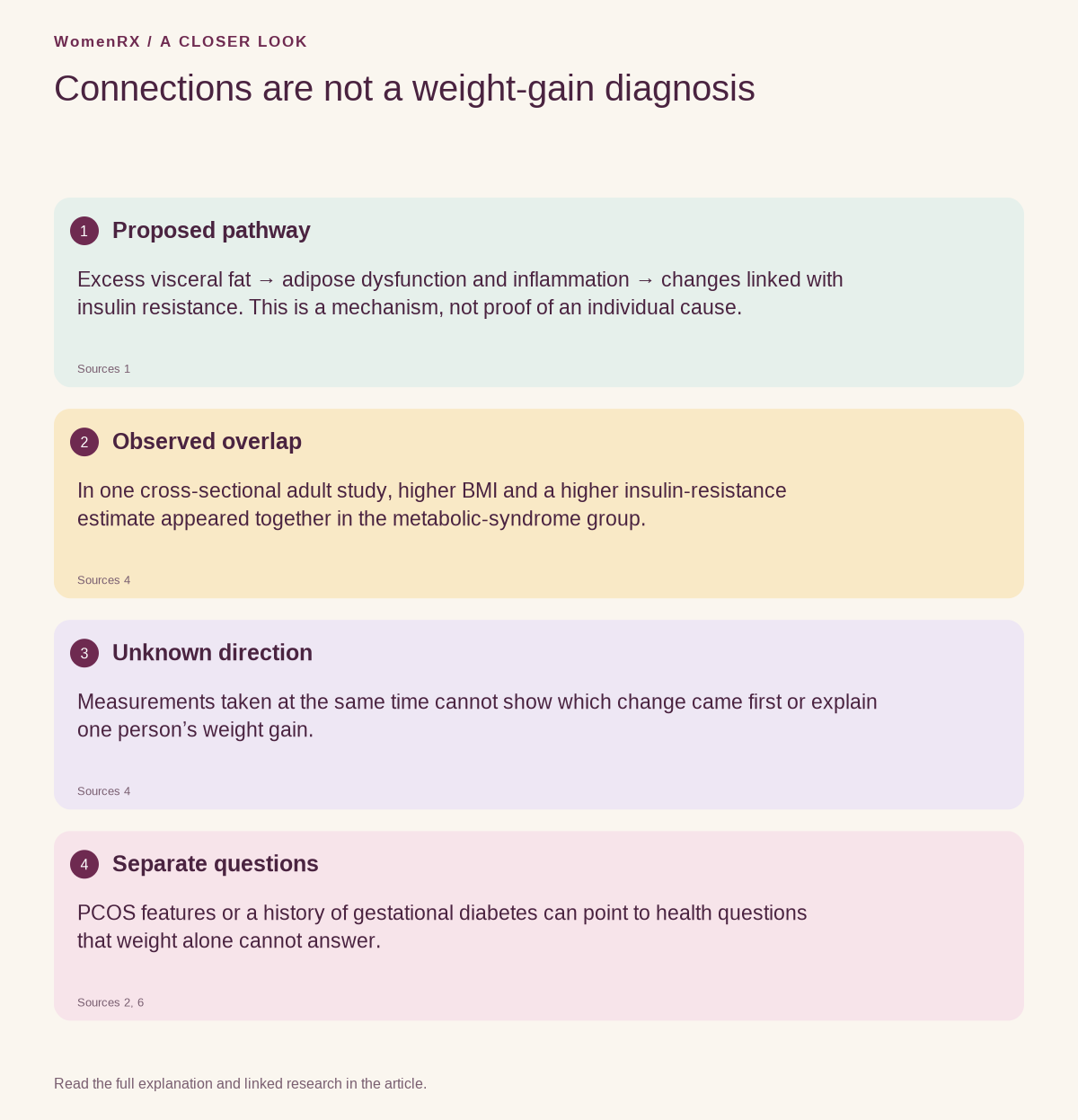
Connections are not a weight-gain diagnosis
Proposed pathway: Excess visceral fat → adipose dysfunction and inflammation → changes linked with insulin resistance. This is a mechanism, not proof of an individual cause.1
Observed overlap: In one cross-sectional adult study, higher BMI and a higher insulin-resistance estimate appeared together in the metabolic-syndrome group.4
Unknown direction: Measurements taken at the same time cannot show which change came first or explain one person’s weight gain.4
Separate questions: PCOS features or a history of gestational diabetes can point to health questions that weight alone cannot answer.26
Read the figure as text
Read the proposed pathway separately from the observed overlap and the unanswered question about an individual’s weight.- Proposed pathway: Excess visceral fat → adipose dysfunction and inflammation → changes linked with insulin resistance. This is a mechanism, not proof of an individual cause.1
- Observed overlap: In one cross-sectional adult study, higher BMI and a higher insulin-resistance estimate appeared together in the metabolic-syndrome group.4
- Unknown direction: Measurements taken at the same time cannot show which change came first or explain one person’s weight gain.4
- Separate questions: PCOS features or a history of gestational diabetes can point to health questions that weight alone cannot answer.26
More questions, answered
Does a normal fasting glucose rule out insulin resistance?
Not on its own. A normal fasting glucose result tells you about blood glucose at the time of testing; it does not directly measure the body’s response to insulin. In an adult study, HOMA-IR was calculated from both fasting glucose and fasting insulin, but the study did not establish a diagnostic cutoff for US women or show how often adults with normal fasting glucose have insulin resistance. Neither result establishes the cause of an individual’s weight change.4
Sources you can check
- Metabolic Dysfunction-Associated Steatotic Liver Disease and Respiratory Disorders: A Systematic Review of Clinical and Pathophysiological Associations.Georgakopoulou VE, Steiropoulos P, Androutsakos T, Karabella I, Reppas K, Cholongitas E, Dalamaga M. · Current obesity reports · 2026Return to first citation
- Acupuncture improves anxiety and depression in patients with polycystic ovary syndrome: a systematic evaluation and meta-analysis.Ye R, Sun Y, Yang H, Peng J, Tian Q, He S, Yao S, Liu Y, Liu Y, Chen J. · Frontiers in medicine · 2026Return to first citation
- The case for broader use of HOMA-IR in pediatric metabolic assessment: a narrative review.Snouda S. · Frontiers in pediatrics · 2026Return to first citation
- Single point insulin sensitivity estimator as a marker of metabolic syndrome in a South Indian cohort.Sreekumar S, Eagappan S, Raghavan KS, Sridhar S. · The Indian journal of medical research · 2026Return to first citation
- Association of Gestational Diabetes Clinician Type with Postpartum Screening and Risk of Type 2 Diabetes Mellitus.Polnaszek BE, Chung J, Cruz M, Harrison R, Palatnik A. · American journal of perinatology · 2026Return to first citation
- Long-term effectiveness of a reminder system for postpartum glucose intolerance screening in gestational diabetes.Bochanen N, Verstraete S, Laenen A, Buyse L, Wens J, De Block C, Benhalima K. · Acta diabetologica · 2026Return to first citation