Insulin Resistance and Weight: What the Evidence Can Guide
Weight management may help lower diabetes risk, but a label of insulin resistance alone doesn’t tell you which treatment or diet is right for you.
Insulin resistance means the body responds less effectively to insulin. Different methods are used to assess it, and a recent review describes challenges in standardizing its diagnosis. Lifestyle programs can help people with prediabetes reduce diabetes risk, but that doesn’t prove a particular diet reverses insulin resistance or that weight loss will resolve everyone’s risk. Focus on the outcome being measured, not the label alone. 4 6
Start with what the diagnosis means
Insulin helps move glucose from the blood into the body’s cells, where it can be used for energy. With insulin resistance, the body responds less effectively to insulin. It’s a description of how the body is handling insulin, not a complete explanation for someone’s health or weight. 2 4
Different methods are used to assess insulin resistance, and a recent review describes challenges in standardizing its diagnosis. The hyperinsulinemic-euglycemic clamp is described as a reference method, while HOMA-IR and insulin measurements during a glucose tolerance test are among the other approaches discussed. It’s useful to ask which result prompted the label and what that result is meant to guide. 4
A cross-sectional study of 70 Syrian women found that BMI had a weak, statistically nonsignificant correlation with HOMA-IR. This finding does not support using BMI alone to infer insulin resistance; the small study also can’t establish how body measurements relate to insulin resistance in other groups. 5
Separate weight, blood sugar, and diabetes risk
These are related, but they’re not the same outcome. Losing weight is a change in body weight. Lower glucose or insulin-resistance measures are changes in biomarkers. Preventing type 2 diabetes is a longer-term health outcome. Progress in one doesn’t guarantee that every other measure will change in the same way.
A 2026 meta-analysis of 77 randomized trials involving 22,629 adults with prediabetes found that greater weight loss was associated with larger reductions in diabetes incidence. Participants in interventions with at least 5% weight loss had higher reversion rates to normoglycemia than those with less weight loss. The trials support lifestyle intervention for diabetes prevention in people with prediabetes; they don’t establish that weight loss cures insulin resistance for everyone, or that these findings apply specifically to women. 6
The same meta-analysis found that interventions including supervised exercise were more effective at reducing diabetes incidence than interventions without supervised exercise. That supports considering structured activity as part of a prevention program. It doesn’t establish that one particular eating plan is best: the review included varied diet and/or activity interventions, rather than a definitive comparison of named diets for reversing insulin resistance. 6
So, if weight management is one of your goals, look for an approach you can sustain and judge it by the outcomes that matter to you and your care team. A change in weight alone doesn’t show whether blood sugar or longer-term diabetes risk has changed. And needing medication or additional support wouldn’t mean you’ve failed: lifestyle measures are not enough to manage blood sugar for everyone with type 2 diabetes. 2
When PCOS or pregnancy history is part of the picture
A 2025 Society for Endocrinology guideline notes that PCOS is common among women presenting with androgen excess and that androgen excess in women with PCOS is closely correlated with adverse metabolic health outcomes. That association is a reason to consider the broader metabolic picture, not proof that every woman with PCOS has insulin resistance. 3
Pregnancy changes the context, too. Gestational diabetes is high blood sugar that develops when the body can’t produce enough insulin to meet the extra needs of pregnancy. It usually goes away after birth, but a history of gestational diabetes is associated with a greater chance of developing type 2 diabetes later. It’s a pregnancy-related risk history, not by itself proof of ongoing insulin resistance. 1
A useful next question
If someone has told you that you have insulin resistance, ask what specific result they’re referring to and what they recommend tracking: a biomarker, blood-sugar status, diabetes risk, or weight. Then ask how the proposed plan is expected to affect that outcome. This keeps the conversation focused on a measurable goal rather than treating “reverse insulin resistance” as a promise that one number or diet can deliver.
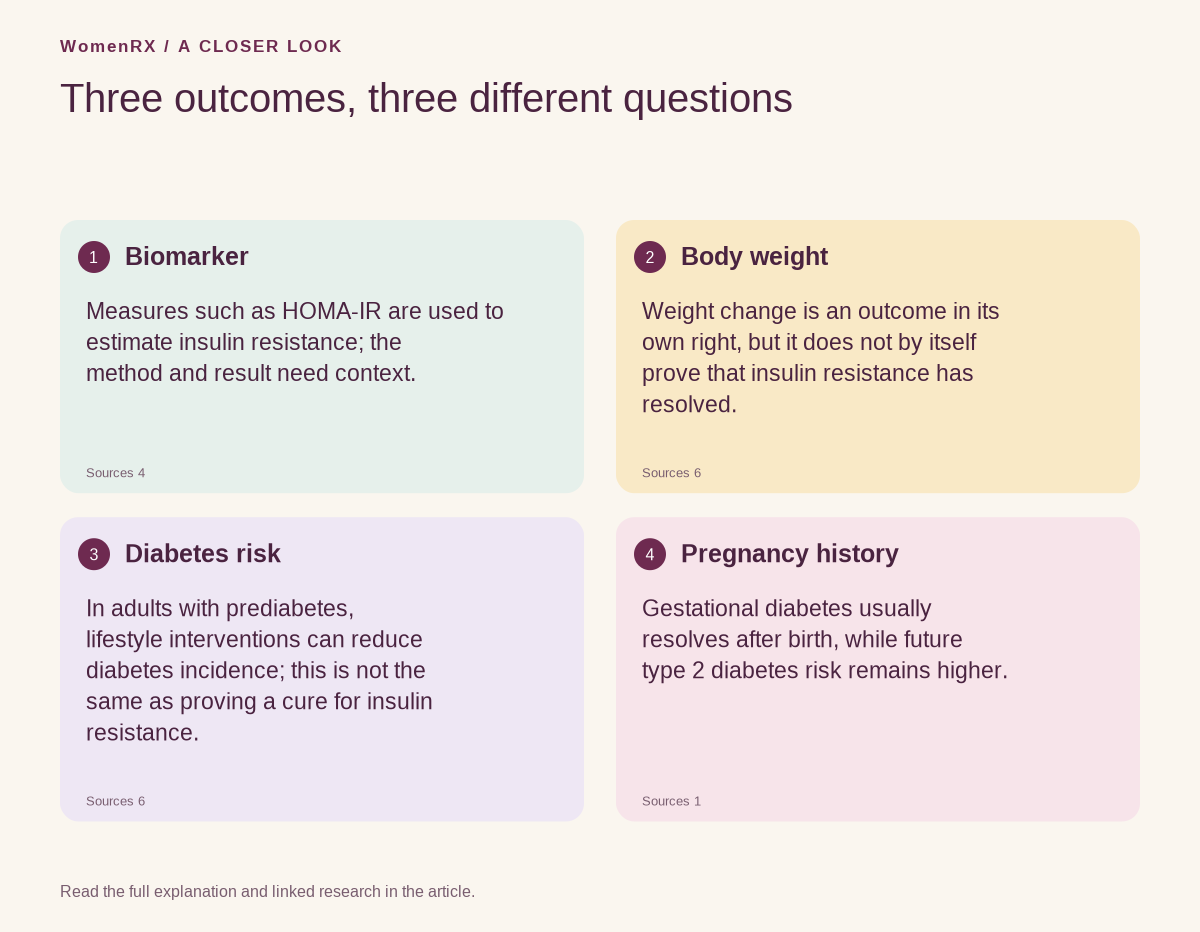
Three outcomes, three different questions
Biomarker: Measures such as HOMA-IR are used to estimate insulin resistance; the method and result need context.4
Body weight: Weight change is an outcome in its own right, but it does not by itself prove that insulin resistance has resolved.6
Diabetes risk: In adults with prediabetes, lifestyle interventions can reduce diabetes incidence; this is not the same as proving a cure for insulin resistance.6
Pregnancy history: Gestational diabetes usually resolves after birth, while future type 2 diabetes risk remains higher.1
Read the figure as text
This comparison separates biomarkers, body-weight change, and diabetes risk, then adds pregnancy history as a related risk context.- Biomarker: Measures such as HOMA-IR are used to estimate insulin resistance; the method and result need context.4
- Body weight: Weight change is an outcome in its own right, but it does not by itself prove that insulin resistance has resolved.6
- Diabetes risk: In adults with prediabetes, lifestyle interventions can reduce diabetes incidence; this is not the same as proving a cure for insulin resistance.6
- Pregnancy history: Gestational diabetes usually resolves after birth, while future type 2 diabetes risk remains higher.1
More questions, answered
Does a specific diet reverse insulin resistance?
Research supports lifestyle programs for reducing diabetes risk in adults with prediabetes, but it doesn’t establish that one named diet reverses insulin resistance. The trials used varied diet and/or activity approaches rather than a definitive comparison of specific diets. 6
Does having had gestational diabetes mean I still have insulin resistance?
Not necessarily. Gestational diabetes is high blood sugar during pregnancy when the body can’t meet the increased insulin needs. It usually resolves after birth, though a history of it is linked with higher future type 2 diabetes risk. That history is worth keeping in view, but it doesn’t by itself establish ongoing insulin resistance. 1
Sources you can check
- Gestational diabetes - NHSAccessed 2026-09-25Return to first citation
- Diabetes Medicine | Insulin | MedlinePlusAccessed 2026-09-25Return to first citation
- Society for Endocrinology Clinical Practice Guideline for the Evaluation of Androgen Excess in Women.Elhassan YS, Hawley JM, Cussen L, Abbara A, Clarke SA, Kempegowda P, Dhillon-Smith RK, Thadani P, Busby M, Owusu-Darkwah L, Marrington R, Duncan WC, Semple RK, Quinton R, O'Reilly ... · Clinical endocrinology · 2025Return to first citation
- Insulin Resistance: Current State of Knowledge and Clinical Implications-Toward a Better Diagnostic Framework and the Question of Its Disease Status.Rodzeń Ł, Rodzeń M, Dyńka D, Łojko D, Karakuła-Juchnowicz H, Kraszewski S, Fazio S, Unwin D, Bikman B. · Nutrients · 2026Return to first citation
- Evaluation of body mass index, waist-to-hip ratio, and waist-to-height ratio as predictors of insulin resistance in Syrian adult women: A cross-sectional study.Zam W, Farkoh H, Makhoul J, Youssef J. · The Journal of international medical research · 2026Return to first citation
- Identifying Promising Practices in Lifestyle Intervention Programs for the Prediabetes Population: A Meta-Analysis and Meta-Regression of Randomized Controlled Trials.Rong J, Ho M, Zhou D, Chau PH. · Worldviews on evidence-based nursing · 2026Return to first citation