How Insulin Resistance Is Assessed: What Tests Can Show
There’s no single routine blood test that labels insulin resistance; different tests reveal insulin action, blood sugar, or the broader metabolic picture.
The hyperinsulinemic-euglycemic clamp directly assesses how the body responds to insulin, but it is mainly used in research. 3 HOMA-IR combines fasting insulin and glucose, yet insulin measurement varies and there’s no widely accepted cutoff. 3 6 Glucose tests can identify abnormal glucose regulation, but they don’t directly measure insulin resistance. Results make more sense alongside your health context, not as one stand-alone label. 1 2
The test depends on the question
“Insulin resistance” describes a response: the body’s tissues are less responsive to insulin’s effects. Insulin helps glucose move from the blood into cells. A test of blood glucose therefore tells you about glucose levels, not directly how sensitive your tissues are to insulin. 1 2
That distinction matters because a normal glucose result does not, by itself, establish that insulin sensitivity is normal. And an insulin-resistance estimate is not the same thing as a diagnosis of prediabetes or diabetes. Those are related but different questions. 2
What the different tests measure
The hyperinsulinemic-euglycemic clamp is a reference method used mainly in research. It assesses how much glucose the body takes up in response to insulin. It is complex, so it is not the usual test a person gets during routine care. 2 3
HOMA-IR is calculated using fasting insulin and fasting glucose. It offers an estimate from a blood draw, rather than directly measuring tissue response. But insulin results can vary with the measurement method, and accepted diagnostic cutoffs for HOMA-IR have not been established. A number flagged by a lab or interpreted using a published study cutoff should not automatically be treated as a universal diagnosis. 3 6
That last point is not just theoretical. In one cross-sectional study of 515 nonpregnant adults with overweight or obesity and without diabetes, researchers proposed a HOMA-IR cutoff based on whether participants had metabolic syndrome. The study was limited to a specific population and purpose; its proposed threshold is not a universal clinical standard. 4
Fasting glucose and A1C assess glucose, not insulin resistance itself. Fasting glucose is a snapshot; A1C reflects average blood glucose over roughly the previous three months. These tests can help assess glucose-related risk, but they cannot tell you directly how much insulin your tissues need to handle glucose. 1 2
An oral glucose tolerance test (OGTT) measures how glucose changes after a glucose drink. If insulin is also measured at multiple points, the test can show more about insulin-and-glucose responses over time than fasting results alone. Still, insulin measurements during an OGTT do not have widely accepted cutoff values, and the test is not a stand-alone diagnostic test for insulin resistance. 2
Why a single number can mislead
Fasting insulin, HOMA-IR, and other indirect measures are estimates. Results may differ with the method used to measure insulin, the population being studied, and the cutoff chosen. Researchers have proposed thresholds in particular groups, but those thresholds do not automatically carry over to everyone. For example, a study of young Caucasian women with polyendocrine metabolic ovarian syndrome proposed cutoffs for several indices within that group; its authors also noted that commonly accepted HOMA-IR cutoffs had not been established. 6
PCOS can be a reason to discuss metabolic assessment, but having PCOS does not, by itself, prove that you have insulin resistance. PCOS is among the conditions linked with insulin resistance, while HOMA-IR remains an indirect estimate rather than a universal test for everyone with PCOS. 3
A practical way to read your results
Ask what each result was meant to answer. If the concern is prediabetes or diabetes, glucose-based tests address that question. If someone has calculated HOMA-IR, ask which reference range or cutoff they used and whether it applies to your situation. If the picture is unclear, your clinician may consider the overall pattern, including glucose-related results and other metabolic measures, rather than treating one insulin value as decisive. The available evidence supports that caution, but it does not establish one required panel or decision rule for everyone. 2 5 6
The useful takeaway is simple: blood tests can identify glucose abnormalities and estimate insulin sensitivity in different ways, but they do not all measure the same thing. A result is most useful when you know what it measures, what it cannot establish, and how it fits with the rest of your health.
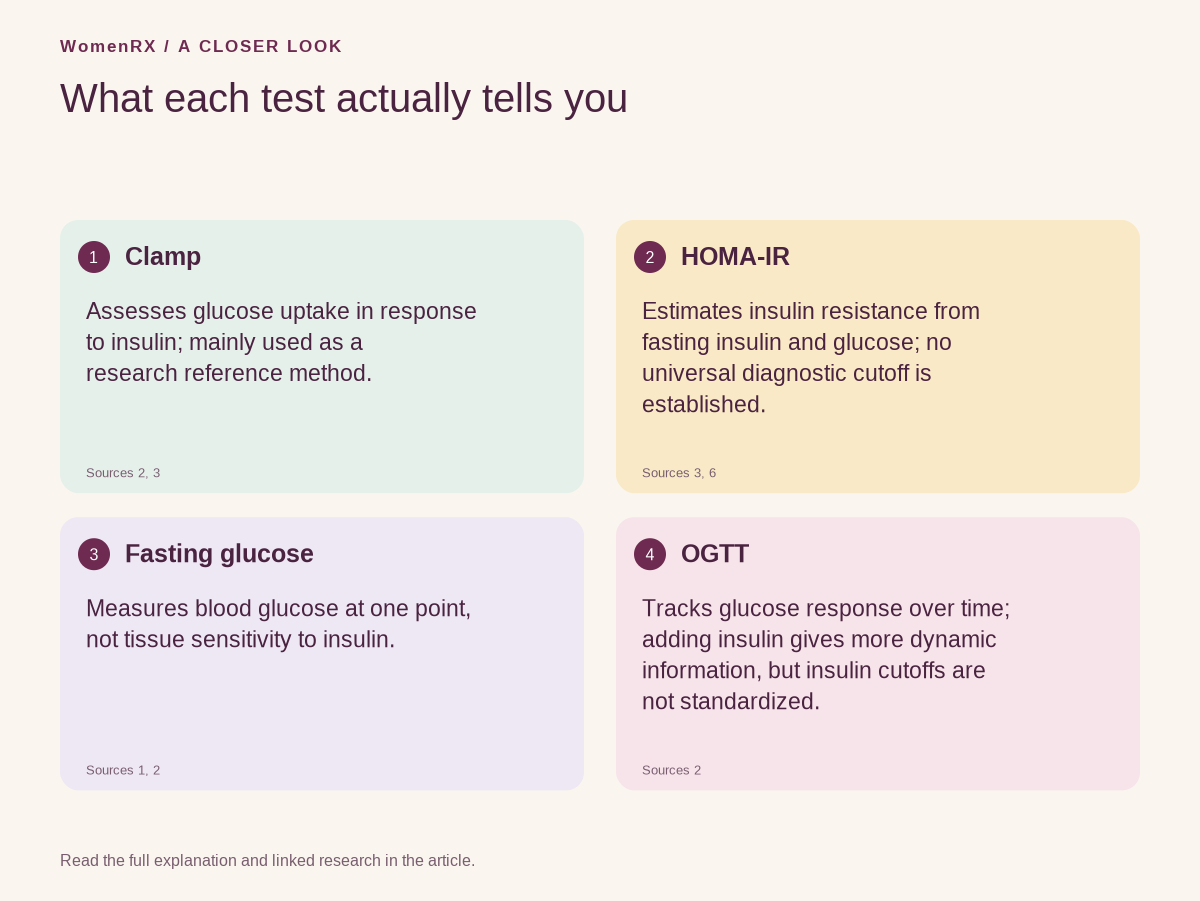
What each test actually tells you
Clamp: Assesses glucose uptake in response to insulin; mainly used as a research reference method.23
HOMA-IR: Estimates insulin resistance from fasting insulin and glucose; no universal diagnostic cutoff is established.36
Fasting glucose: Measures blood glucose at one point, not tissue sensitivity to insulin.12
OGTT: Tracks glucose response over time; adding insulin gives more dynamic information, but insulin cutoffs are not standardized.2
Read the figure as text
These tests answer different questions: direct insulin response, estimated insulin sensitivity, or glucose regulation.- Clamp: Assesses glucose uptake in response to insulin; mainly used as a research reference method.23
- HOMA-IR: Estimates insulin resistance from fasting insulin and glucose; no universal diagnostic cutoff is established.36
- Fasting glucose: Measures blood glucose at one point, not tissue sensitivity to insulin.12
- OGTT: Tracks glucose response over time; adding insulin gives more dynamic information, but insulin cutoffs are not standardized.2
More questions, answered
Does a normal fasting glucose rule out insulin resistance?
No. Fasting glucose measures blood sugar at one point in time, not how responsive tissues are to insulin. Research also describes abnormal insulin-response patterns in some people whose glucose tolerance is normal. 1 2
Is HOMA-IR a diagnosis?
HOMA-IR is an estimate based on fasting insulin and glucose. There is no widely accepted diagnostic cutoff, and insulin measurement methods can affect the result, so a single value should be interpreted in context. 3 6
Sources you can check
- Blood Glucose | Blood Sugar | Diabetes | MedlinePlusAccessed 2026-09-25Return to first citation
- Insulin Resistance: Current State of Knowledge and Clinical Implications-Toward a Better Diagnostic Framework and the Question of Its Disease Status.Rodzeń Ł, Rodzeń M, Dyńka D, Łojko D, Karakuła-Juchnowicz H, Kraszewski S, Fazio S, Unwin D, Bikman B. · Nutrients · 2026Return to first citation
- Targeting Insulin Resistance Through Nutrition: Pathophysiological Insights and Dietary Interventions.Caretto A, Zanardini A, Frontino G, Pedone E. · Nutrients · 2026Return to first citation
- Capturing metabolic syndrome: new thresholds for insulin resistance and novel body composition indices.Frigerio F, Vitozzi A, Piciocchi C, Ricci F, De Marinis M, Galfano V, Lubrano C, Mariani S, Gangitano E, Minnetti M, Muzzioli L, Lenzi A, Caprio M, Isidori AM, Gnessi L, Migliaccio... · International journal of obesity (2005) · 2026Return to first citation
- The undervalued league of insulin resistance testing: uncovering their importance.Rani K, Patil P, Bharti P, Kumar S, Prabhala S. · Hormone molecular biology and clinical investigation · 2024Return to first citation
- Clinical Obesity and Insulin Resistance Assessed Based on SHBG Levels and HOMA-IR, TyG-Waist Circumference (TyG-WC), TyG-Waist to Height Ratio (TyG-WHtR), and TyG-Waist to Hip Ratio (TyG-WHR) Values in Young Caucasian Women with Polyendocrine Metabolic Ovarian Syndrome (PMOS).Kochanowicz M, Owczarek AJ, Małek P, Madej P, Chudek J, Olszanecka-Glinianowicz M. · Journal of clinical medicine · 2026Return to first citation