How Is Insulin Resistance Assessed?
A symptom, fasting insulin result, or supplement claim tells you less than you might think; the useful next question is what your glucose tests and health history show.
Insulin resistance means the body isn’t responding to insulin as effectively as it should. Fasting glucose and A1c assess glucose status, while an oral glucose tolerance test can add information when the question calls for it. Fasting insulin and a calculation called HOMA-IR are used in research, but they answer a different question from glucose-based screening. PCOS and pregnancy each change which risks and tests matter. 12348
First, separate insulin resistance from high blood sugar
Insulin helps move glucose from your blood into your cells. When your body doesn’t respond to insulin as effectively, blood glucose can eventually rise, but the two aren’t identical. That’s why a question like “Am I insulin resistant?” is often more useful when made specific: “Do my results show a glucose problem, and is there a reason to look more closely at my metabolic health?” 1
For example, a person may have a glucose result that doesn’t answer every question about how her body is using insulin. In a small study of 32 adults matched by age and sex, the group classified as obese had higher fasting insulin and calculated HOMA-IR than the non-obese group, while glucose-tolerance categories varied within both groups. This illustrates a distinction between measures, not a way to diagnose an individual from body size or one test result. The results described in the abstract do not break out findings for women. 7
What the common tests actually measure
Fasting glucose measures blood glucose after a fast. A1c is another commonly used measure of glucose status. An oral glucose tolerance test checks the glucose response after a measured glucose drink. These are tests for glucose abnormalities, not direct measurements of how sensitive each tissue is to insulin. A Korean Diabetes Association consensus statement says fasting glucose and A1c are commonly used there because they’re practical, while an oral glucose tolerance test can add information when a glucose problem after the drink is suspected or greater diagnostic certainty is needed. Its screening recommendations are written for Korea, not as a US testing schedule. 3
That distinction matters if one result looks reassuring but the concern hasn’t gone away. The Korean statement notes that fasting glucose, A1c, and the two-hour glucose result from a tolerance test don’t always identify the same people. It doesn’t follow that everyone needs every test; it means the reason for testing helps determine which result is useful. 3
Does fasting insulin give a clearer answer?
A fasting insulin result measures insulin in the blood at that moment. Researchers sometimes combine fasting insulin with fasting glucose to calculate HOMA-IR, an estimate used in studies of insulin resistance. One cross-sectional study explicitly calculated it from those two fasting measurements; the small comparison study above used it to compare groups. Neither study establishes a universal cutoff that would turn one person’s result into a stand-alone diagnosis. 87
So if you’re considering paying for a fasting insulin test, ask what decision its result would change. Is the concern an abnormal glucose result, a history that raises diabetes risk, or something else? A fasting insulin number doesn’t replace answering that more practical question with the appropriate glucose assessment. The tests measure related but different things. 378
Symptoms need the same context. The Korean consensus statement lists PCOS and acanthosis nigricans, a skin finding, as examples of evidence of insulin resistance that can contribute to diabetes-screening decisions. It treats them as risk information, not as stand-alone diagnostic tests. A vague symptom by itself cannot tell you which metabolic measure, if any, is abnormal. 3
PCOS and pregnancy are different testing conversations
If you have PCOS, insulin resistance is one possible part of the picture, and PCOS is linked with prediabetes and type 2 diabetes. But a fasting insulin result is not a PCOS test. PCOS is assessed through a broader pattern of reproductive and hormonal findings, not a single metabolic number. The practical question is whether you also need an assessment of glucose health, rather than whether one insulin value can explain every PCOS symptom. 15
Pregnancy changes the context again. Insulin resistance increases after the first trimester, and screening for gestational diabetes is among the prenatal tests commonly offered. A screening result may call for more information; it isn’t automatically a diagnosis. Pregnancy brings a prenatal glucose-screening context, while a fasting insulin result measures insulin rather than glucose. 42
A continuous glucose monitor can provide useful glucose information in some pregnancies affected by diabetes, but an international consensus statement says appropriate CGM thresholds for diagnosing gestational diabetes still need to be determined. That is a specific limitation of CGM-based diagnosis, not a claim that all home glucose readings are meaningless. 4
Be wary of the leap from a marker to a cure
A product can change a research marker without being proven to improve outcomes that matter to you. In a systematic review of nine randomized trials involving 615 adults, bergamot supplementation was associated with changes in glucose, insulin, and HOMA-IR. But six trials were rated poor quality, and the reviewers judged the certainty of evidence low to very low across outcomes. They cautioned that the findings do not establish bergamot’s clinical efficacy. The review concerned adults with dyslipidemia or metabolic syndrome, not a demonstrated treatment for insulin resistance specifically in women. 6
Before buying a test or supplement, pin down the claim: Does it identify a glucose problem, estimate a research marker, or promise to treat one? Those are three different propositions. Your glucose results, health history, and whether PCOS or pregnancy applies will usually make the next decision clearer than the label “insulin resistant” on its own. 1236
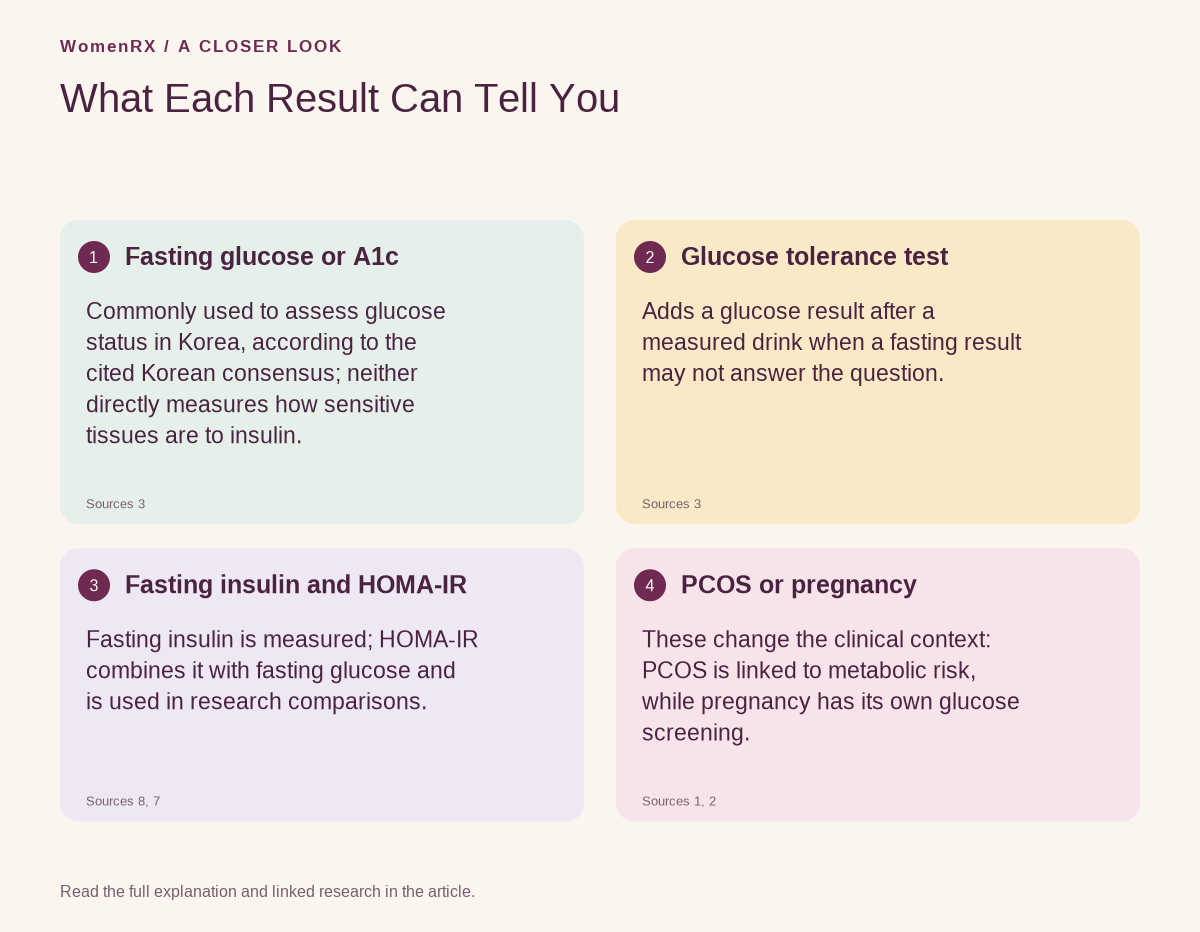
What Each Result Can Tell You
Fasting glucose or A1c: Commonly used to assess glucose status in Korea, according to the cited Korean consensus; neither directly measures how sensitive tissues are to insulin.3
Glucose tolerance test: Adds a glucose result after a measured drink when a fasting result may not answer the question.3
Fasting insulin and HOMA-IR: Fasting insulin is measured; HOMA-IR combines it with fasting glucose and is used in research comparisons.87
PCOS or pregnancy: These change the clinical context: PCOS is linked to metabolic risk, while pregnancy has its own glucose screening.12
Read the figure as text
The same conversation may involve a glucose test, an estimate of insulin resistance, or a risk clue. They are not interchangeable.- Fasting glucose or A1c: Commonly used to assess glucose status in Korea, according to the cited Korean consensus; neither directly measures how sensitive tissues are to insulin.3
- Glucose tolerance test: Adds a glucose result after a measured drink when a fasting result may not answer the question.3
- Fasting insulin and HOMA-IR: Fasting insulin is measured; HOMA-IR combines it with fasting glucose and is used in research comparisons.87
- PCOS or pregnancy: These change the clinical context: PCOS is linked to metabolic risk, while pregnancy has its own glucose screening.12
More questions, answered
Can a normal fasting glucose result rule out every glucose problem?
Not necessarily. A Korean clinical consensus notes that fasting glucose, A1c, and the two-hour result of an oral glucose tolerance test don’t always identify the same people in Korea. Whether another test adds useful information depends on the reason you’re being assessed. 3
Does having PCOS mean I have diabetes?
No. PCOS can be associated with insulin resistance and increased risk of prediabetes and type 2 diabetes, but it does not itself establish either glucose diagnosis. 1
Sources you can check
- PCOS | Polycystic Ovary Syndrome | MedlinePlusAccessed 2026-09-25Return to first citation
- Prenatal Testing | Gestational Diabetes | MedlinePlusAccessed 2026-09-25Return to first citation
- Bridging Evidence and Practice: A Consensus Statement from the Korean Diabetes Association on Diabetes Screening, Pharmacological Treatment and Severe Diabetes.Choi JH, Kang S, Kim SK, Kim WJ, Kim JM, Bae J, Yun JS, Jeon E, Kim YE, Bae JH, Choe HJ, Cho YM, Ko SH, Kim SY, Kim HJ, Hwang YC, Moon MK, Chon S, Kang SM, Kwon HS, Kim MK, Lee YB,... · Diabetes & metabolism journal · 2025Return to first citation
- Application of continuous glucose monitoring and automated insulin delivery technologies for pregnant women with type 1, type 2, or gestational diabetes: an international consensus statement.Benhalima K, Durnwald C, Sweeting A, Adams D, Addala A, Battelino T, Bergenstal RM, Carlson A, Donovan LE, Reis Franco D, Heverly J, Isaacs D, Khunti K, Kihara AB, Levitt N, Levy C... · The lancet. Diabetes & endocrinology · 2026Return to first citation
- From polycystic ovary syndrome to polyendocrine metabolic ovarian syndrome: what obstetricians and gynecologists need to know.Bahri-Khomami M, Hoeger KM, Huddleston H, Mahalingaiah S, Teede HJ, Dokras A. · American journal of obstetrics and gynecology · 2026Return to first citation
- Bergamot (Citrus bergamia) Supplementation and Cardiovascular Disease Risk Factors: A Systematic Review and Meta-Analysis.Chambari M, Mardani H, Roshandel M, Rafiei H, Linsenmeyer W, Jafari M, Ulaganathan V, Jafari A. · Food science & nutrition · 2026Return to first citation
- Similar Blood Glucose Pattern with Highest Peak at Minute 45 on Oral Glucose Tolerance Test Despite Higher Fasting Insulin and Insulin Resistance in Healthy Obese than Non-Obese Subject.Saraswati MR, Nugraha IBA, Suastika K. · Acta medica Indonesiana · 2022Return to first citation
- Idiopathic post prandial glucose lowering, a whistle blower for subclinical hypothyroidism and insulin resistance. A cross-sectional study in Tertiary Care Centre of northeast India.Longkumer C, Nath CK, Barman B, Ruram AA, Visi V, Yasir MD, Sangma MA. · Journal of family medicine and primary care · 2020Return to first citation