Insulin Resistance and Pregnancy: What Fertility Evidence Shows
Insulin resistance alone doesn’t tell you whether you’ll conceive; questions about ovulation, glucose results, and associated diagnoses give the finding more context.
An insulin-resistance result isn’t, by itself, a diagnosis of infertility or a prediction that you’ll have pregnancy complications. In one prospective Singapore cohort, lower fecundability was linked to metabolic-unhealth definitions among some participants with overweight or obesity, but not to weight alone; the study doesn’t isolate insulin resistance as the cause. That cohort measured time to pregnancy, not pregnancy complications; a separate review concerns women with diabetes. Neither establishes pregnancy risks from isolated insulin resistance. 57
The result needs context
“Insulin resistance” describes a metabolic finding. It isn’t the same diagnosis as polycystic ovary syndrome (PCOS) or diabetes, and it doesn’t tell you on its own whether you’re ovulating or how long conception may take. Infertility can have several causes, including failure to ovulate, which is often associated with PCOS, as well as problems involving the fallopian tubes, uterus, eggs, or a partner’s fertility. 2
That distinction matters because the clearest fertility findings in this evidence concern groups defined by overall metabolic health, not people with isolated insulin resistance.
What one preconception study can, and can’t, tell you
A prospective study followed 834 Asian women in Singapore who were trying to conceive. The researchers compared time to pregnancy among women with different body-mass and metabolic-health profiles. Among participants with overweight or obesity, lower fecundability was observed in groups classified as metabolically unhealthy. The classification varied: it could reflect several metabolic-syndrome criteria or a HOMA-IR measure of insulin resistance. Participants classified as metabolically healthy did not show the same reduction compared with the study’s metabolically healthy, normal-weight reference group. 5
This is a useful distinction: weight alone did not sort everyone into the same fertility pattern in this cohort. But it does not show that insulin resistance by itself caused longer time to pregnancy. The study involved a specific Singaporean population, and its findings compare combined metabolic categories with a reference group. They aren’t a personal forecast or proof that changing an insulin-resistance result will shorten time to pregnancy.
Other prospective Singapore cohort analyses examined insulin resistance alongside specific factors, such as dietary inflammatory patterns or one-carbon nutrients. Those analyses don’t establish insulin resistance as an independent fertility cause either. 34
When ovulation is the question
If you’re concerned about ovulation, ask whether PCOS or another cause could be involved. PCOS is one condition associated with failure to ovulate, but insulin resistance alone doesn’t establish that you have PCOS. 2
An insulin-resistance result deserves interpretation alongside your other metabolic findings, but it doesn’t establish whether you’re ovulating. The available cohort evidence doesn’t provide a simple insulin-resistance cutoff that predicts an individual woman’s chance of conception.
Keep glucose findings separate from fertility findings
An insulin-resistance measure and a diabetes diagnosis aren’t interchangeable. If you’re planning pregnancy, clarify what your results actually show and whether you have diabetes or another condition that needs attention before conception. Preconception care can identify and address health problems such as diabetes or high blood pressure before pregnancy. 1
Evidence about pregnancy outcomes is a separate question from time to conception. The Singapore cohort studies measured time to pregnancy, not pregnancy complications. 345 A review of women with diabetes describes pregnancy as a period of pronounced insulin resistance, but it cannot establish whether a pre-pregnancy insulin-resistance result predicts complications in women without diabetes. 7
What about metformin?
An insulin-resistance result alone isn’t enough to conclude that metformin is right for you. A narrative review describes its use in PCOS and notes that evidence about pregnancy and live-birth outcomes remains controversial; that discussion doesn’t establish a benefit for women with isolated insulin resistance. 6
A practical conversation can focus on three separate questions: Is ovulation a concern? Do your glucose results show diabetes or another diagnosis? And, if PCOS is suspected, what findings support that diagnosis? If you’re preparing for pregnancy, preconception care is a reasonable place to review these together. 12
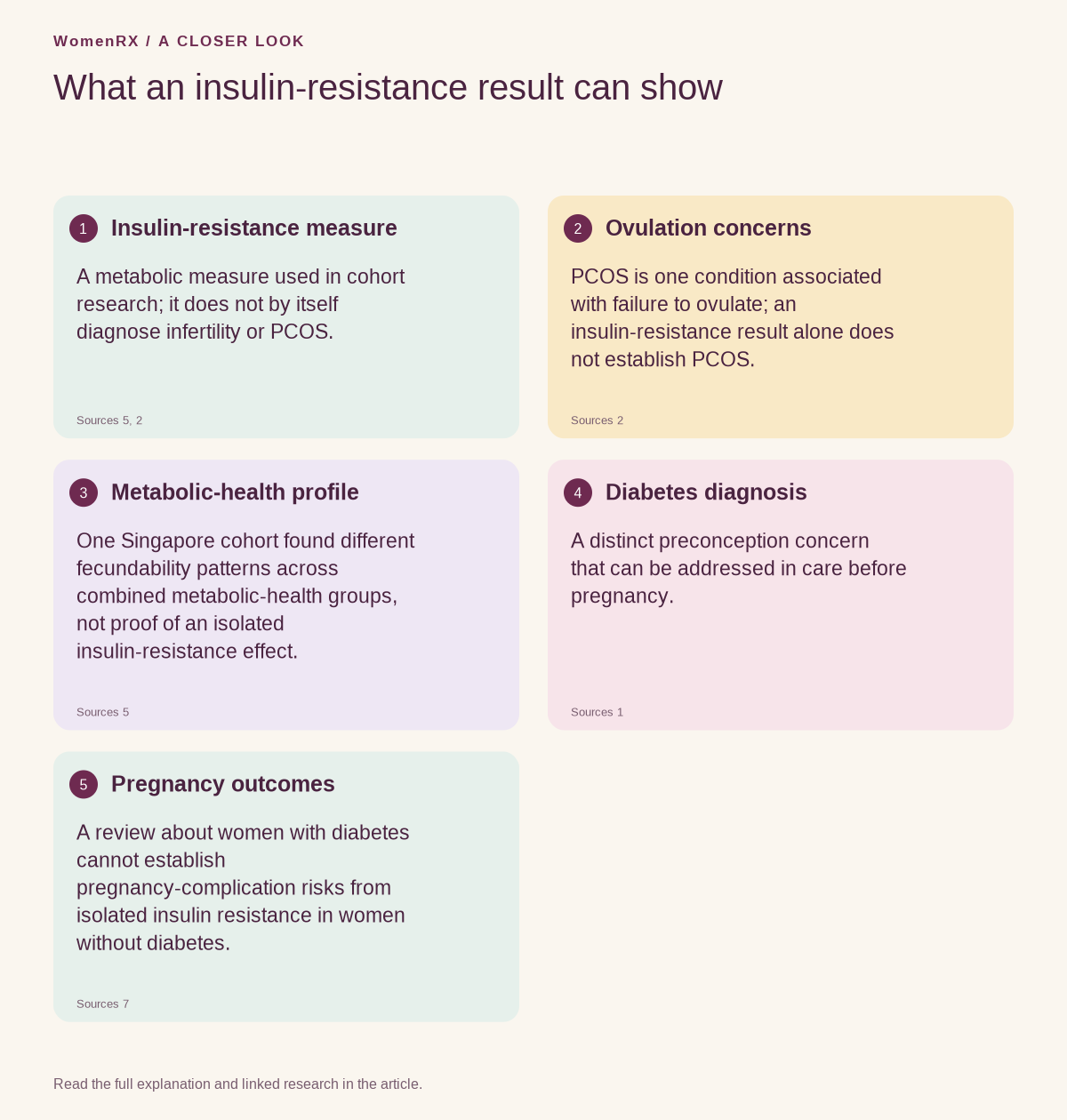
What an insulin-resistance result can show
Insulin-resistance measure: A metabolic measure used in cohort research; it does not by itself diagnose infertility or PCOS.52
Ovulation concerns: PCOS is one condition associated with failure to ovulate; an insulin-resistance result alone does not establish PCOS.2
Metabolic-health profile: One Singapore cohort found different fecundability patterns across combined metabolic-health groups, not proof of an isolated insulin-resistance effect.5
Diabetes diagnosis: A distinct preconception concern that can be addressed in care before pregnancy.1
Pregnancy outcomes: A review about women with diabetes cannot establish pregnancy-complication risks from isolated insulin resistance in women without diabetes.7
Read the figure as text
These distinctions help separate a metabolic measure from fertility diagnoses and pregnancy-outcome evidence.- Insulin-resistance measure: A metabolic measure used in cohort research; it does not by itself diagnose infertility or PCOS.52
- Ovulation concerns: PCOS is one condition associated with failure to ovulate; an insulin-resistance result alone does not establish PCOS.2
- Metabolic-health profile: One Singapore cohort found different fecundability patterns across combined metabolic-health groups, not proof of an isolated insulin-resistance effect.5
- Diabetes diagnosis: A distinct preconception concern that can be addressed in care before pregnancy.1
- Pregnancy outcomes: A review about women with diabetes cannot establish pregnancy-complication risks from isolated insulin resistance in women without diabetes.7
More questions, answered
Does insulin resistance mean I can’t get pregnant?
No. The finding alone doesn’t establish infertility. A prospective cohort found different time-to-pregnancy patterns across combined metabolic-health groups, but it didn’t show that isolated insulin resistance prevents pregnancy. 5
Should I take metformin to improve fertility?
An elevated insulin-resistance measure alone doesn’t establish a fertility benefit from metformin. A review discusses metformin in PCOS but describes pregnancy and live-birth evidence as unsettled; that isn’t a recommendation for isolated insulin resistance. 6
Sources you can check
- Preconception Care: MedlinePlusAccessed 2026-09-25Return to first citation
- Infertility | Infertility Treatments | MedlinePlusAccessed 2026-09-25Return to first citation
- An Empirical Dietary Inflammatory Pattern and Fecundability in a Multiethnic Asian Preconception Cohort.Loh J, Yu G, Colega MT, Tan K, Chong YS, Godfrey KM, Chan JKY, Chan SY, Eriksson JG, Chong MF, Loy SL, Lai JS. · The Journal of nutrition · 2026Return to first citation
- One-carbon metabolism, insulin resistance, and fecundability in a Singapore prospective preconception cohort study.Ku CW, Chan HG, Sia AL, Huang C, Quek J, Cheung YB, Tan KML, Lai JS, Godfrey KM, Chan JKY, Yap F, Loy SL. · The American journal of clinical nutrition · 2025Return to first citation
- Metabolic health status and fecundability in a Singapore preconception cohort study.Loy SL, Chan DWK, Ku CW, Cheung YB, Godfrey KM, Tan KML, Chong YS, Shek LP, Tan KH, Chan SY, Chan JKY, Yap F. · American journal of obstetrics and gynecology · 2022Return to first citation
- Therapeutic Potential of Anti-Obesity Drugs in Obesity-Associated Female Reproductive Dysfunction: Translating Mechanistic Evidence into Personalized Clinical Strategies.Varra FN, Theodosis-Nobelos P, Varra VK, Varras M. · Medicina (Kaunas, Lithuania) · 2026Return to first citation
- Glucose excursions throughout the reproductive life stages in women with diabetes.Knorr S, Knudsen TS, Kirkegaard K, Hviid KVR, Nielsen HS, Kampmann U. · The Journal of clinical endocrinology and metabolism · 2026Return to first citation