Adenomyosis and Fertility: What the Evidence Can Tell You
Adenomyosis may be linked with fertility and pregnancy challenges, but a diagnosis alone can’t predict whether you’ll conceive or have a healthy pregnancy.
Research links adenomyosis with lower implantation in some fertility-treatment studies and with miscarriage and other pregnancy complications, but results vary and don’t predict an individual’s outcome. The right next step depends on your age, reproductive history, symptoms, imaging, and whether you’re trying now. If you’re planning pregnancy, discuss how to balance symptom relief with fertility goals before starting treatment. 4 8

Adenomyosis means tissue similar to the uterine lining is present in the muscle wall of the uterus. Some people have no symptoms; others have painful or heavy periods. Having adenomyosis does not mean you can’t get pregnant. It does make sense to include it in a pregnancy-planning conversation, because studies suggest possible effects on implantation and pregnancy outcomes, but they can’t tell you what will happen in your case. 1 3 4
What the fertility research shows, and what it doesn’t
Adenomyosis has been associated with infertility and miscarriage in research, and reviews describe possible links with preterm birth and other pregnancy complications. These are associations, not a personal forecast. Studies use different diagnostic definitions and include people with different disease patterns and reproductive histories. Adenomyosis can also occur alongside endometriosis, which may contribute to fertility difficulties and make it harder to isolate adenomyosis’s effect. 3 4 5
One possible explanation is that changes in the uterine muscle and lining could affect how the uterus moves or how receptive the lining is to an embryo. Researchers have proposed these pathways, but they don’t establish that one mechanism is responsible for an individual’s fertility or pregnancy outcome. 4 7
A 2026 retrospective study offers a useful example of why results need context: patients with adenomyosis received ultralong GnRH-agonist pretreatment before their first frozen embryo transfer. In this group, the implantation rate was lower than in the comparison group without adenomyosis (50.7% versus 62.8%), while live birth rates did not differ significantly (49.2% versus 47.5%). Whether the comparison group received the same pretreatment is unclear from these results, so they aren’t a clean test of the treatment or of adenomyosis alone. This was one treatment setting, not a comparison of everyone with adenomyosis against everyone without it. 8
Diagnosis and pattern can shape the conversation
Adenomyosis is assessed using imaging such as transvaginal ultrasound or MRI. Research reviews describe possible differences between focal and diffuse disease, and between inner and outer uterine locations. But researchers have not yet established reliable subtype-based predictions for fertility or assisted reproduction; even a more detailed scan can’t provide a sure answer about whether you’ll conceive. 3 4 5
If the diagnosis is suspected rather than confirmed, ask what the imaging shows and whether other conditions, including endometriosis, may also be relevant. The goal isn’t to chase a particular label. It’s to understand what might affect your plans and what questions remain open.
Make symptom treatment fit your pregnancy plans
Some treatments for adenomyosis are aimed at reducing pain or bleeding, rather than helping you conceive. Options listed in clinical guidance include hormonal treatments and pain medicines; some procedures, including hysterectomy, are not compatible with carrying a pregnancy. Tell the clinician discussing treatment whether you want to try now, later, or are unsure, so the plan reflects that goal. 1
Uterus-sparing surgery is sometimes considered, but the evidence does not support treating it as a reliable fertility fix. A review of surgical studies reported pregnancies and live births after several procedures, but most included research was retrospective, patient selection varied, and comparisons between approaches were imprecise. Surgery also changes the considerations for a pregnancy afterward. Ask what evidence applies to your specific disease pattern and what the possible tradeoffs are before weighing a procedure. 6 7
A practical discussion can cover: what the imaging suggests; whether another fertility factor should be assessed; which symptom treatments fit your timing; and whether a fertility specialist or a clinician experienced in adenomyosis should help coordinate the plan. Fertility assessment can involve both partners, not just the person with a uterus. 2
When to ask about fertility assessment
If you’re ready to try, you don’t necessarily have to wait until you’ve been trying for a long time to raise a known or suspected fertility concern. In general, US guidance says an evaluation may be appropriate after 12 months of trying if you’re under 35, or after 6 months if you’re 35 or older; ask sooner if you’re over 40, have irregular periods, or already know of a possible fertility issue. 2
Adenomyosis is one part of the picture. Your age, reproductive history, symptoms, other diagnoses, and preferences all help shape what to do next. A diagnosis can guide a conversation, but it can’t settle your individual odds.
Association is not an individual forecast
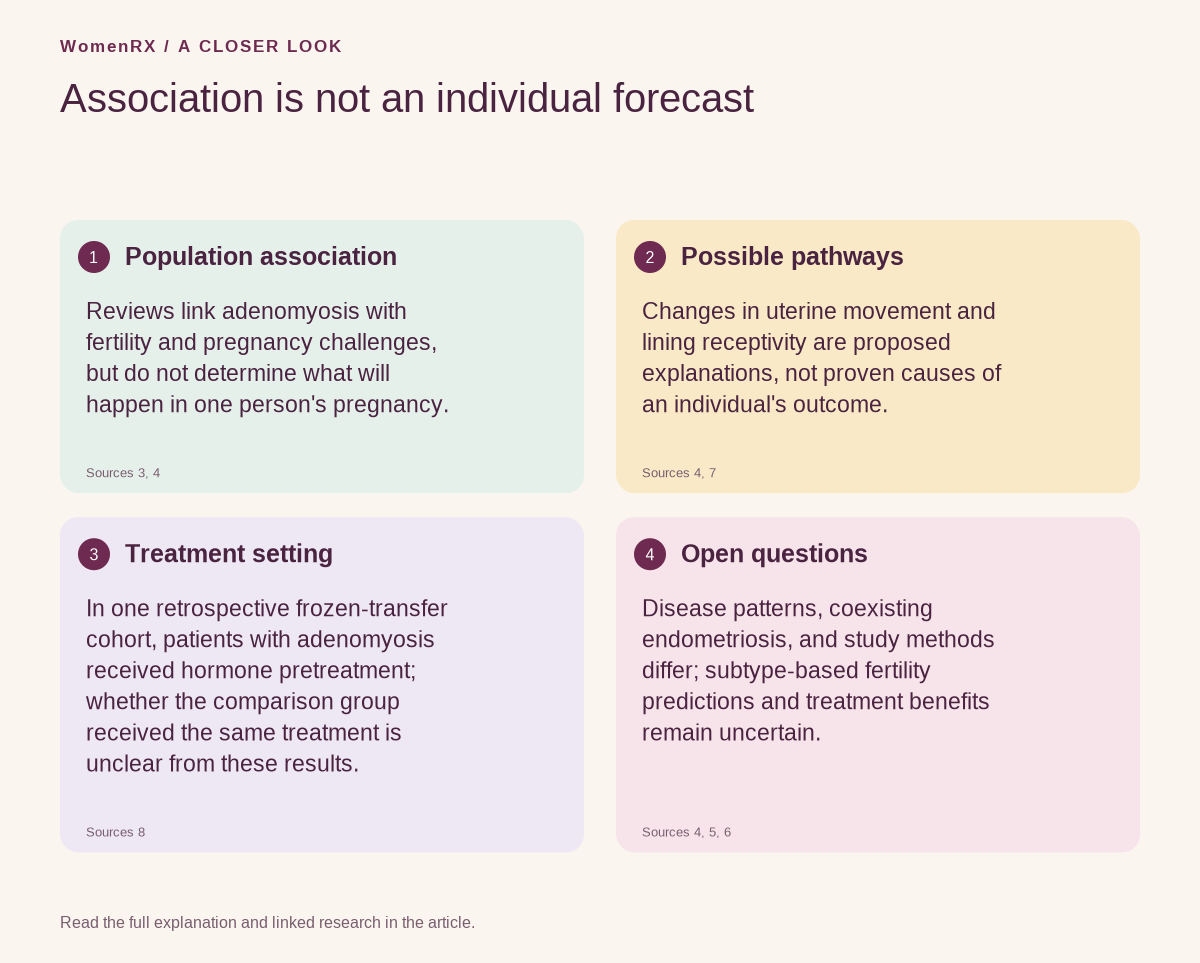
Population association: Reviews link adenomyosis with fertility and pregnancy challenges, but do not determine what will happen in one person's pregnancy.34
Possible pathways: Changes in uterine movement and lining receptivity are proposed explanations, not proven causes of an individual's outcome.47
Treatment setting: In one retrospective frozen-transfer cohort, patients with adenomyosis received hormone pretreatment; whether the comparison group received the same treatment is unclear from these results.8
Open questions: Disease patterns, coexisting endometriosis, and study methods differ; subtype-based fertility predictions and treatment benefits remain uncertain.456
Read the figure as text
Adenomyosis research can inform what to discuss, but different evidence types answer different questions.- Population association: Reviews link adenomyosis with fertility and pregnancy challenges, but do not determine what will happen in one person's pregnancy.34
- Possible pathways: Changes in uterine movement and lining receptivity are proposed explanations, not proven causes of an individual's outcome.47
- Treatment setting: In one retrospective frozen-transfer cohort, patients with adenomyosis received hormone pretreatment; whether the comparison group received the same treatment is unclear from these results.8
- Open questions: Disease patterns, coexisting endometriosis, and study methods differ; subtype-based fertility predictions and treatment benefits remain uncertain.456
More questions, answered
Does adenomyosis mean I’ll need fertility treatment?
No. A diagnosis by itself doesn’t establish that you can’t conceive naturally or that you need treatment. Fertility decisions depend on your circumstances and, when relevant, an assessment of both partners. 2 4
Can I treat adenomyosis while trying to conceive?
Some symptom treatments are hormonal or otherwise intended to manage bleeding and pain rather than support conception. Ask how a proposed option fits your plans and timing; treatment choices should reflect whether you’re trying now or later. 1
Sources you can check
- Adenomyosis - NHSAccessed 2026-09-25Return to first citation
- Infertility | Infertility Treatments | MedlinePlusAccessed 2026-09-25Return to first citation
- Ultrasound signs of adenomyosis in pregnancy and counselling related to infertility and obstetric outcomes.Bertucci E, Ceffa S, Danieli A, Diamanti M, Sileo FG, Tramontano AL, Alboni C, La Marca A. · Minerva obstetrics and gynecology · 2026Return to first citation
- Adenomyosis, Infertility and Maternal-Fetal Outcomes: Diagnostic and Therapeutic Strategies Across Disease Phenotype-A Narrative Review.Martire FG, Costantini E, Ianes I, d'Abate C, Sorrenti G, De Bonis M, Lazzeri L, Zupi E. · Journal of clinical medicine · 2026Return to first citation
- The impact of adenomyosis localization in myometrium on fertility and pregnancy outcomes: a narrative systematic review of the literature.Kolovos G, Kalampokas T, Dedes I, Vlahos N, Mueller M. · Frontiers in reproductive health · 2026Return to first citation
- Conservative Surgical Management of Adenomyosis: Implications for Infertility and Pregnancy Outcomes-A Perspective Review.Ioannidou A, Louis K, Sioutis D, Panagopoulos P, Theofanakis C, Machairiotis N. · Journal of clinical medicine · 2025Return to first citation
- Pregnancy Outcomes With and Without Adenomyomectomy in Infertile Patients With Adenomyosis: A Single-Center Retrospective Study.Hamaguchi F, Kitawaki Y, Ohara T, Miyamoto T, Okunomiya A, Sunada M, Okada Y, Mandai M, Horie A. · The journal of obstetrics and gynaecology research · 2025Return to first citation
- Clinical features and reproductive outcomes after first frozen embryo transfer in patients with different ultrasound-diagnosed adenomyosis subtypes following ultralong gonadotropin-releasing hormone agonist pretreatment: a retrospective cohort study.Jiang J, Li L, Hou X, Zhu Y, Sun H, Huang C, Mei J. · BMC pregnancy and childbirth · 2026Return to first citation