Fibromyalgia and Fertility: What the Evidence Can Tell You
A study abstract gives conflicting signals about past pregnancies and cannot show whether fibromyalgia affects fertility.
One population-based study abstract reports an age-adjusted odds ratio of 0.3 for never having been pregnant among women with fibromyalgia versus women without chronic pain. Yet its conclusion describes pregnancies as rarer among women with fibromyalgia and suggests reduced fertility. The abstract alone cannot resolve that inconsistency or show whether fibromyalgia affects a person’s ability to conceive. The study summary doesn’t provide information about attempts to conceive or time to pregnancy, and it can’t answer questions about pregnancy outcomes. 4
The study described here does not show whether fibromyalgia affects the ability to conceive. It found an association involving women’s past pregnancy histories, but that finding can’t tell you whether the condition affects your chance of conceiving. Questions about pregnancy outcomes and medication safety are separate; the study doesn’t answer them. 4
What one study found, and what it can’t show
A population-based study in Germany surveyed and clinically examined women ages 35 to 74. Of the 653 women examined, 36 met the study’s criteria for fibromyalgia. Compared with women without chronic pain, those with fibromyalgia had a reported age-adjusted odds ratio of 0.3 for never having been pregnant. Yet the abstract’s conclusion describes pregnancies as rarer among women with fibromyalgia and suggests reduced fertility. The abstract alone cannot resolve this inconsistency. 4
These statements about reproductive history are not proof that fibromyalgia changes fertility. “Never pregnant” doesn’t tell us whether someone tried to conceive, wanted a pregnancy, had a partner or circumstances that made pregnancy possible, or experienced difficulty conceiving. The study summary does not provide information about attempts to conceive or time to pregnancy. It therefore can’t estimate an individual’s chances of becoming pregnant. 4
Fertility, pregnancy, and treatment are different questions
Fertility research asks about conceiving. Pregnancy research asks about outcomes after conception. The study described above reports reproductive history, not pregnancy outcomes, so it can’t establish whether fibromyalgia affects miscarriage, birth, or other outcomes. 4
Treatment is another distinct question. Fibromyalgia care may include exercise, talking therapies, and medicines; antidepressants, including amitriptyline, are among the medicines used for some people. That treatment information doesn’t establish whether a particular medicine is appropriate while trying to conceive or during pregnancy. 3
If you’re planning a pregnancy, you could ask the clinician who manages your fibromyalgia whether your current medicines and supplements need review and what symptom-management options might fit your plans. Bring the names of prescription and over-the-counter medicines and supplements you use. Ask about options for managing pain, sleep, and fatigue if a treatment needs to be reconsidered.
Make the preconception conversation specific
You might ask:
- “Does anything in my current treatment need to be reviewed before I try to conceive?”
- “If a medicine should be changed, what are the options for managing my symptoms?”
- “How can we plan for changes in pain, sleep, or fatigue while I’m trying to conceive or pregnant?”
- “Is there another health issue or personal fertility factor we should assess separately from fibromyalgia?”
Fibromyalgia symptoms can vary and may include widespread pain, fatigue, and poor sleep, so a useful plan considers more than pain alone. 12 Exercise, talking therapies, and medicines may each play a role in symptom care, but what works can differ from person to person. 3
The clearest takeaway is that a past-pregnancy association is not a diagnosis of infertility. It’s reasonable to discuss your own fertility concerns and ask whether treatment should be reviewed before trying, while keeping those questions separate from what the study can establish about fibromyalgia itself.
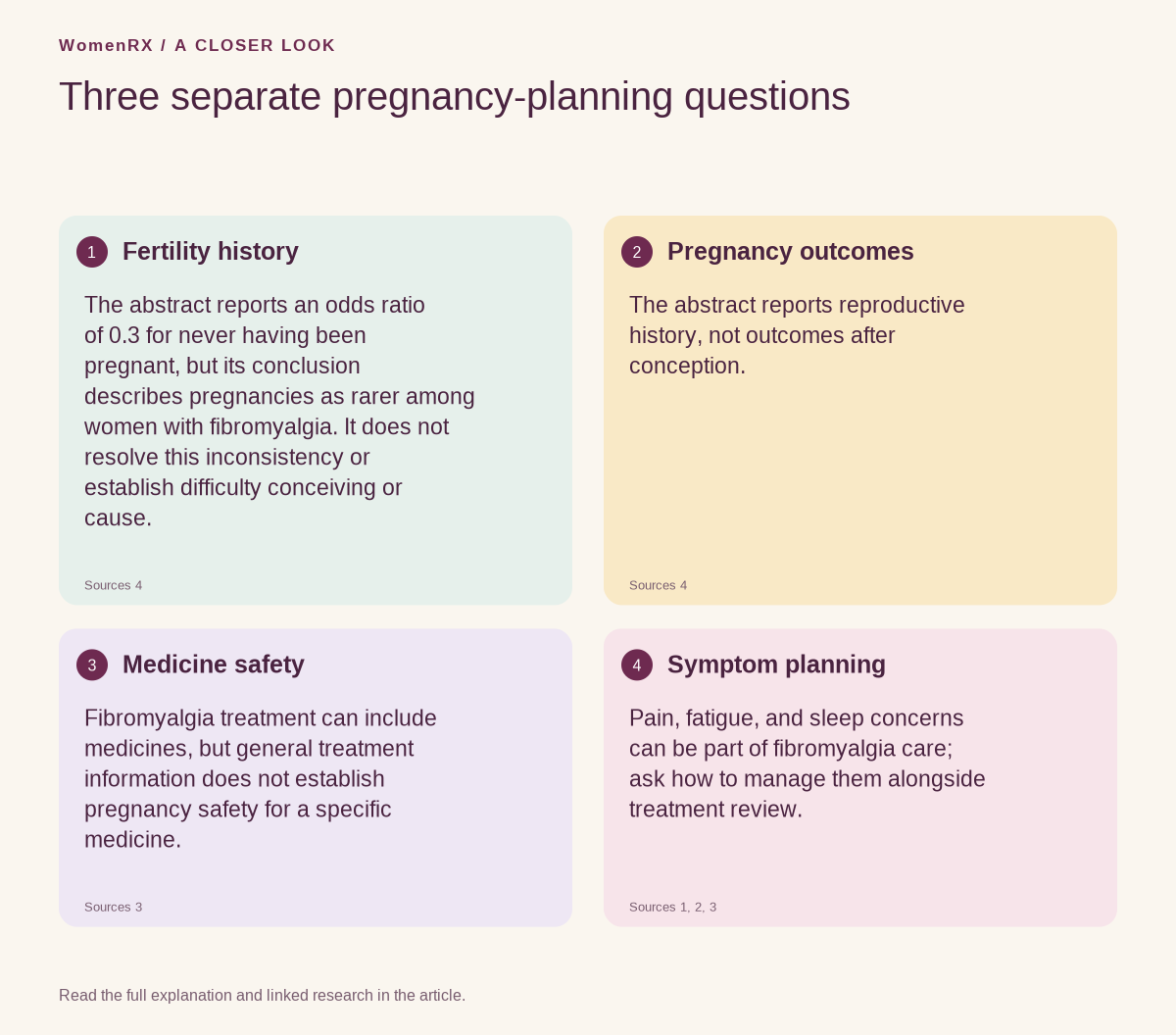
Three separate pregnancy-planning questions
Fertility history: The abstract reports an odds ratio of 0.3 for never having been pregnant, but its conclusion describes pregnancies as rarer among women with fibromyalgia. It does not resolve this inconsistency or establish difficulty conceiving or cause.4
Pregnancy outcomes: The abstract reports reproductive history, not outcomes after conception.4
Medicine safety: Fibromyalgia treatment can include medicines, but general treatment information does not establish pregnancy safety for a specific medicine.3
Symptom planning: Pain, fatigue, and sleep concerns can be part of fibromyalgia care; ask how to manage them alongside treatment review.123
Read the figure as text
A past-pregnancy association, outcomes after conception, and treatment safety are not interchangeable kinds of evidence.- Fertility history: The abstract reports an odds ratio of 0.3 for never having been pregnant, but its conclusion describes pregnancies as rarer among women with fibromyalgia. It does not resolve this inconsistency or establish difficulty conceiving or cause.4
- Pregnancy outcomes: The abstract reports reproductive history, not outcomes after conception.4
- Medicine safety: Fibromyalgia treatment can include medicines, but general treatment information does not establish pregnancy safety for a specific medicine.3
- Symptom planning: Pain, fatigue, and sleep concerns can be part of fibromyalgia care; ask how to manage them alongside treatment review.123
More questions, answered
Does a history of fibromyalgia mean I’ll have trouble getting pregnant?
Not necessarily. The study abstract reports an age-adjusted odds ratio of 0.3 for never having been pregnant among women with fibromyalgia versus controls, but its conclusion describes pregnancies as rarer among women with fibromyalgia. The abstract alone cannot resolve that inconsistency. It doesn’t tell us whether participants tried to conceive or had difficulty conceiving, and it can’t predict an individual’s fertility. 4
Should I change my fibromyalgia medicine before trying to conceive?
General fibromyalgia treatment information doesn’t establish pregnancy safety for a particular medicine. 3 You could ask the clinician managing your treatment whether your medicines and supplements need review and what symptom-management options may fit your plans.
Sources you can check
- Fibromyalgia - NHSAccessed 2026-09-25Return to first citation
- Fibromyalgia - Symptoms - NHSAccessed 2026-09-25Return to first citation
- Fibromyalgia - Treatment - NHSAccessed 2026-09-25Return to first citation
- [Sociodemographic characteristics, risk factors and reproductive history in subjects with fibromyalgia--results of a population-based case-control study].Schochat T, Beckmann C. · Zeitschrift fur Rheumatologie · 2003Return to first citation