Fibromyalgia and Hormones: What the Research Shows
Hormone changes may be worth noticing, but current findings don’t show that fibromyalgia is a sex-hormone disorder.
Small studies of women who were still menstruating found no clear pattern of sex-hormone deficiency in fibromyalgia, and one study found that pain sensitivity did not rise and fall with menstrual-cycle phase. That doesn’t rule out an individual’s cycle-related flares, and it doesn’t settle what happens around menopause. Fibromyalgia itself can fluctuate, so a flare isn’t proof of a hormone imbalance. 1 4 5
What the hormone studies actually found
Two small studies offer a useful, limited check on the idea that fibromyalgia means a measurable sex-hormone imbalance. In one study, researchers compared 19 women with fibromyalgia with 18 healthy women. They took blood on one day of the menstrual cycle; average estradiol and progesterone levels didn’t differ between the groups. That’s evidence against a simple hormone-deficiency explanation in that sample, not proof that every hormone level is normal in every person with fibromyalgia. 5
A second study followed 74 regularly menstruating women with fibromyalgia and 74 age-matched women without it. Researchers assessed hormones and pain sensitivity at three cycle phases. The groups’ hormone patterns were broadly similar, with a small progesterone difference in one phase that remained within the normal range. Women with fibromyalgia had lower pain thresholds and tolerance across the cycle, but their pain sensitivity did not show a clear rise and fall with the phases tested. 4
Taken together, these results don’t support the claim that fibromyalgia is caused by a measurable sex-hormone imbalance. They also don’t show that hormones never affect an individual’s symptoms: the studies were limited, assessed selected hormone measures, and cannot represent everyone’s experience.
A personal flare can still be real
A group study that doesn’t find an average cycle-related change can’t tell you whether your own pain, fatigue, or sleep reliably shifts at a particular point in your cycle. It tests for a pattern across participants under specific study conditions, not every possible symptom or every person’s experience.
That distinction matters because fibromyalgia symptoms can vary over time, and pain, fatigue, and sleep problems are part of the condition. A change that happens near a period may be worth noticing, but timing alone doesn’t establish that a hormone abnormality caused it. 1 2
If you’re trying to make sense of a pattern, you could note when pain, fatigue, or sleep changes occur alongside your bleeding or other cycle symptoms. Use those notes as a description of what happens to you, not as a test for a hormone disorder. The practical question is whether there’s a repeatable pattern worth discussing, not whether one difficult day proves a hormonal cause.
What about perimenopause and menopause?
The menstrual-cycle findings above are from women who were still having regular periods. They don’t answer whether fibromyalgia symptoms change during perimenopause or after menopause. The research summarized here doesn’t establish that menopause worsens fibromyalgia, or that it improves it. Avoid applying results from cycling women to a different life stage.
Menopause-related symptoms are a separate consideration. The North American Menopause Society’s position statement identifies hormone therapy as an option for appropriate women with bothersome hot flashes and other vasomotor symptoms, and for prevention of bone loss. Those are specific menopause-related reasons to discuss treatment; they aren’t evidence that hormone therapy treats fibromyalgia. 3
So if new hot flashes or other bothersome menopause symptoms appear alongside familiar widespread pain, it may help to distinguish the two sets of concerns. Whether menopause treatment makes sense depends on the menopause symptoms and an individual assessment of benefits and risks, not on fibromyalgia alone. 3
What to take away
Fibromyalgia isn’t shown by these studies to be a sex-hormone deficiency, and the available cycle research doesn’t find a consistent phase-linked change in pain sensitivity. Your symptoms can still have a personal pattern, and the findings don’t settle the menopause question. Treat fibromyalgia and menopause symptoms as potentially overlapping but distinct concerns, rather than assuming one explains the other.
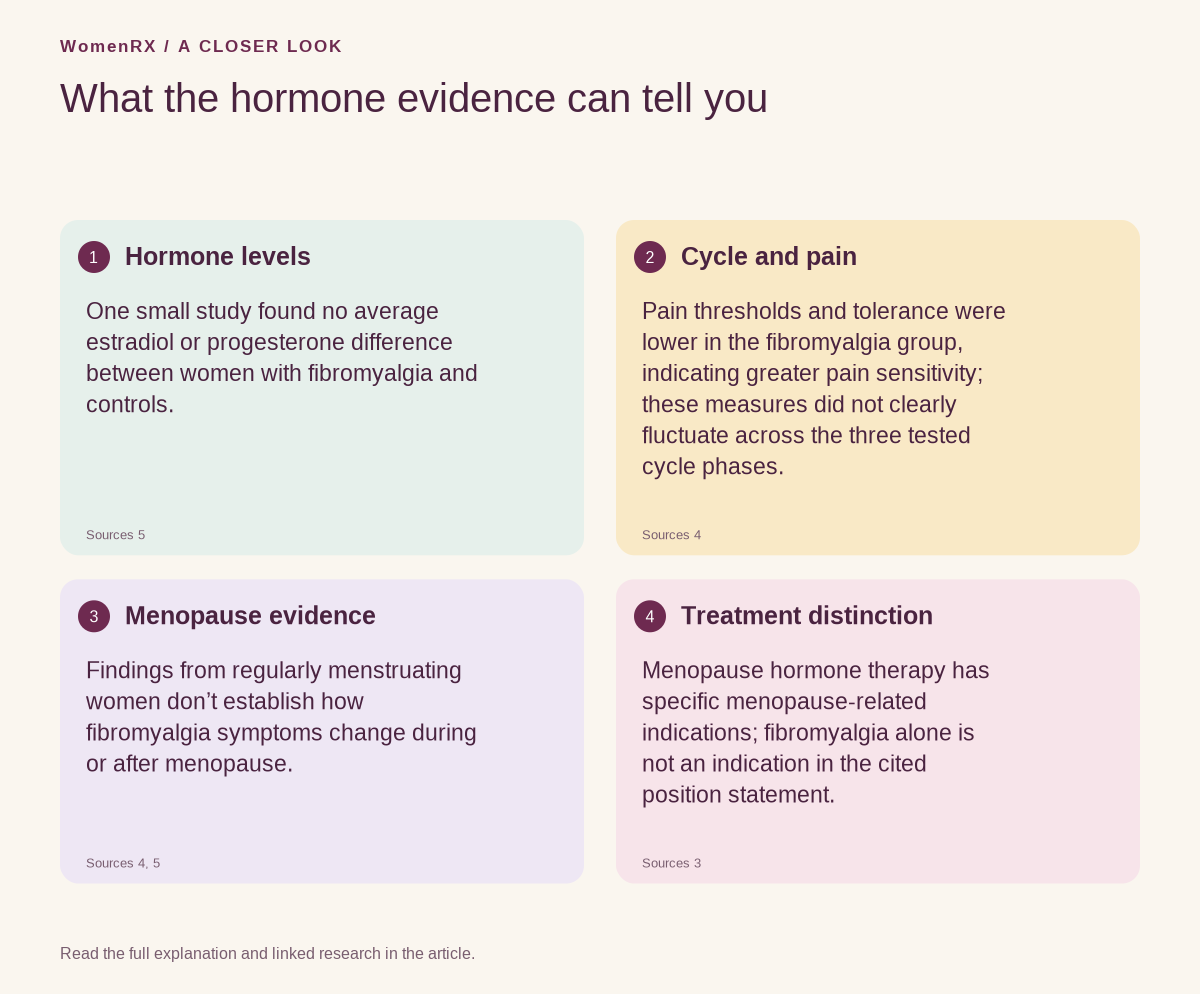
What the hormone evidence can tell you
Hormone levels: One small study found no average estradiol or progesterone difference between women with fibromyalgia and controls.5
Cycle and pain: Pain thresholds and tolerance were lower in the fibromyalgia group, indicating greater pain sensitivity; these measures did not clearly fluctuate across the three tested cycle phases.4
Menopause evidence: Findings from regularly menstruating women don’t establish how fibromyalgia symptoms change during or after menopause.45
Treatment distinction: Menopause hormone therapy has specific menopause-related indications; fibromyalgia alone is not an indication in the cited position statement.3
Read the figure as text
Separate findings from menstruating women, what remains unclear around menopause, and the distinct reasons menopause treatment may be considered.- Hormone levels: One small study found no average estradiol or progesterone difference between women with fibromyalgia and controls.5
- Cycle and pain: Pain thresholds and tolerance were lower in the fibromyalgia group, indicating greater pain sensitivity; these measures did not clearly fluctuate across the three tested cycle phases.4
- Menopause evidence: Findings from regularly menstruating women don’t establish how fibromyalgia symptoms change during or after menopause.45
- Treatment distinction: Menopause hormone therapy has specific menopause-related indications; fibromyalgia alone is not an indication in the cited position statement.3
More questions, answered
Does fibromyalgia mean my estrogen or progesterone is low?
Not based on the small studies summarized here. One study found no difference in average estradiol or progesterone between women with fibromyalgia and controls, while another found cycle-related levels broadly similar between groups. Those results don’t establish every individual’s hormone status. 4 5
Does hormone therapy treat fibromyalgia?
The menopause position statement supports hormone therapy for specific menopause-related indications, including bothersome vasomotor symptoms and prevention of bone loss. It doesn’t identify fibromyalgia itself as an indication. 3
Sources you can check
- Fibromyalgia - NHSAccessed 2026-09-25Return to first citation
- Fibromyalgia - Symptoms - NHSAccessed 2026-09-25Return to first citation
- The 2022 hormone therapy position statement of The North American Menopause Society.“The 2022 Hormone Therapy Position Statement of The North American Menopause Society” Advisory Panel. · Menopause (New York, N.Y.) · 2022Return to first citation
- Sex hormones and pain in regularly menstruating women with fibromyalgia syndrome.Okifuji A, Turk DC. · The journal of pain · 2006Return to first citation
- Normal profile of sex hormones in women with primary fibromyalgia.Samborski W, Sobieska M, Pieta P, Drews K, Brzosko M. · Annales Academiae Medicae Stetinensis · 2005Return to first citation