How Clinicians Diagnose Fibromyalgia
Fibromyalgia is assessed by the pattern of pain and other symptoms, with tests chosen to check specific clues rather than to confirm the condition.
There isn’t a single blood test or scan that confirms fibromyalgia. Clinicians look at how widespread and persistent your pain is, how symptoms such as fatigue, unrefreshing sleep, and concentration problems fit together, and what a physical exam shows. They may order targeted tests when your history or exam suggests another or additional condition; fibromyalgia can coexist with other diagnoses. 1 2 4
The diagnosis comes from a pattern, not one test
Fibromyalgia can involve pain across the body along with fatigue, stiffness, sleep that doesn’t feel restorative, and difficulty concentrating or remembering things. Symptoms can vary over time and from person to person. A clinician considers how these symptoms fit together and how long they’ve been affecting you, rather than relying on one isolated complaint. 1 2 3
There’s no definitive biomarker for fibromyalgia. That doesn’t mean the symptoms are imaginary, or that a clinician has to rule out every possible illness before considering the diagnosis. It means diagnosis depends on the symptom pattern, an assessment of your health, and criteria that help describe that pattern. 4
What symptom criteria look at
The 2016 American College of Rheumatology (ACR) criteria combine a measure of pain distribution, called the Widespread Pain Index, with a measure of symptom severity. They also require pain across multiple body regions and clarify that fibromyalgia can be diagnosed alongside other conditions. These are useful criteria, but they are not the only framework or a complete diagnostic system on their own; the 2026 review also describes a separate AAPT 2019 framework. 4
Older criteria relied more heavily on an examination for tender points. Newer approaches put more emphasis on the areas where you feel pain and on symptoms such as fatigue, sleep problems, and cognitive difficulties. The shift makes assessment less dependent on a particular tender-point exam, but criteria can still miss or misclassify people. 4
A clinician may ask where you hurt, how your symptoms have changed, and how sleep, energy, or concentration are affected. It can help to describe a concrete example, such as pain in several areas on most days alongside waking unrefreshed, rather than only saying you feel sore or tired. This gives the clinician a clearer picture of how symptoms occur together. 2 3
Why a normal test doesn’t rule it in or out
Routine blood work or imaging cannot, by itself, establish fibromyalgia. Tests may still be useful for a different reason: your symptoms or exam may point toward another explanation that needs attention. The goal is a focused assessment, not an endless search for every conceivable cause. 4
For example, the 2026 review identifies findings such as objective joint inflammation, a neurologic deficit, anemia, thyroid disease, muscle disease, or marked sleep-apnea risk as reasons not to dismiss other possibilities simply because someone meets fibromyalgia criteria. That list is not a checklist of tests everyone needs; what, if anything, to investigate depends on the particular history and exam. 4
A normal result can therefore answer a specific question without acting as a fibromyalgia test. And a person can have fibromyalgia plus another condition. Recognizing one diagnosis shouldn’t prevent a clinician from evaluating a new or distinct symptom pattern. 4
The assessment should leave room for overlap
Widespread pain is not unique to fibromyalgia. Other musculoskeletal conditions can cause pain in overlapping areas, and different conditions may occur together. In a small, retrospective study at one Japanese university hospital, researchers described diagnostic confusion between fibromyalgia and myofascial pain syndrome, a condition involving regional muscle pain. Because the study was small and based on selected referrals, it cannot tell us how often this happens generally; it does illustrate why the physical exam and the details of the pain pattern can matter. 5
Fibromyalgia is reported across genders and is described as more common in women than men. A systematic review notes that sex-sensitive under-recognition remains a concern, though the criteria have not resolved it. Your symptoms deserve consideration based on their pattern, not on assumptions about who gets fibromyalgia or how someone with it is expected to look. 1 4
A useful way to describe what’s happening
Before an evaluation, you might jot down a few representative details: the areas affected, whether pain is widespread or concentrated in particular places, how sleep and fatigue feel, and which symptoms interfere most with daily life. This isn’t a diagnostic score; it’s a way to make the pattern easier to explain. Be sure to mention symptoms that feel new or clearly different from your usual experience, since those details can change what else needs consideration. 2 3 4
The main takeaway: fibromyalgia is assessed through a recognizable symptom pattern, not confirmed by a single test and not reached only after every other condition has been excluded. A thoughtful evaluation can consider fibromyalgia while still checking for explanations that fit specific clues, including conditions that may coexist. 4
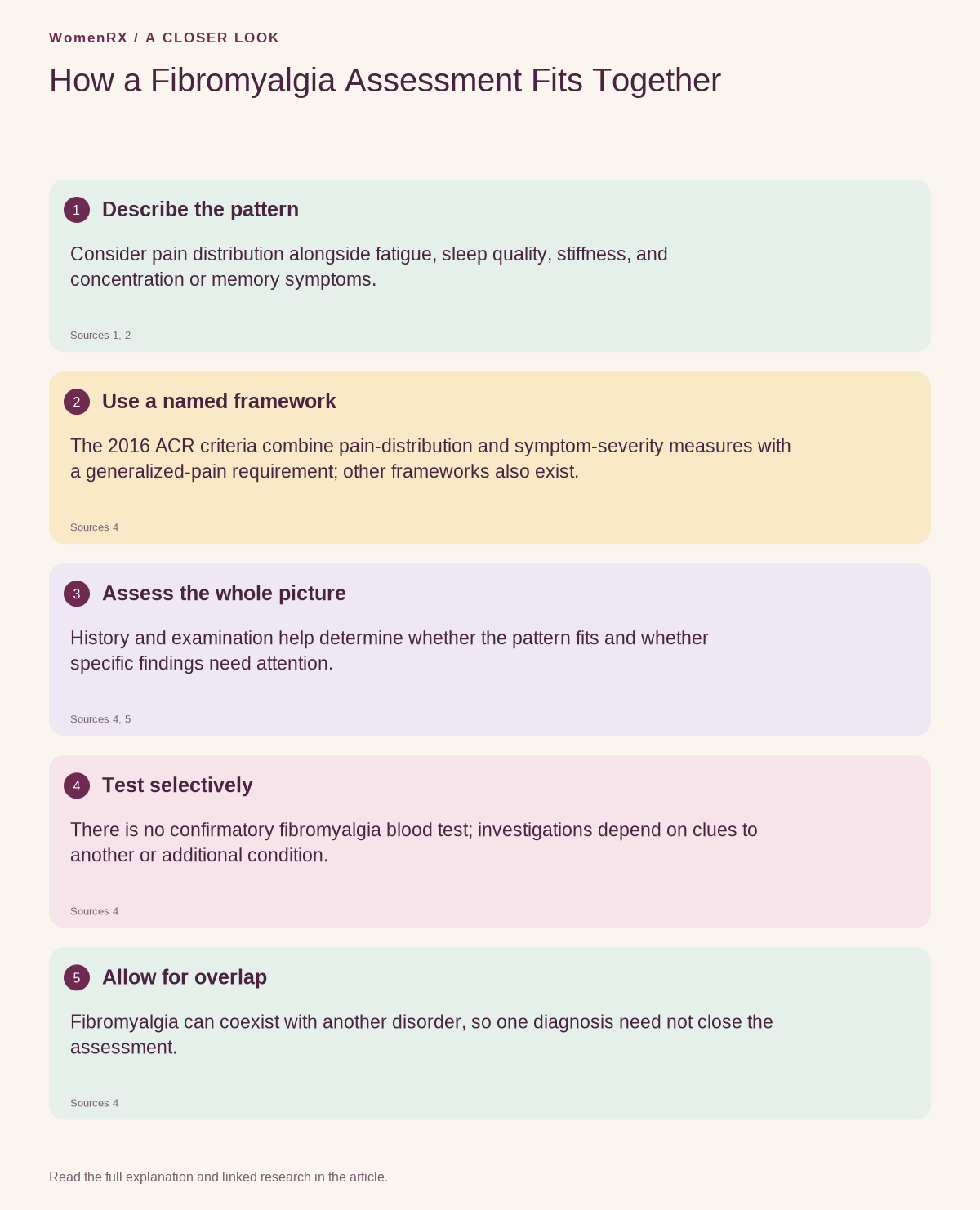
How a Fibromyalgia Assessment Fits Together
Describe the pattern: Consider pain distribution alongside fatigue, sleep quality, stiffness, and concentration or memory symptoms.12
Use a named framework: The 2016 ACR criteria combine pain-distribution and symptom-severity measures with a generalized-pain requirement; other frameworks also exist.4
Assess the whole picture: History and examination help determine whether the pattern fits and whether specific findings need attention.45
Test selectively: There is no confirmatory fibromyalgia blood test; investigations depend on clues to another or additional condition.4
Allow for overlap: Fibromyalgia can coexist with another disorder, so one diagnosis need not close the assessment.4
Read the figure as text
A clinician connects the symptom pattern with exam findings, then considers targeted evaluation when particular clues point elsewhere or suggest a coexisting condition.- Describe the pattern: Consider pain distribution alongside fatigue, sleep quality, stiffness, and concentration or memory symptoms.12
- Use a named framework: The 2016 ACR criteria combine pain-distribution and symptom-severity measures with a generalized-pain requirement; other frameworks also exist.4
- Assess the whole picture: History and examination help determine whether the pattern fits and whether specific findings need attention.45
- Test selectively: There is no confirmatory fibromyalgia blood test; investigations depend on clues to another or additional condition.4
- Allow for overlap: Fibromyalgia can coexist with another disorder, so one diagnosis need not close the assessment.4
More questions, answered
Do you still need a tender-point exam?
Older criteria relied on tender-point examination, while newer criteria emphasize pain distribution and associated symptoms. A tender-point exam is not the defining feature of the newer approach. 4
Can fibromyalgia be diagnosed if I have another condition?
Yes. The 2016 criteria clarify that fibromyalgia can coexist with other disorders, so one diagnosis does not automatically rule out the other. 4
Sources you can check
- Fibromyalgia - NHSAccessed 2026-09-25Return to first citation
- Fibromyalgia - Symptoms - NHSAccessed 2026-09-25Return to first citation
- Pain | MedlinePlusAccessed 2026-09-25Return to first citation
- Why Fibromyalgia Criteria Keep Changing: A Systematic Review of Misclassification, Measurement, and Diagnostic Spillover.Gür A. · Archives of rheumatology · 2026Return to first citation
- Proportion of Myofascial Pain Syndrome Among Patients with Diagnosed or Suspected Fibromyalgia: A Pilot Cross-Sectional Study.Hadano T, Sugiyama Y, Yoshida H. · Journal of pain research · 2026Return to first citation