How TSH and Free T4 Help Diagnose Hypothyroidism
TSH and free T4 work best as a pair: together, they help distinguish low thyroid hormone from a milder or less typical pattern.
Outside pregnancy, TSH is usually the first blood test for suspected primary hypothyroidism. If it’s high, free T4 helps clarify the result: high TSH with low free T4 fits overt primary hypothyroidism, while high TSH with normal free T4 is called subclinical hypothyroidism. An abnormal result may need follow-up. Pregnancy changes testing considerations, and after birth, follow-up depends in part on whether you take levothyroxine. 4 5 6
Why clinicians start with TSH
The thyroid makes T4, and the pituitary gland releases thyroid-stimulating hormone (TSH) to help regulate thyroid hormone production. When the thyroid is underproducing hormone, TSH often rises as the body signals for more. That’s why TSH is usually the first test for suspected primary hypothyroidism outside pregnancy. Some labs add free T4 when TSH is outside the reference range. 4
Free T4 measures the portion of thyroxine that isn’t bound to blood proteins. Looking at it alongside TSH helps show whether an abnormal TSH is accompanied by low thyroid hormone. 4 6
Read the pattern, not one result alone
- High TSH, low free T4: This pattern supports overt primary hypothyroidism, meaning the thyroid gland is not making enough hormone. 4
- High TSH, normal free T4: This is called subclinical hypothyroidism. Some people have nonspecific symptoms; others have none. A mildly abnormal result may not persist, so follow-up can matter before treating a single result as the full story. 4
- TSH and free T4 both within their reference ranges: These results don’t show the usual blood-test pattern of primary hypothyroidism. Symptoms still deserve attention, but symptoms alone can’t establish this diagnosis. 4 5
- Low free T4 without a high TSH: This is not the usual pattern of primary hypothyroidism. In uncommon cases, a problem involving the pituitary or hypothalamus can cause hypothyroidism, and TSH alone may not identify it. 4
A lab’s reference range is useful, but TSH and free T4 are interpreted together, alongside the clinical context. 4
An abnormal result can need follow-up
One abnormal TSH doesn’t always settle the question. Some people whose tests initially show subclinical hypothyroidism later have TSH levels return to normal without treatment. A clinician may consider the result’s degree, free T4, symptoms, and whether repeat testing is appropriate rather than relying on one reading. 4
TSH and free T4 also help monitor someone taking levothyroxine. If you already use it, make sure the person interpreting your results knows that, since a result may be part of checking treatment as well as assessing thyroid function. 1 3
Mention supplements, too. Biotin can interfere with some thyroid blood-test methods and lead to inaccurate TSH or T4 results. Tell the clinician or lab that you take it; they can advise whether it affects the timing or interpretation of your test. 6
Diagnosis and cause are different questions
TSH and free T4 assess thyroid function. They don’t, by themselves, explain why it has changed. If an autoimmune cause such as Hashimoto’s thyroiditis is being considered, a thyroid antibody test may help. It answers a different question from TSH and free T4, and it isn’t automatically needed for every abnormal result. 2 4
TSH and thyroid hormone levels are measured with blood tests. Imaging tests address other thyroid questions, such as evaluating a nodule. 2
Pregnancy and levothyroxine testing
Pregnancy needs separate consideration when interpreting thyroid tests, including tests ordered for suspected hypothyroidism. If you take levothyroxine, you may need more blood tests during pregnancy to check thyroid hormone levels and whether your dose is right. 4 1 6
After birth: treatment follow-up or a new thyroid change
If you were taking levothyroxine before pregnancy, a dose increased during pregnancy may need to change after delivery. US prescribing information describes returning to the pre-pregnancy dose after delivery and checking TSH 6 to 8 weeks after a dose change. That’s follow-up for someone already being treated, not a testing schedule for everyone who has given birth. Make a postpartum dose and testing plan with the clinician managing your thyroid medicine. 6
A new thyroid problem after birth is a different question. Postpartum thyroiditis can first raise thyroid hormone levels and later leave the thyroid underactive. If thyroid symptoms develop after delivery, when they began and any earlier thyroid results can help put new TSH and free T4 results in context. 5
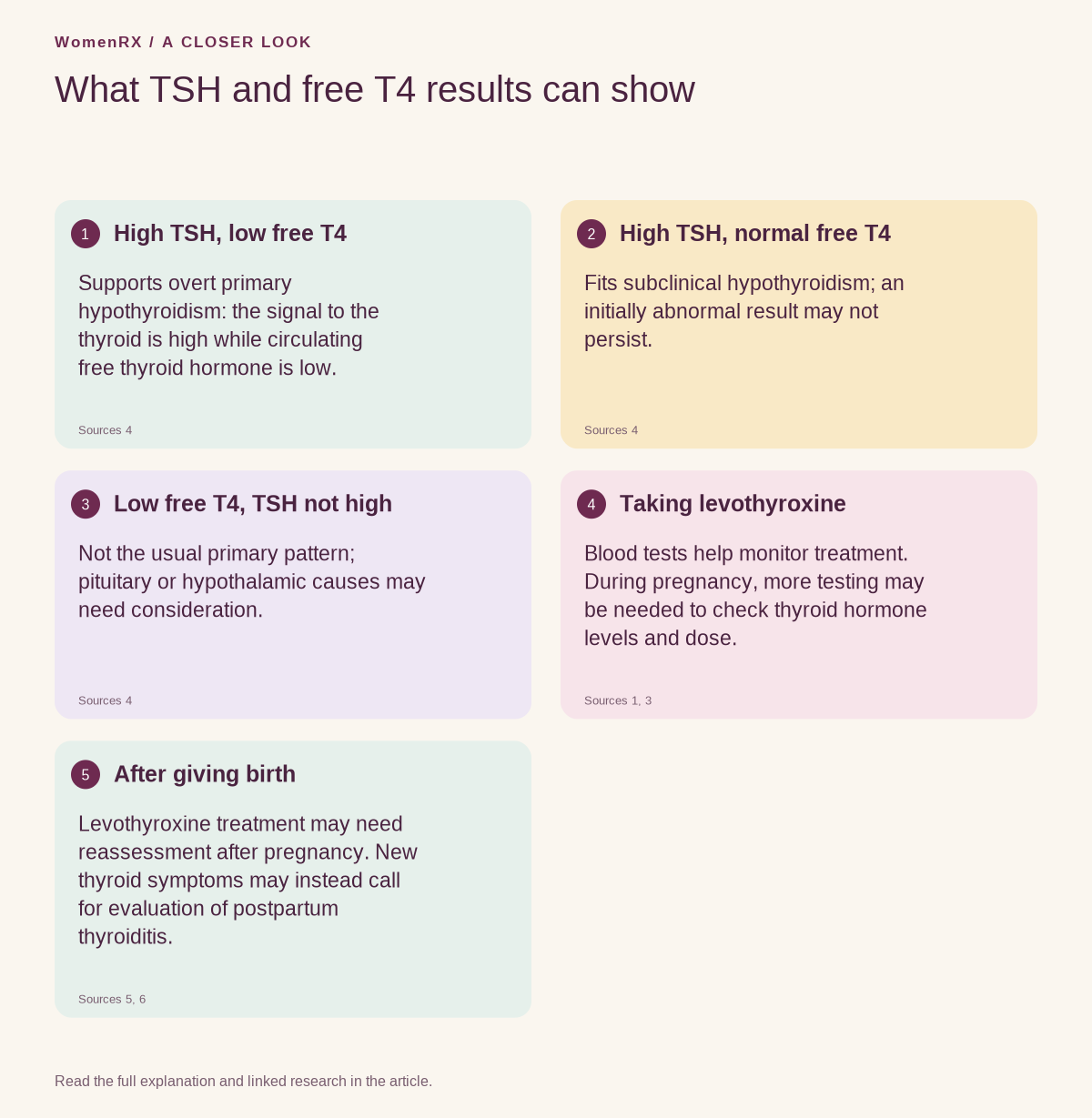
What TSH and free T4 results can show
High TSH, low free T4: Supports overt primary hypothyroidism: the signal to the thyroid is high while circulating free thyroid hormone is low.4
High TSH, normal free T4: Fits subclinical hypothyroidism; an initially abnormal result may not persist.4
Low free T4, TSH not high: Not the usual primary pattern; pituitary or hypothalamic causes may need consideration.4
Taking levothyroxine: Blood tests help monitor treatment. During pregnancy, more testing may be needed to check thyroid hormone levels and dose.13
After giving birth: Levothyroxine treatment may need reassessment after pregnancy. New thyroid symptoms may instead call for evaluation of postpartum thyroiditis.56
Read the figure as text
These patterns show what the two tests contribute to diagnosis. Pregnancy and the period after birth add context to how results are followed up.- High TSH, low free T4: Supports overt primary hypothyroidism: the signal to the thyroid is high while circulating free thyroid hormone is low.4
- High TSH, normal free T4: Fits subclinical hypothyroidism; an initially abnormal result may not persist.4
- Low free T4, TSH not high: Not the usual primary pattern; pituitary or hypothalamic causes may need consideration.4
- Taking levothyroxine: Blood tests help monitor treatment. During pregnancy, more testing may be needed to check thyroid hormone levels and dose.13
- After giving birth: Levothyroxine treatment may need reassessment after pregnancy. New thyroid symptoms may instead call for evaluation of postpartum thyroiditis.56
More questions, answered
Do thyroid antibodies diagnose hypothyroidism?
Antibody tests can help identify an autoimmune cause, such as Hashimoto’s thyroiditis. TSH and free T4 assess thyroid function, so antibodies answer a related but different question. 2 4
Can biotin affect thyroid test results?
Yes. Biotin can interfere with some tests for TSH and thyroid hormones, producing inaccurate results. Tell the clinician or lab you take it so they can advise you about testing. 6
Sources you can check
- Levothyroxine: a medicine for an underactive thyroid (hypothyroidism) - NHSAccessed 2026-09-25Return to first citation
- Thyroid Tests: MedlinePlusAccessed 2026-09-25Return to first citation
- LEVOTHYROXINE SODIUM TABLET [CARDINAL HEALTH 107, LLC] | US prescribing information and patient instructionsAccessed 2026-09-25Return to first citation
- Thyroid testing in primary hypothyroidism.Ambasta A, Grenet G, Otte J, Thompson W, Bassett K, Perry T. · African journal of primary health care & family medicine · 2025Return to first citation
- Hypothyroidism (Underactive Thyroid) - NIDDKAccessed 2026-09-25Return to first citation
- LEVOTHYROXINE SODIUM TABLET [A-S MEDICATION SOLUTIONS] | US prescribing information and patient instructionsAccessed 2026-09-25Return to first citation