Hypothyroidism and Hot Flashes: What the Symptoms Can Tell You
Underactive and overactive thyroid conditions can feel different, but flushing alone can’t tell you whether your thyroid or menopause is the cause.
Hypothyroidism is associated with cold intolerance, while excess thyroid hormone can cause heat intolerance, palpitations, or tremor. Those clues can help frame a conversation, but they don’t diagnose the cause of flushing. During perimenopause or after menopause, vasomotor symptoms are another possibility. Thyroid blood tests, interpreted with your symptoms and medication history, are more useful than symptoms alone. 2 4 6
The short answer: don’t assume an underactive thyroid explains flushing
A thyroid diagnosis by itself can’t explain why you’re having new episodes of warmth or sweating. Hypothyroidism is associated with cold intolerance; excess thyroid hormone can be associated with heat intolerance, palpitations, tremor, and sleep disturbance. These symptom patterns can point to different questions, but they aren’t a reliable way to identify the cause on their own. 4
Menopause is also a possible source. Vasomotor symptoms, including hot flashes, are common concerns in menopause, and hormone therapy is an effective treatment for bothersome vasomotor symptoms. That doesn’t mean every flush is a menopause symptom, or that a thyroid condition is responsible. More than one factor may be worth considering. 6
What thyroid tests can, and can’t, show
A thyroid function test commonly includes thyroid-stimulating hormone (TSH) and thyroid hormones such as T4; some evaluations also measure T3. TSH is produced by the pituitary gland and helps regulate thyroid hormone production. A low TSH alongside high T3 and/or T4 usually indicates an overactive thyroid. Test ranges can vary with the laboratory and other factors, so a result needs interpretation in context. 2 3
A result can help show whether thyroid hormone levels are outside the expected range. It cannot, by itself, prove that a particular episode of flushing came from the thyroid rather than menopause or another cause. Symptoms and test results are considered together. 2
If you take levothyroxine, don’t change the amount based on a hot flash or a single symptom. The dose is checked with blood tests. Also mention any recent changes to menopause hormone therapy: in a small randomized trial of 20 menopausal women with hypothyroidism, oral estradiol changed thyroid measures, and 3 of the 10 women in that group had TSH changes considered clinically important and needed a levothyroxine dose increase. This small study is a reason to include treatment changes in the discussion, not a reason to adjust medication yourself. 1 5
Take a useful snapshot before your appointment
You don’t need a perfect symptom diary. A few specific details can make it easier to discuss what’s changed and whether thyroid testing or follow-up is relevant:
- When the episodes began, how often they happen, and whether they interrupt sleep.
- What you notice during an episode, such as warmth, sweating, a racing heartbeat, or tremor. These details describe the experience; they don’t identify its cause. 4
- Whether you’re still having menstrual cycles, or when your last period was, if applicable.
- Your levothyroxine dose and any recent changes to thyroid or menopause treatment.
- The date and results of your most recent thyroid tests, if you have them. Regular blood tests are used to check levothyroxine treatment. 1
If the episodes are new or recurring, share that snapshot with the clinician who manages your thyroid or menopause care. Ask how your TSH and free T4 fit with your symptoms and whether the timing of any medication changes matters. The goal is to review the pattern and the test results together, rather than treating flushing as proof that the thyroid dose needs changing.
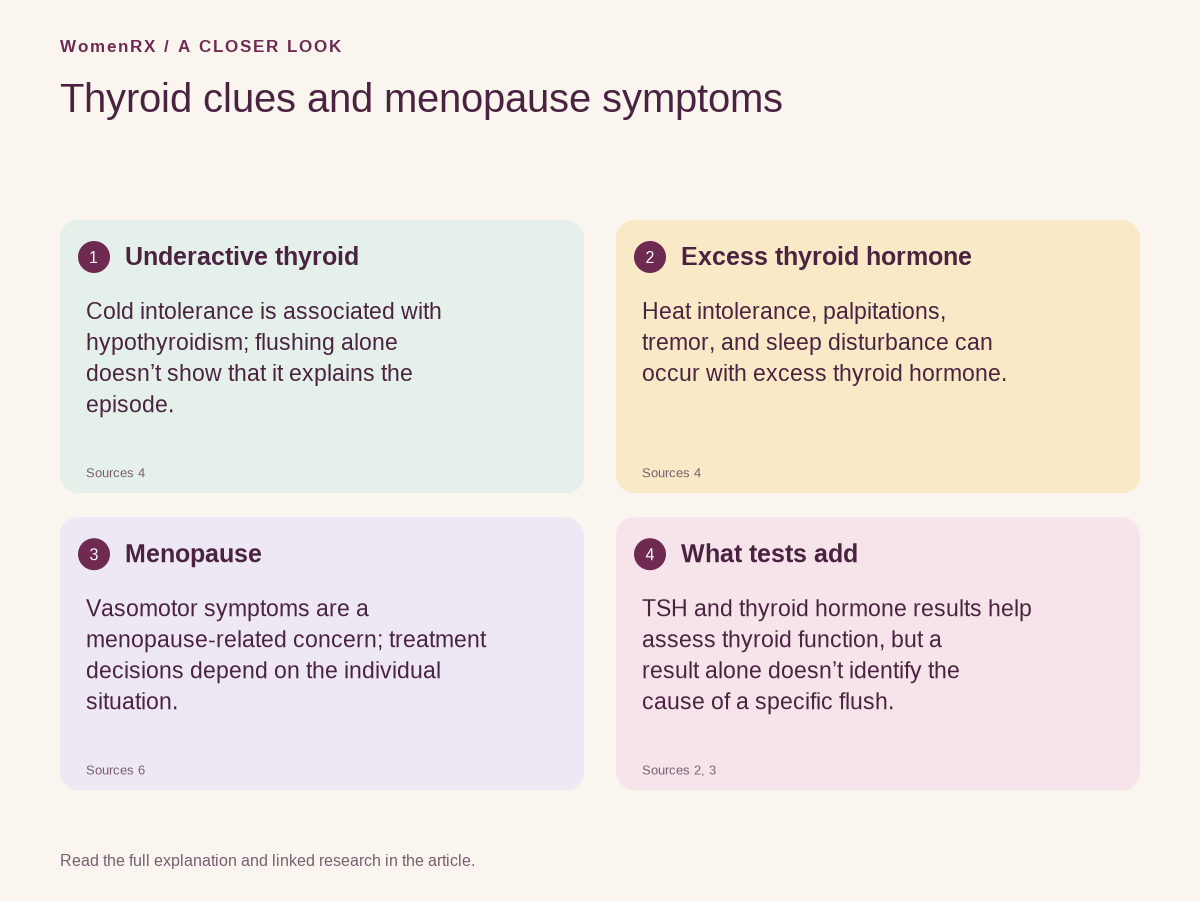
Thyroid clues and menopause symptoms
Underactive thyroid: Cold intolerance is associated with hypothyroidism; flushing alone doesn’t show that it explains the episode.4
Excess thyroid hormone: Heat intolerance, palpitations, tremor, and sleep disturbance can occur with excess thyroid hormone.4
Menopause: Vasomotor symptoms are a menopause-related concern; treatment decisions depend on the individual situation.6
What tests add: TSH and thyroid hormone results help assess thyroid function, but a result alone doesn’t identify the cause of a specific flush.23
Read the figure as text
These patterns can help organize a conversation, but symptoms overlap and don’t establish the cause of a flushing episode.- Underactive thyroid: Cold intolerance is associated with hypothyroidism; flushing alone doesn’t show that it explains the episode.4
- Excess thyroid hormone: Heat intolerance, palpitations, tremor, and sleep disturbance can occur with excess thyroid hormone.4
- Menopause: Vasomotor symptoms are a menopause-related concern; treatment decisions depend on the individual situation.6
- What tests add: TSH and thyroid hormone results help assess thyroid function, but a result alone doesn’t identify the cause of a specific flush.23
More questions, answered
Can hot flashes tell me whether my thyroid is overactive?
No. Heat intolerance can occur with excess thyroid hormone, but a flush alone doesn’t establish that your thyroid is overactive. Blood tests, including TSH and thyroid hormone measurements, help assess thyroid function. 2 4
Sources you can check
- Levothyroxine: a medicine for an underactive thyroid (hypothyroidism) - NHSAccessed 2026-09-25Return to first citation
- Overactive thyroid (hyperthyroidism) - Diagnosis - NHSAccessed 2026-09-25Return to first citation
- Thyroid Tests: MedlinePlusAccessed 2026-09-25Return to first citation
- The Health and Productivity Impact of Thyroid Diseases Among Working-Age Women in Western Europe.Hu H, Wang Y, Yu Z, Li K, Yang F. · International journal of women's health · 2026Return to first citation
- Effects of oral versus transdermal estradiol plus micronized progesterone on thyroid hormones, hepatic proteins, lipids, and quality of life in menopausal women with hypothyroidism: a clinical trial.Kaminski J, Junior CM, Pavesi H, Drobrzenski B, Amaral GMD. · Menopause (New York, N.Y.) · 2021Return to first citation
- The 2022 hormone therapy position statement of The North American Menopause Society.“The 2022 Hormone Therapy Position Statement of The North American Menopause Society” Advisory Panel. · Menopause (New York, N.Y.) · 2022Return to first citation