Thyroid Problems and Weight: What Testing Can Tell You
Weight change alone can’t identify a thyroid problem; TSH and thyroid hormone tests help show whether your thyroid is underactive.
When weight change raises a thyroid concern, thyroid-stimulating hormone (TSH) is usually the first blood test. High TSH with free T4 in range fits a subclinical pattern; low free T4 calls for a different interpretation because thyroid hormone is no longer in range. 2 4 Treating hypothyroidism replaces thyroid hormone, but average weight change after treatment is modest. 3 5
What the first test can tell you
Thyroid hormones affect weight, but weight change alone can’t tell you whether your thyroid is underactive. Thyroid-stimulating hormone (TSH) is commonly the first blood test used to check thyroid function. Additional blood tests can measure thyroid hormones such as T4 and T3. 2
A TSH result is interpreted against the lab’s reference range and alongside other results and circumstances. An elevated TSH with free T4 still in range is the biochemical pattern called subclinical hypothyroidism. A high TSH alone doesn’t show whether free T4 remains in range. 2 4
An isolated TSH elevation can be temporary. Follow-up testing can help show whether it was an isolated result or part of a persistent pattern, without treating one number as the whole treatment decision. Subclinical hypothyroidism is more prevalent among women, but that doesn’t mean a weight change in a woman is necessarily thyroid-related. 4
Thyroid antibodies can help identify autoimmune thyroid disorders. They don’t measure weight change, and the antibody result is one part of interpreting what is happening with the thyroid. 2
When results don’t show that pattern
High TSH with low free T4 is different from high TSH with free T4 still in range: it does not fit the definition of subclinical hypothyroidism. Because hypothyroidism means the thyroid isn’t making enough hormone to meet the body’s needs, a low free T4 calls for clinical interpretation rather than a treatment decision based on TSH alone. 4 5
If TSH is not elevated, the tests haven’t shown an elevated-TSH pattern of underactive thyroid. They also don’t identify another reason for weight change. Thyroid hormones affect weight and other body functions, but a thyroid test is not a general investigation of every possible cause. 2 4
For example, a change on the scale can reflect water as well as fat or muscle. Diet, activity, stress, and sleep can also affect weight. An unexpected weight change is worth discussing rather than assuming it must be thyroid-related; a sudden gain can sometimes signal another medical problem. 6
That distinction can keep the next conversation focused: ask what the TSH and free T4 results show together, whether a high TSH needs follow-up testing, and what else might explain the change if the thyroid pattern does not fit. An ultrasound or nuclear medicine test is not simply another weight test; imaging is used for specific questions, such as evaluating nodules or investigating some causes of an overactive thyroid. 2 4
What treatment can, and can’t, change
Levothyroxine is used to treat an underactive thyroid. Blood tests help check whether the prescribed dose is appropriate. After treatment begins or a dose changes, follow-up testing shows whether thyroid hormone replacement needs adjusting; for adults with primary hypothyroidism, TSH is generally checked about 6 to 8 weeks after a dose change. 1 5 7
Treatment can affect weight, but the expected change is limited. A 2026 systematic review pooled results from 23 studies including 763 adults treated with levothyroxine who achieved normal thyroid function. Average weight fell by about 1.39 kg from before treatment, with reductions more evident in studies of overt hypothyroidism than subclinical hypothyroidism. These were adult results, and the review did not report a women-only estimate. They do not promise a particular change for an individual. 3
The practical point is that levothyroxine is treatment for an underactive thyroid, not a dependable weight-loss method. If thyroid tests normalize but weight remains a concern, that does not by itself show that the medication should be increased; dose monitoring is based on blood tests, not weight loss goals. Too much thyroid hormone can harm the heart and bones. 5 7
Pregnancy and the months after birth
If you’re pregnant and already take levothyroxine, tell the clinician managing it. Levothyroxine can be used during pregnancy when needed, and additional blood tests may be needed to check thyroid hormone levels and the dose. Untreated hypothyroidism during pregnancy can affect both mother and baby. 1 5
After birth, thyroiditis can develop and may move from a period of excess thyroid hormone to an underactive thyroid. That’s one reason a new thyroid concern postpartum deserves testing rather than an assumption that weight change explains it. If you were taking levothyroxine before pregnancy, your treatment and TSH also need reassessment after delivery as pregnancy-related hormone requirements change. 5 7
If you’re breastfeeding, you can usually take levothyroxine, but check with a pharmacist or doctor first. 1
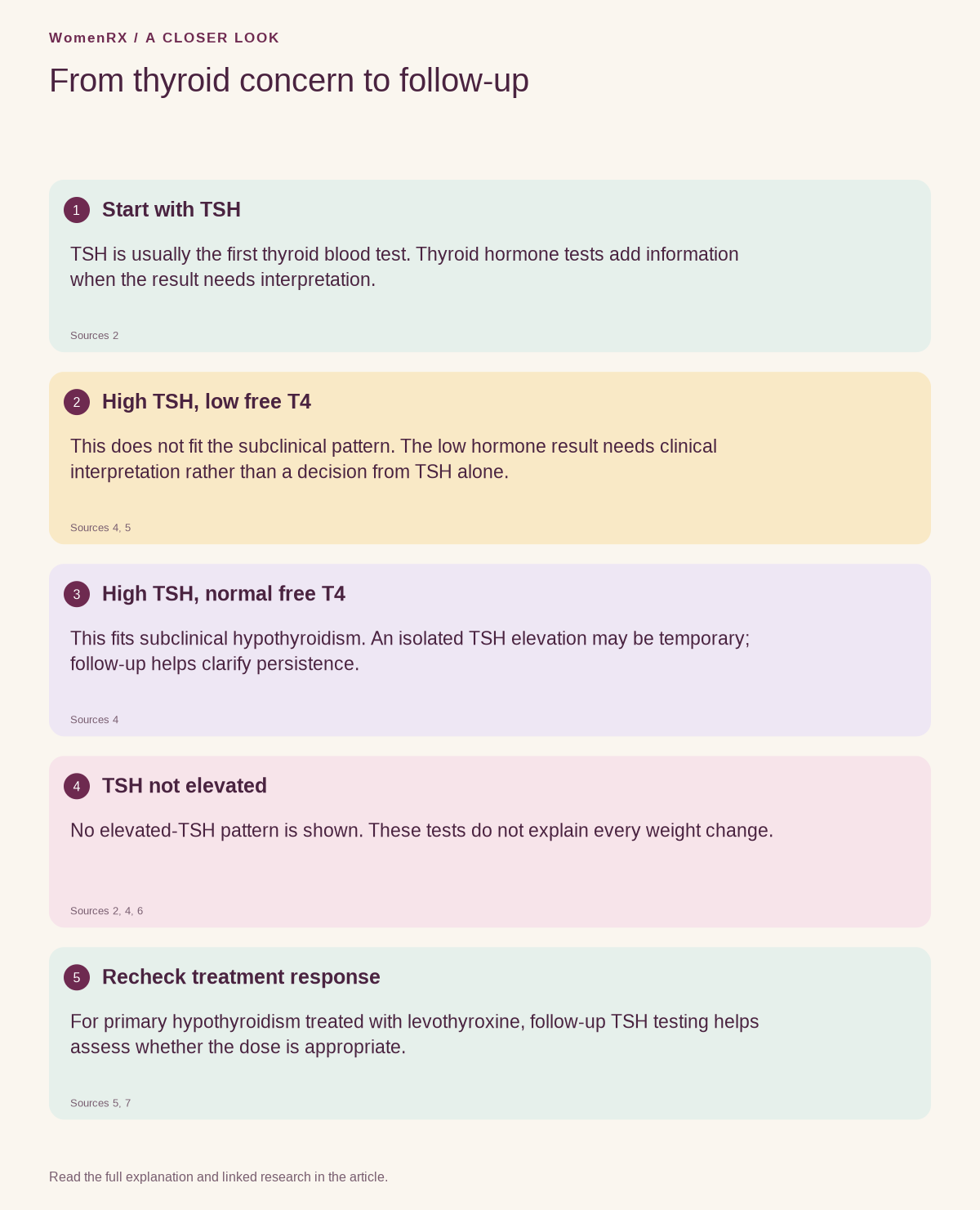
From thyroid concern to follow-up
Start with TSH: TSH is usually the first thyroid blood test. Thyroid hormone tests add information when the result needs interpretation.2
High TSH, low free T4: This does not fit the subclinical pattern. The low hormone result needs clinical interpretation rather than a decision from TSH alone.45
High TSH, normal free T4: This fits subclinical hypothyroidism. An isolated TSH elevation may be temporary; follow-up helps clarify persistence.4
TSH not elevated: No elevated-TSH pattern is shown. These tests do not explain every weight change.246
Recheck treatment response: For primary hypothyroidism treated with levothyroxine, follow-up TSH testing helps assess whether the dose is appropriate.57
Read the figure as text
Read the result branches together, not as a diagnosis from weight change alone.- Start with TSH: TSH is usually the first thyroid blood test. Thyroid hormone tests add information when the result needs interpretation.2
- High TSH, low free T4: This does not fit the subclinical pattern. The low hormone result needs clinical interpretation rather than a decision from TSH alone.45
- High TSH, normal free T4: This fits subclinical hypothyroidism. An isolated TSH elevation may be temporary; follow-up helps clarify persistence.4
- TSH not elevated: No elevated-TSH pattern is shown. These tests do not explain every weight change.246
- Recheck treatment response: For primary hypothyroidism treated with levothyroxine, follow-up TSH testing helps assess whether the dose is appropriate.57
More questions, answered
Can thyroid antibodies explain weight gain?
An antibody test can help identify an autoimmune thyroid disorder, but it does not measure weight change or establish that the thyroid is causing it. TSH and thyroid hormone results provide information about thyroid function. 2
Does a normal TSH explain why my weight changed?
No. It does not identify the cause of a weight change. TSH is usually the first thyroid test, but its meaning depends on the other results and your circumstances. 2 6
Sources you can check
- Levothyroxine: a medicine for an underactive thyroid (hypothyroidism) - NHSAccessed 2026-09-25Return to first citation
- Thyroid Tests: MedlinePlusAccessed 2026-09-25Return to first citation
- Levothyroxine therapy for euthyroidism restoration results in clinically insignificant weight and anthropometric changes: a systematic review and meta-analysis.Wolde Sellasie S, Ossola N, Piticchio T, Uccioli L, Trimboli P. · International journal of obesity (2005) · 2026Return to first citation
- Cardiometabolic Outcomes and Levothyroxine Treatment Effects in Subclinical Hypothyroidism: A Systematic Review.Hag Elagib MA, Alamin MA, Omer Amin Ahmed Y, Musa IE, Khaleifa MA, Elsamani EA, Najar H, Ahmed A. · Cureus · 2026Return to first citation
- Hypothyroidism (Underactive Thyroid) - NIDDKAccessed 2026-09-25Return to first citation
- Body Weight: MedlinePlusAccessed 2026-09-25Return to first citation
- LEVOTHYROXINE SODIUM TABLET [A-S MEDICATION SOLUTIONS] | US prescribing information and patient instructionsAccessed 2026-09-25Return to first citation