Thyroid Symptoms or Menopause After Thyroidectomy?
Hot flashes, poor sleep, and fatigue can overlap, but your symptom pattern, levothyroxine routine, and thyroid blood tests give you a better way to investigate.
After thyroidectomy, you usually can’t tell from one symptom. Sudden warmth in the face, neck, or chest may be a menopausal hot flash, while fatigue and weight gain can occur with an underactive thyroid. Heat sensitivity, sweating, and a fast or irregular heartbeat can occur with an overactive thyroid, but they do not show that your levothyroxine dose is too high. Review your levothyroxine routine and thyroid-stimulating hormone (TSH) and thyroxine (T4) results at follow-up rather than changing your dose yourself. 75613
After thyroid surgery, a new symptom in midlife can have more than one plausible explanation. A night of sweating might be a menopause-related hot flash. Trouble sleeping could also occur when a levothyroxine dose isn’t right. The useful question isn’t “Which symptom belongs to which condition?” It’s “What pattern is developing, and does my thyroid replacement still fit?” 71
Look at the pattern, not a single symptom
During perimenopause, a hot flash is typically a sudden feeling of warmth in the face, neck, and chest; it may bring sweating, including at night. Sleep disruption and mood changes can occur too. Those details are more informative than the word sweaty alone, although they still don’t prove menopause is the only cause. 7
Too little thyroid hormone can cause tiredness and weight gain. An overactive thyroid can cause heat sensitivity, sweating, difficulty sleeping, diarrhea, trembling, or an unusually fast or irregular heartbeat. Those descriptions come from guidance on underactive and overactive thyroid conditions, not a study that validates symptoms as a way to diagnose levothyroxine under- or over-replacement after thyroidectomy. They’re reasons to check, not a home diagnostic test. 56
For example, if you’re having brief waves of warmth in your face, neck, or chest, menopause deserves attention. If you’ve also developed a fast heartbeat or persistent heat sensitivity, bring that up when your thyroid replacement is reviewed. Those symptoms can occur with an overactive thyroid, but they do not establish levothyroxine over-replacement. Fatigue alone is especially hard to sort out: an underactive thyroid can cause it, while menopause-related sleep loss can leave you tired the next day. Both may be relevant. 756
Check what your thyroid results can answer
Levothyroxine replaces thyroid hormone, and regular blood tests help assess whether the dose is right. TSH is commonly used in thyroid testing; T4 is another thyroid hormone measured in blood. Levothyroxine prescribing information describes monitoring with TSH and/or T4. Ask which results your clinician is using for your follow-up, what they mean in light of your surgery and treatment history, and whether a repeat test is needed. A symptom list cannot answer those questions on its own. 183
A result also needs context. The US prescribing information notes that persistent symptoms and laboratory evidence of too little thyroid hormone despite an apparently adequate levothyroxine dose can reflect inadequate absorption, inconsistent use, drug interactions, or a combination. That doesn’t mean any one of those explains your symptoms; it means the conversation should cover more than the number printed on your prescription. 3
Bring your medication routine into the conversation
Think through what has changed since your last thyroid review. Have you started calcium carbonate or iron supplements, an antacid, or a medicine for acid reflux? Levothyroxine prescribing information identifies calcium carbonate and ferrous sulfate as substances that can reduce its absorption. It also identifies antacids and proton pump inhibitors as medicines that may affect absorption. Tell your clinician or pharmacist what you take and when you take it relative to levothyroxine, rather than adjusting either medicine on your own. 3
Mention biotin too, including biotin in a hair, skin, or nail supplement. It can interfere with thyroid blood-test assays and produce misleading results. Bring the supplement name or bottle so your care team can advise you about testing. 3
A compact set of questions for follow-up is: “Do my TSH and T4 results fit the replacement plan for me? Could anything in my medicine or supplement routine affect absorption or the test result? Which of these symptoms needs assessment apart from my thyroid?” These questions leave room for both explanations rather than forcing an either-or answer. 37
Don’t let a thyroid review end the menopause conversation
If your thyroid results and medication review don’t explain the symptoms, hot flashes, night sweats, and sleep problems still deserve attention. Menopause symptoms have treatment options, including nonhormone approaches and, for some women, hormone therapy; the choice depends on the symptom and the person. You don’t have to wait for every symptom to acquire a single label before discussing relief. 74
Get night sweats assessed if they regularly wake you, especially if you’re also losing weight without an explanation or have a fever, cough, or diarrhea. And bring up a new unusually fast or irregular heartbeat rather than assuming it’s a hot flash. These symptoms can have causes beyond either menopause or thyroid replacement. 26
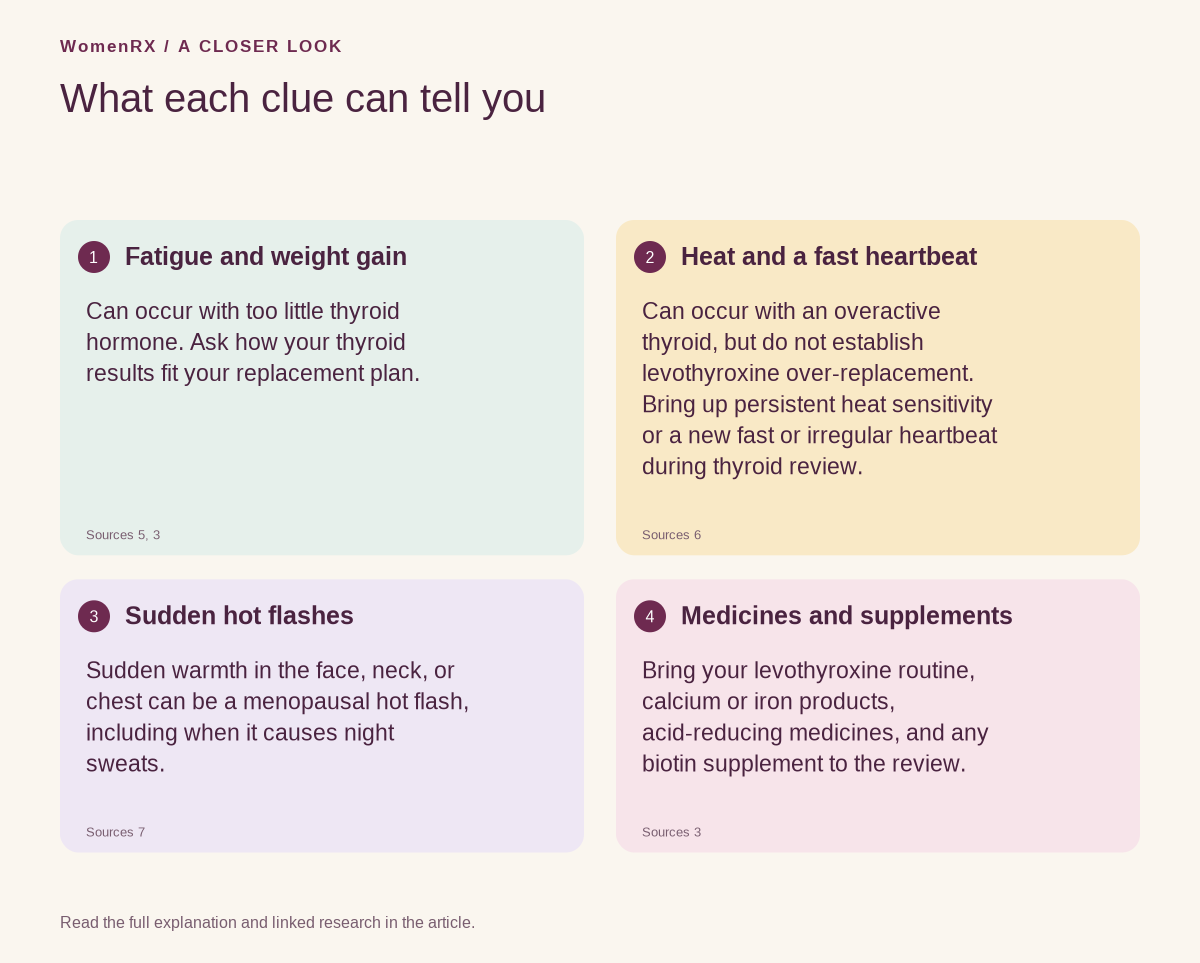
What each clue can tell you
Fatigue and weight gain: Can occur with too little thyroid hormone. Ask how your thyroid results fit your replacement plan.53
Heat and a fast heartbeat: Can occur with an overactive thyroid, but do not establish levothyroxine over-replacement. Bring up persistent heat sensitivity or a new fast or irregular heartbeat during thyroid review.6
Sudden hot flashes: Sudden warmth in the face, neck, or chest can be a menopausal hot flash, including when it causes night sweats.7
Medicines and supplements: Bring your levothyroxine routine, calcium or iron products, acid-reducing medicines, and any biotin supplement to the review.3
Read the figure as text
These clues guide a conversation; none diagnoses the cause by itself.- Fatigue and weight gain: Can occur with too little thyroid hormone. Ask how your thyroid results fit your replacement plan.53
- Heat and a fast heartbeat: Can occur with an overactive thyroid, but do not establish levothyroxine over-replacement. Bring up persistent heat sensitivity or a new fast or irregular heartbeat during thyroid review.6
- Sudden hot flashes: Sudden warmth in the face, neck, or chest can be a menopausal hot flash, including when it causes night sweats.7
- Medicines and supplements: Bring your levothyroxine routine, calcium or iron products, acid-reducing medicines, and any biotin supplement to the review.3
More questions, answered
If my thyroid tests look right, can my symptoms still be menopause-related?
Yes. Thyroid testing helps assess thyroid hormone replacement; it doesn’t measure whether a hot flash or disrupted sleep is affecting you. Describe those symptoms separately so you can discuss menopause care even if no levothyroxine change is needed. 37
Sources you can check
- Levothyroxine: a medicine for an underactive thyroid (hypothyroidism) - NHSAccessed 2026-09-25Return to first citation
- Night sweats - NHSAccessed 2026-09-25Return to first citation
- LEVOTHYROXINE SODIUM TABLET [CARDINAL HEALTH 107, LLC] | US prescribing information and patient instructionsAccessed 2026-09-25Return to first citation
- The 2022 hormone therapy position statement of The North American Menopause Society.“The 2022 Hormone Therapy Position Statement of The North American Menopause Society” Advisory Panel. · Menopause (New York, N.Y.) · 2022Return to first citation
- Underactive thyroid (hypothyroidism) - NHSAccessed 2026-09-25Return to first citation
- Overactive thyroid (hyperthyroidism) - Symptoms - NHSAccessed 2026-09-25Return to first citation
- Menopause | Menopause Symptoms | MedlinePlusAccessed 2026-09-25Return to first citation
- Thyroid Tests: MedlinePlusAccessed 2026-09-25Return to first citation