Hot Flashes or Thyroid Symptoms? How to Tell What Needs Testing
Sweating and feeling too warm can overlap, but symptoms elsewhere in your body may give you a reason to check thyroid function.
Hot flashes and night sweats can be menopause symptoms, while an overactive thyroid can also cause heat sensitivity and excessive sweating. Neither age nor a symptom list can tell you which is responsible. A cluster that includes a fast or irregular heartbeat, trembling, diarrhea, or weight loss is a reason to ask about thyroid testing; a blood test can assess thyroid function, not diagnose menopause.251
Look beyond the sweating
If you’re having hot flashes in midlife, menopause is a plausible explanation. Hot flashes and night sweats are recognized menopause symptoms. But an overactive thyroid can also cause heat sensitivity, warm skin, and excessive sweating. The overlap means that feeling hot, by itself, isn’t a reliable way to choose between the two.25
Thyroid hormones affect how your body uses energy and influence functions including heart rate, digestion, weight, and mood. That’s why a thyroid problem may show up as more than a change in temperature comfort.1
For example, if sweating comes with trembling, a fast or irregular heartbeat, diarrhea, or weight loss despite an increased appetite, it’s worth raising the possibility of an overactive thyroid when you seek care. Difficulty sleeping, anxiety, and tiredness can also occur with an overactive thyroid, but they’re less helpful clues on their own. These are reasons to consider testing, not a way to diagnose yourself from a list.5
An underactive thyroid can complicate the picture too
Not every thyroid concern looks like feeling too hot. An underactive thyroid can cause tiredness and weight gain, as well as irregular or heavy periods if you still have them. Those symptoms deserve attention even if hot flashes are what first made you wonder about menopause. A clinician can consider your symptoms and history, including a family history of thyroid disease, when deciding whether to check thyroid function.7
The question isn’t always “menopause or thyroid disease?” Both can be present. In a study of postmenopausal women seen at a thyroid-disease center, some had autoimmune thyroid disease. That study doesn’t tell us how often thyroid disease explains hot flashes in midlife, but it does make the either-or assumption unhelpful.3
What a thyroid blood test can settle
A thyroid-stimulating hormone test, usually called TSH, is commonly the first blood test used to check thyroid function. Depending on the result and the clinical situation, testing may also include thyroid hormones such as T4 or T3. For an overactive thyroid, a low TSH together with high T3 and/or T4 generally supports the diagnosis; symptoms and test results are considered together.16
A TSH result within the laboratory’s reference range makes common primary thyroid dysfunction less likely, but TSH alone doesn’t answer every thyroid question. The interpretation can be more complicated in certain situations, including pituitary disease or after changes in thyroid treatment, when thyroid hormone measurements may also matter.4 And a thyroid test assesses the thyroid. A normal result doesn’t, by itself, establish that menopause is causing the sweating.
A useful next move is to describe the whole pattern, rather than asking for a test based only on hot flashes. For example: “I’m having night sweats, and I’ve also noticed trembling and a racing heartbeat,” or “I’m having hot flashes, but my periods have become heavy and I’m unusually tired.” Those details help explain why thyroid testing may be worth discussing alongside menopause symptoms.57
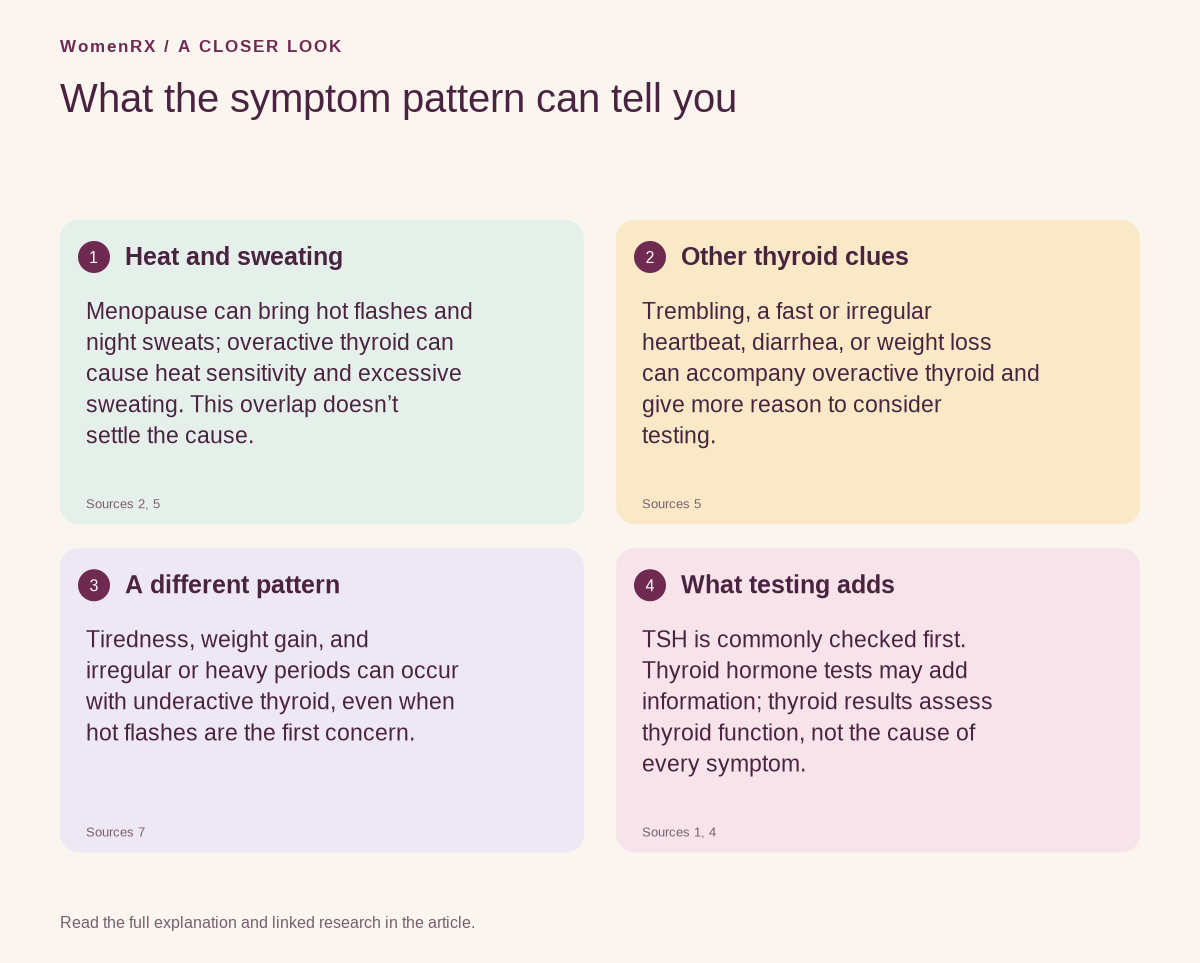
What the symptom pattern can tell you
Heat and sweating: Menopause can bring hot flashes and night sweats; overactive thyroid can cause heat sensitivity and excessive sweating. This overlap doesn’t settle the cause.25
Other thyroid clues: Trembling, a fast or irregular heartbeat, diarrhea, or weight loss can accompany overactive thyroid and give more reason to consider testing.5
A different pattern: Tiredness, weight gain, and irregular or heavy periods can occur with underactive thyroid, even when hot flashes are the first concern.7
What testing adds: TSH is commonly checked first. Thyroid hormone tests may add information; thyroid results assess thyroid function, not the cause of every symptom.14
Read the figure as text
These distinctions can guide a conversation about testing, but none diagnoses the cause of sweating.- Heat and sweating: Menopause can bring hot flashes and night sweats; overactive thyroid can cause heat sensitivity and excessive sweating. This overlap doesn’t settle the cause.25
- Other thyroid clues: Trembling, a fast or irregular heartbeat, diarrhea, or weight loss can accompany overactive thyroid and give more reason to consider testing.5
- A different pattern: Tiredness, weight gain, and irregular or heavy periods can occur with underactive thyroid, even when hot flashes are the first concern.7
- What testing adds: TSH is commonly checked first. Thyroid hormone tests may add information; thyroid results assess thyroid function, not the cause of every symptom.14
Sources you can check
- Thyroid Tests: MedlinePlusAccessed 2026-09-25Return to first citation
- Other medicines for menopause symptoms - NHSAccessed 2026-09-25Return to first citation
- Premature ovarian insufficiency in patients with thyroid-related poly-autoimmunity.Bagaglini MF, Stramazzo I, Nocito M, Fallahi P, Antonelli A, Santaguida MG, Gargano L, Ferrari F, Baldini E, Ulisse S, Carretti A, Centanni M, Virili C. · Frontiers in endocrinology · 2026Return to first citation
- Thyroid function tests: Thyroid disease: assessment and management: Evidence review CNational Guideline Centre (UK). · 2019Return to first citation
- Overactive thyroid (hyperthyroidism) - Symptoms - NHSAccessed 2026-09-25Return to first citation
- Overactive thyroid (hyperthyroidism) - Diagnosis - NHSAccessed 2026-09-25Return to first citation
- Underactive thyroid (hypothyroidism) - NHSAccessed 2026-09-25Return to first citation