Oxybutynin for Hot Flashes: Benefits and Tradeoffs
Oxybutynin reduced hot flashes in two clinical trials, but dry mouth and other anticholinergic effects matter when deciding whether it fits your situation.
Oxybutynin is a medicine for overactive bladder that has also reduced hot flashes more than placebo in trials lasting six and 12 weeks. It isn’t a standard first choice for everyone: dry mouth was common, and difficulty urinating, reduced sweating, and possible cognitive effects deserve attention. The strongest practical question is whether its likely symptom relief is worth those effects alongside your other medicines and health concerns. 245
If hot flashes are disrupting your day or sleep, oxybutynin may come up in a conversation about nonhormonal treatment. The evidence for short-term relief is real. So is the reason to pause before treating it like a simple substitute for hormone therapy: oxybutynin affects more than hot flashes.
Why a bladder medicine might help hot flashes
Oxybutynin is an anticholinergic medicine used for overactive bladder symptoms, including sudden urgency, frequent urination, and urge incontinence. It relaxes the bladder muscle so the bladder can hold more urine. It also reduces sweating. That effect helped prompt research into whether it could ease hot flashes, although exactly how it reduces them isn’t settled. The hot-flash use is distinct from its US-approved overactive-bladder indication. 234
That overlap may sound appealing if you have both hot flashes and bladder urgency. But it doesn’t mean one medicine will necessarily solve both problems for you. And because oxybutynin acts beyond the bladder, the same action that may help one symptom can create another, such as dry mouth or trouble emptying your bladder. 124
What women in the trials experienced
In a 12-week randomized trial, 148 naturally postmenopausal women with at least seven moderate-to-severe vasomotor symptoms a day received extended-release oxybutynin or placebo. By week 12, the oxybutynin group averaged 9.48 fewer episodes per day than at baseline, compared with 4.69 fewer in the placebo group. Symptoms also became less severe in the oxybutynin group. These are changes within each group, not the number of symptoms every woman had after treatment. 5
A separate six-week randomized trial enrolled 150 women with frequent hot flashes who were not candidates for estrogen-based therapy. Some had breast cancer, and 65% were taking tamoxifen or an aromatase inhibitor. Both oxybutynin groups had greater reductions in hot-flash frequency and a combined hot-flash score than the placebo group. The trial also reported improvements in several measures of how hot flashes interfered with daily life. Its findings are useful for women considering a nonhormonal option, but the six-week follow-up cannot tell us how well oxybutynin works or how it feels to take over years. 4
Neither trial compared oxybutynin directly with hormone therapy or with other nonhormonal medicines. Hormone therapy remains the most effective treatment for hot flashes for women who can use it; options with evidence of benefit also include low-dose paroxetine, venlafaxine, and gabapentin. The choice isn’t simply ‘oxybutynin or nothing.’ 456
The side effects that change the decision
Dry mouth is more than a minor inconvenience for some people. In the 12-week trial, 52.1% of women assigned oxybutynin reported it, versus 5.3% assigned placebo; 6.8% of the oxybutynin group stopped treatment because of dry mouth. In the six-week trial, women taking oxybutynin reported more dry mouth, difficulty urinating, and abdominal pain than women taking placebo, though most reported side effects were graded mild or moderate. Constipation, blurred vision, dizziness, and sleepiness are also recognized effects of the medicine. 1245
Pay particular attention to how you urinate. A medicine that reduces bladder urgency may be a poor fit if emptying your bladder is already difficult. If you cannot urinate at all, seek urgent medical care. Oxybutynin can also interfere with normal sweating; feeling overheated and not sweating normally in hot conditions needs urgent attention. 12
There’s a longer-term question, too. Anticholinergic medicines can affect thinking, and observational research has linked greater cumulative anticholinergic exposure with adverse outcomes, particularly in older adults. That does not establish that oxybutynin taken for hot flashes causes dementia. The six-week hot-flash trial did not formally test cognition, excluded women taking other potent anticholinergic drugs, and had an average participant age of 57. It therefore offers limited reassurance about long-term cognitive effects or taking oxybutynin alongside other anticholinergics. 48
Where it may fit among your options
A useful comparison starts with what you most want to change. If you have both troublesome hot flashes and overactive-bladder symptoms, oxybutynin’s bladder action may be relevant. If constipation, dry mouth, difficulty emptying your bladder, or trouble tolerating heat is already part of your day, its side-effect profile may weigh more heavily. 124
Your medication list matters as well. For example, trospium is another anticholinergic medicine used for overactive bladder. If you already take an anticholinergic bladder medicine, adding oxybutynin is a different proposition from trying it without one: anticholinergic effects can accumulate across medicines. The six-week hot-flash trial did not test oxybutynin in women taking other potent anticholinergics. 478
Oxybutynin has credible short-term hot-flash results, not a head-to-head win over the alternatives or a clear long-term safety answer. That distinction helps make the next conversation specific: which symptoms might it help you with, which side effects would be hardest for you to live with, and what else are you already taking? 456
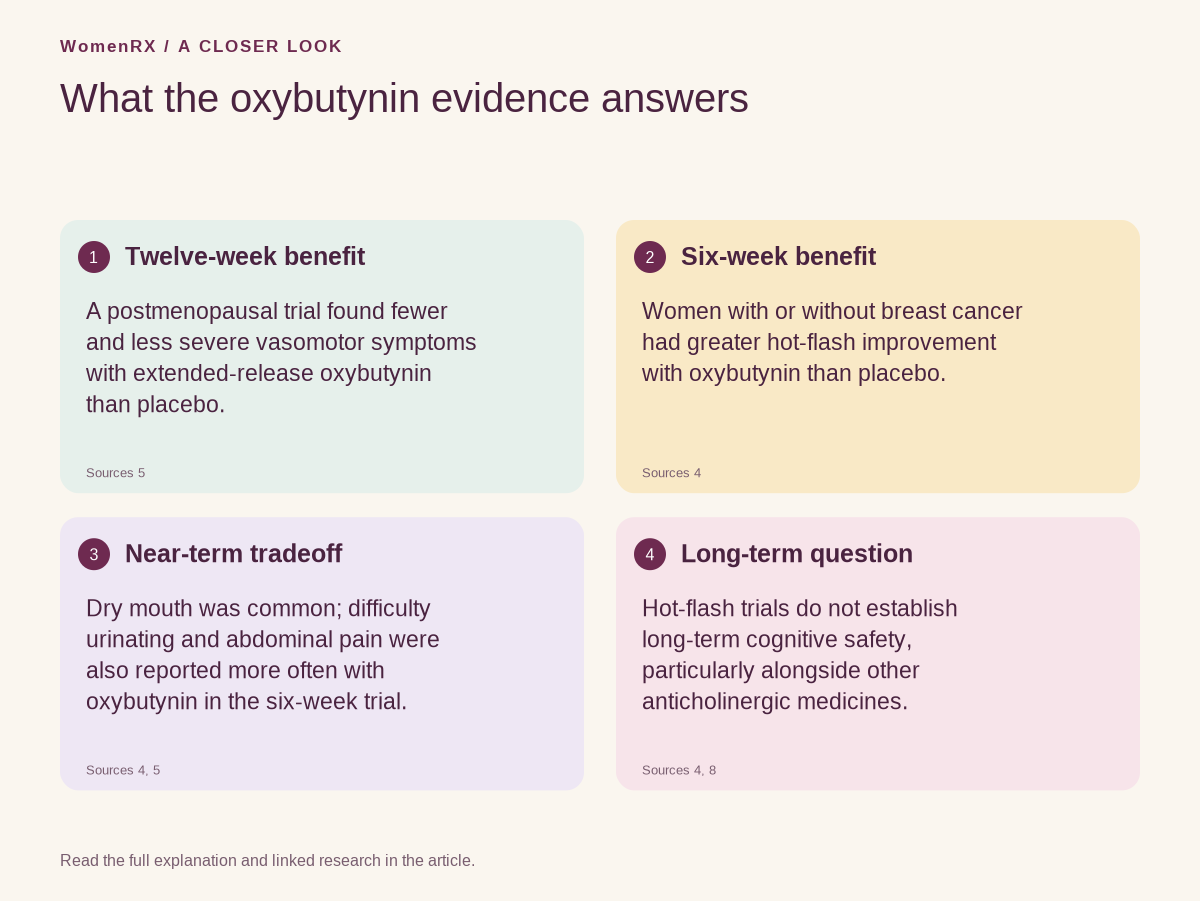
What the oxybutynin evidence answers
Twelve-week benefit: A postmenopausal trial found fewer and less severe vasomotor symptoms with extended-release oxybutynin than placebo.5
Six-week benefit: Women with or without breast cancer had greater hot-flash improvement with oxybutynin than placebo.4
Near-term tradeoff: Dry mouth was common; difficulty urinating and abdominal pain were also reported more often with oxybutynin in the six-week trial.45
Long-term question: Hot-flash trials do not establish long-term cognitive safety, particularly alongside other anticholinergic medicines.48
Read the figure as text
The benefit findings and safety questions come from different kinds of evidence.- Twelve-week benefit: A postmenopausal trial found fewer and less severe vasomotor symptoms with extended-release oxybutynin than placebo.5
- Six-week benefit: Women with or without breast cancer had greater hot-flash improvement with oxybutynin than placebo.4
- Near-term tradeoff: Dry mouth was common; difficulty urinating and abdominal pain were also reported more often with oxybutynin in the six-week trial.45
- Long-term question: Hot-flash trials do not establish long-term cognitive safety, particularly alongside other anticholinergic medicines.48
More questions, answered
Does oxybutynin help if I also have bladder urgency?
Treating overactive-bladder symptoms is oxybutynin’s established use, and trials show it can reduce hot flashes. The hot-flash trials don’t establish how much added benefit a woman with both concerns should expect. Difficulty emptying your bladder is also a possible adverse effect, so urgency and incomplete emptying shouldn’t be treated as the same problem. 1245
Sources you can check
- Side effects of oxybutynin - NHSAccessed 2026-09-25Return to first citation
- About oxybutynin - NHSAccessed 2026-09-25Return to first citation
- Common questions about oxybutynin - NHSAccessed 2026-09-25Return to first citation
- Oxybutynin vs Placebo for Hot Flashes in Women With or Without Breast Cancer: A Randomized, Double-Blind Clinical Trial (ACCRU SC-1603).Leon-Ferre RA, Novotny PJ, Wolfe EG, Faubion SS, Ruddy KJ, Flora D, Dakhil CSR, Rowland KM, Graham ML, Le-Lindqwister N, Smith TJ, Loprinzi CL. · JNCI cancer spectrum · 2020Return to first citation
- Extended-release oxybutynin therapy for vasomotor symptoms in women: a randomized clinical trial.Simon JA, Gaines T, LaGuardia KD, Extended-Release Oxybutynin Therapy for VMS Study Group. · Menopause (New York, N.Y.) · 2016Return to first citation
- Hormone Therapy and Other Treatments for Symptoms of Menopause.Hill DA, Crider M, Hill SR. · American family physician · 2016Return to first citation
- Trospium chloride treatment of overactive bladder.Biastre K, Burnakis T. · The Annals of pharmacotherapy · 2009Return to first citation
- Anticholinergic Medication Burden Scales: A Systematic Review.Vennard O, Stewart C, Tolia M, Soiza RL, Myint PK. · Journal of the American Geriatrics Society · 2026Return to first citation