Paroxetine for Hot Flashes: When to Review
A simple record of hot flashes, sleep disruption, and side effects can make follow-up more useful without treating study timelines as promises.
Track how often hot flashes or night sweats happen, how disruptive they feel, how they affect sleep or daily life, and any side effects. Compare the overall pattern with how things were before treatment, not with one unusually good or difficult day. Paroxetine’s response timeline isn’t fully characterized, so agree on a review point with your prescriber and raise bothersome or persistent side effects sooner. 1
Keep a useful record, not a perfect diary
Before you start, or as soon as you can, note what your hot flashes and night sweats are usually like. Then use the same simple format while taking paroxetine as prescribed. You might record:
- Frequency: How often you notice hot flashes or night sweats, and whether they happen during the day or at night.
- Disruption: How intense or bothersome they feel. You could use descriptions such as mild, moderate, or severe, as long as you use them consistently.
- Sleep and daily impact: Whether symptoms wake you, leave you feeling less rested, or interrupt work or usual activities.
- Tolerability: Any new or bothersome effects, when you noticed them, and whether they’re easing, continuing, or interfering with your day.
This isn’t a diagnostic score or a test. It’s a practical way to describe your experience and compare patterns over time. The Brisdelle medication guide advises telling your prescriber about side effects that bother you or don’t go away. 1
Compare patterns, not individual days
At a review, look at the record as a whole. Are hot flashes less frequent or less disruptive? Are fewer waking you at night? Is sleep or daily life easier? Are side effects making treatment harder to tolerate? A change in what matters to you can be worth discussing even if you haven’t counted every episode precisely.
There isn’t a guaranteed day by which paroxetine should help. US prescribing information says the relationship between exposure and response, and the time course of response, haven’t been fully characterized for menopausal hot flashes. 1
Research gives context, but not a personal appointment schedule. A review of paroxetine studies reported reductions in hot flashes over treatment periods of 6 to 12 weeks. That describes results summarized across studies, not a promise about when you’ll notice a change or a required time to wait before asking for a review. 4 In a separate randomized study of postmenopausal women previously treated for gynecologic cancer, researchers assessed hot flashes and sleep at the start of the study and at weeks 4 and 16. Those were measurement points for that particular study group, not a universal follow-up plan. 3
Trial averages can’t predict your individual response, either. A meta-analysis of six randomized trials involving 1,486 women found that placebo response accounted for much of the average reduction in hot-flash frequency and severity. The authors caution that their estimates don’t describe the percentage of individuals who may benefit from paroxetine. 2
Agree on a review point that fits you
Ask your prescriber when they’d like to check in and what kind of change would make treatment worthwhile to you. Your notes can make that conversation specific. If symptoms remain disruptive, you’re unsure whether anything has changed, or side effects are getting in the way, you can get in touch rather than relying on a study’s calendar.
You don’t have to wait for a planned check-in to mention a side effect that bothers you or doesn’t go away. 1 If you’re considering starting or stopping another medicine while taking Brisdelle, its medication guide says to speak with your healthcare provider first. 1
For the review, a short summary is enough: what changed in your symptoms, sleep, and daily life; what side effects you’ve noticed; and what you’d most like help deciding next.
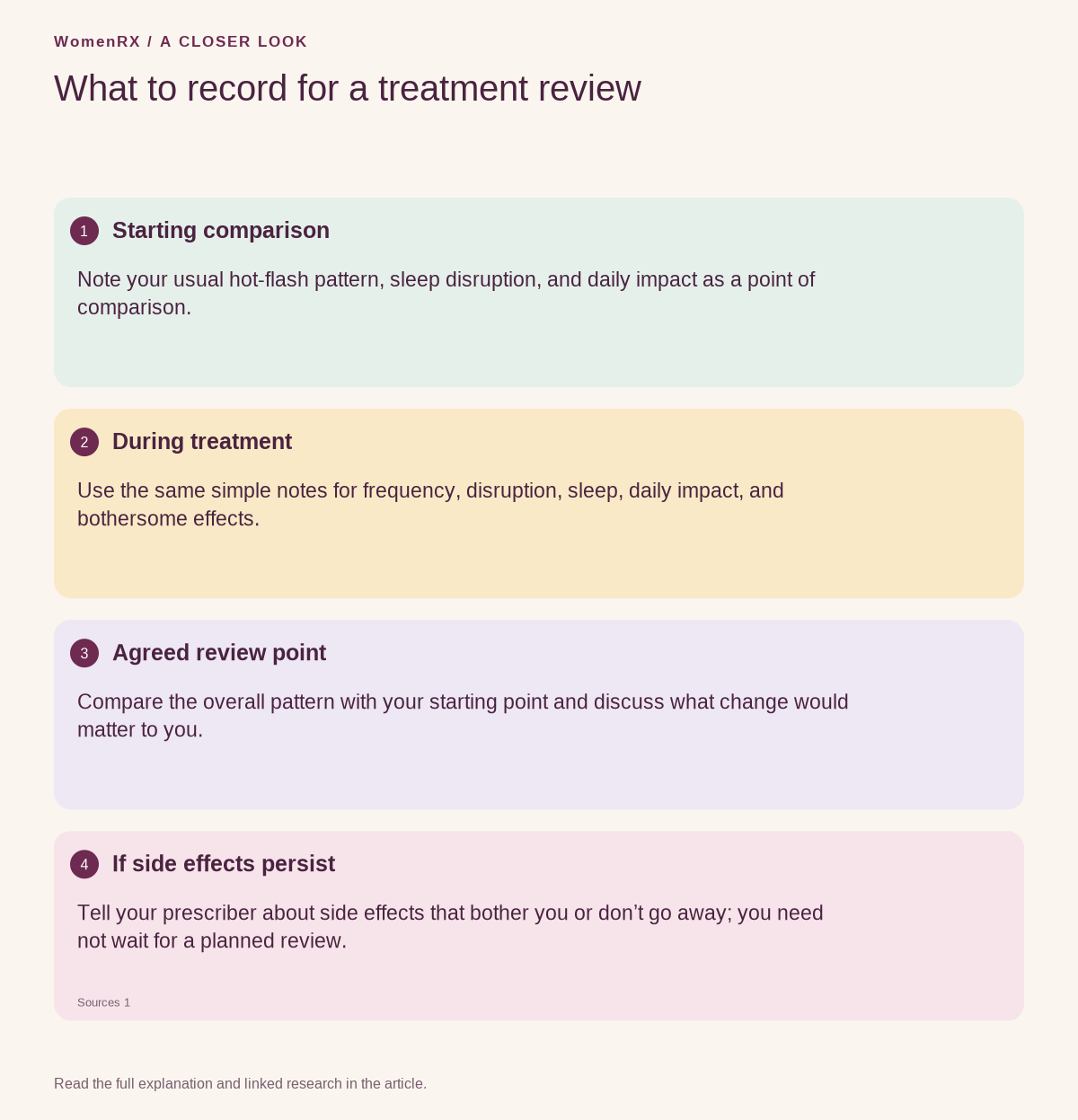
What to record for a treatment review
Starting comparison: Note your usual hot-flash pattern, sleep disruption, and daily impact as a point of comparison.
During treatment: Use the same simple notes for frequency, disruption, sleep, daily impact, and bothersome effects.
Agreed review point: Compare the overall pattern with your starting point and discuss what change would matter to you.
If side effects persist: Tell your prescriber about side effects that bother you or don’t go away; you need not wait for a planned review.1
Read the figure as text
A flexible sequence for organizing observations and follow-up, without suggesting a fixed time by which paroxetine should help.- Starting comparison: Note your usual hot-flash pattern, sleep disruption, and daily impact as a point of comparison.
- During treatment: Use the same simple notes for frequency, disruption, sleep, daily impact, and bothersome effects.
- Agreed review point: Compare the overall pattern with your starting point and discuss what change would matter to you.
- If side effects persist: Tell your prescriber about side effects that bother you or don’t go away; you need not wait for a planned review.1
Sources you can check
- BRISDELLE (PAROXETINE) CAPSULE [LEGACY PHARMA USA, INC.] | US prescribing information and patient instructionsAccessed 2026-09-25Return to first citation
- Magnitude of placebo response in clinical trials of paroxetine for vasomotor symptoms: a meta-analysis.Rhodes JR, Alldredge CT, Elkins GR. · Frontiers in psychiatry · 2023Return to first citation
- Role of paroxetine in the management of hot flashes in gynecological cancer survivors: Results of the first randomized single-center controlled trial.Capriglione S, Plotti F, Montera R, Luvero D, Lopez S, Scaletta G, Aloisi A, Serra GB, Angioli R. · Gynecologic oncology · 2016Return to first citation
- Critical appraisal of paroxetine for the treatment of vasomotor symptoms.Carroll DG, Lisenby KM, Carter TL. · International journal of women's health · 2015Return to first citation