Paroxetine for Hot Flashes: What About Weight?
Weight changes are worth noticing, but antidepressant studies can’t predict what will happen when you take paroxetine for menopausal hot flashes.
Paroxetine is used for moderate to severe menopausal hot flashes. In a large antidepressant study, people starting paroxetine had slightly more average weight gain at six months than people starting sertraline, but the finding doesn’t predict your weight change or specifically describe hot-flash treatment. Bring up weight gain or loss that happens without trying, especially if it’s sudden. 142
The weight evidence comes from different patients
If you’re taking paroxetine for hot flashes, it’s reasonable to wonder whether a change on the scale is related. BRISDELLE, a paroxetine product, is used to treat moderate to severe hot flashes associated with menopause. The weight findings discussed here, though, come from studies of antidepressant treatment rather than a weight estimate for people using paroxetine specifically for hot flashes. 134
Those studies offer context, not a forecast. Their results depend on who was studied, what treatment was compared, and how long weight was measured.
A short study and a six-month comparison
In a study of adults with depression, paroxetine treatment was not associated with weight gain after 35 days. That finding covers a short period and doesn’t settle what may happen over subsequent months. 3
A larger US observational study examined 183,118 people starting one of several antidepressants. At six months, estimated average weight gain among those starting paroxetine was 0.37 kg greater than among those starting sertraline. That’s a difference between groups, not a finding that everyone taking paroxetine gained weight or gained that amount. 4
The study followed people for 24 months, but its primary weight comparison was at six months. Its reported findings don’t provide a women-only or menopause-specific weight estimate. Low medication adherence and incomplete weight measurements also limit what can be concluded about change over time. 4
If your weight changes, look at the pattern
A weight change after you start paroxetine doesn’t, by itself, show that paroxetine caused it. Body weight includes water, muscle, bone, and fat, and everyday factors such as diet can affect it too. 2
If tracking feels useful, note your weight around the time you start treatment and record later changes with their dates. You might also note changes in appetite, activity, or other medicines. This can help you describe what happened and when, though it can’t identify the cause on its own. If weighing yourself feels distressing, you can describe changes you’ve noticed without keeping a scale record.
Bring up weight gain or loss that happens without trying, particularly a sudden, unexpected change. You don’t need to wait until it matches an average from a study. Tell your clinician when you first noticed it and whether it has continued, so you can consider the change in the context of your health and treatment. 2
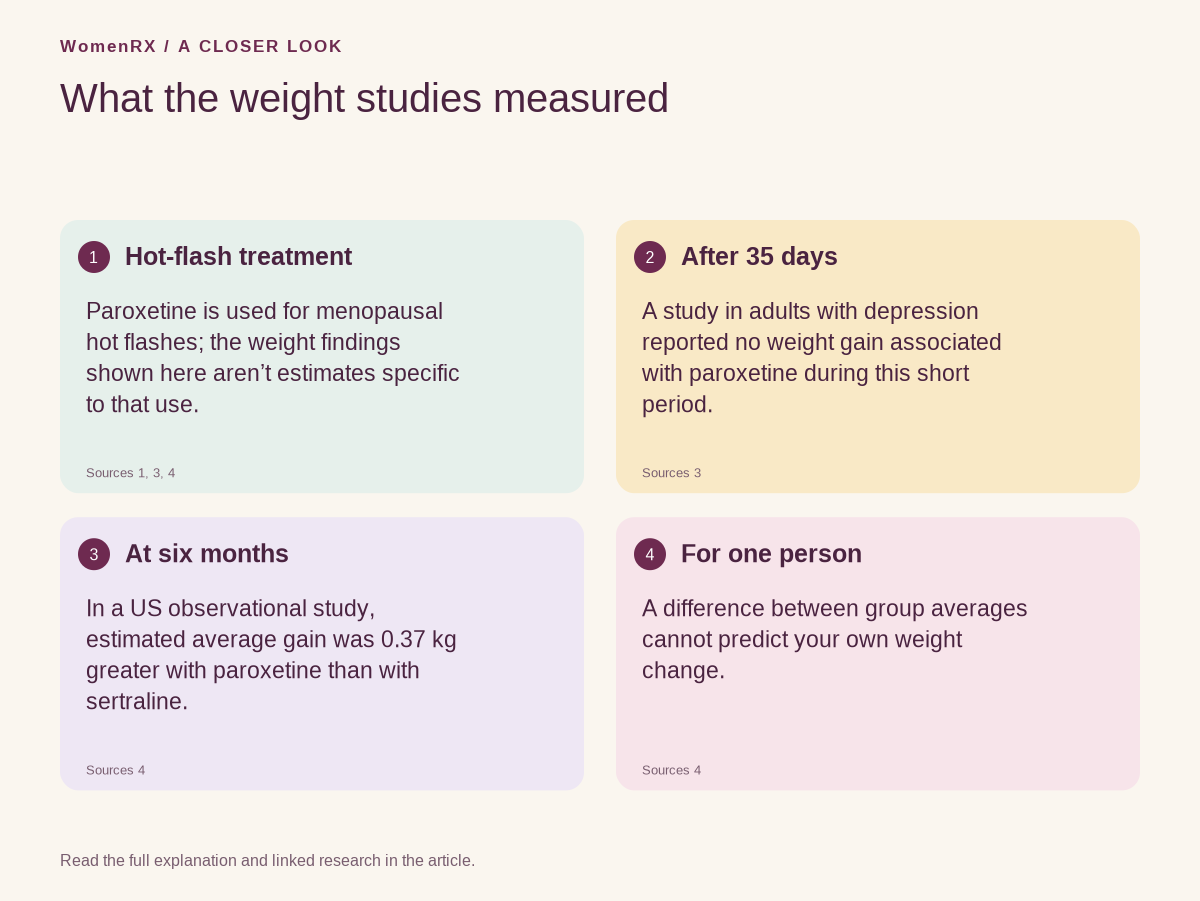
What the weight studies measured
Hot-flash treatment: Paroxetine is used for menopausal hot flashes; the weight findings shown here aren’t estimates specific to that use.134
After 35 days: A study in adults with depression reported no weight gain associated with paroxetine during this short period.3
At six months: In a US observational study, estimated average gain was 0.37 kg greater with paroxetine than with sertraline.4
For one person: A difference between group averages cannot predict your own weight change.4
Read the figure as text
The timeframe and study population change what each finding can tell you.- Hot-flash treatment: Paroxetine is used for menopausal hot flashes; the weight findings shown here aren’t estimates specific to that use.134
- After 35 days: A study in adults with depression reported no weight gain associated with paroxetine during this short period.3
- At six months: In a US observational study, estimated average gain was 0.37 kg greater with paroxetine than with sertraline.4
- For one person: A difference between group averages cannot predict your own weight change.4
More questions, answered
Does the 0.37 kg difference mean I’ll gain that much?
No. It’s the estimated difference in average weight gain at six months between people starting paroxetine and people starting sertraline in an observational study. It isn’t an individual prediction or a result specific to menopausal hot-flash treatment. 4
Should I wait for a certain amount of weight change before speaking up?
No. Bring up weight gain or loss that happens without trying, especially if the change is sudden or unexpected. 2
Sources you can check
- BRISDELLE (PAROXETINE) CAPSULE [LEGACY PHARMA USA, INC.] | US prescribing information and patient instructionsAccessed 2026-09-25Return to first citation
- Body Weight: MedlinePlusAccessed 2026-09-25Return to first citation
- Leptin plasma concentrations increase during antidepressant treatment with amitriptyline and mirtazapine, but not paroxetine and venlafaxine: leptin resistance mediated by antihistaminergic activity?Schilling C, Gilles M, Blum WF, Daseking E, Colla M, Weber-Hamann B, Lederbogen F, Krumm B, Heuser I, Wudy SA, Kopf D, Deuschle M. · Journal of clinical psychopharmacology · 2013Return to first citation
- Medication-Induced Weight Change Across Common Antidepressant Treatments : A Target Trial Emulation Study.Petimar J, Young JG, Yu H, Rifas-Shiman SL, Daley MF, Heerman WJ, Janicke DM, Jones WS, Lewis KH, Lin PD, Prentice C, Merriman JW, Toh S, Block JP. · Annals of internal medicine · 2024Return to first citation