Paroxetine for Hot Flashes: What Trial Results Mean
Trials have measured hot-flash frequency, severity, and combined scores, but the dose and comparison group matter when you interpret the numbers.
Studies have counted hot flashes, rated their severity, or combined frequency and severity in a score. In one six-week trial, women taking 12.5 mg or 25 mg of controlled-release paroxetine had a larger average drop in daily hot flashes than women taking placebo. Those results are not interchangeable with trials of 7.5 mg paroxetine, and no group average can predict one person’s response. 2 1
First ask what the study counted
“Improvement” can mean fewer hot flashes, less severe episodes, or a change in a score that combines frequency and severity. These outcomes overlap, but they are not identical. A combined score can improve without telling you whether frequency, severity, or both changed most. 2 3
In a six-week randomized trial of 165 menopausal women, researchers measured a daily score based on hot-flash frequency and severity. They also reported daily episode counts. In the groups taking 12.5 mg and 25 mg of controlled-release paroxetine, average frequency fell from 7.1 to 3.8 flashes per day and from 6.4 to 3.2. In the placebo group, it fell from 6.6 to 4.8. The average reductions were 3.3, 3.2, and 1.8 flashes per day, respectively. 2
The trial also reported median reductions in the combined frequency-and-severity score: 62.2% and 64.6% in the two paroxetine groups, compared with 37.8% with placebo. These percentages describe change from each group’s own starting point. They are not the extra percentage reduction attributable to paroxetine. The comparison between groups is more useful for judging a treatment effect than a before-and-after number alone. 2
Dose and formulation change the comparison
Those six-week results came from 12.5 mg and 25 mg controlled-release paroxetine. They should not be presented as expected results for 7.5 mg paroxetine. US prescribing information describes separate phase 3 trials of 7.5 mg daily in postmenopausal women with frequent moderate-to-severe vasomotor symptoms. The trial descriptions are different, so their outcomes shouldn’t be treated as interchangeable. 2 1
That distinction matters when a number is shared without its study context. A result belongs to the dose, formulation, participants, and follow-up period that produced it. The six-week trial’s figures do not tell you what an individual taking a different formulation or dose will experience. 1 2
The placebo group helps put change in perspective
Hot flashes also declined in the placebo group in the six-week trial. A separate, much smaller 12-week study helps show why that matters: 41 postmenopausal women were evaluated after being assigned to placebo, raloxifene, or 20 mg of paroxetine daily. In the paroxetine group, average weekly frequency fell by 49.8% and severity by 36.6%. In the placebo group, frequency fell by 37.4% and severity by 39.9%. The study found no statistically significant differences between treatment groups. 3
That finding doesn’t prove the treatments had identical effects. With only 41 women evaluated across three groups, the study was small. It does show why a large percentage change within one group isn’t enough to establish that a treatment caused the change. 3
Frequency and severity aren’t the whole experience
The trial results described here report episode counts, severity ratings, or a combined score. They don’t give a comparable numerical measure of how bothersome hot flashes felt in daily life. A person may care about whether episodes disrupt sleep or make work uncomfortable, but a lower count alone doesn’t capture those effects. 2 3
So when you read a before-and-after claim, check three things: what was measured, what happened in the placebo group, and whether the number is a change from baseline or a comparison between groups. Then keep the study’s dose, formulation, and timeframe attached to the result. These details make the numbers more informative without turning a group average into a personal promise.
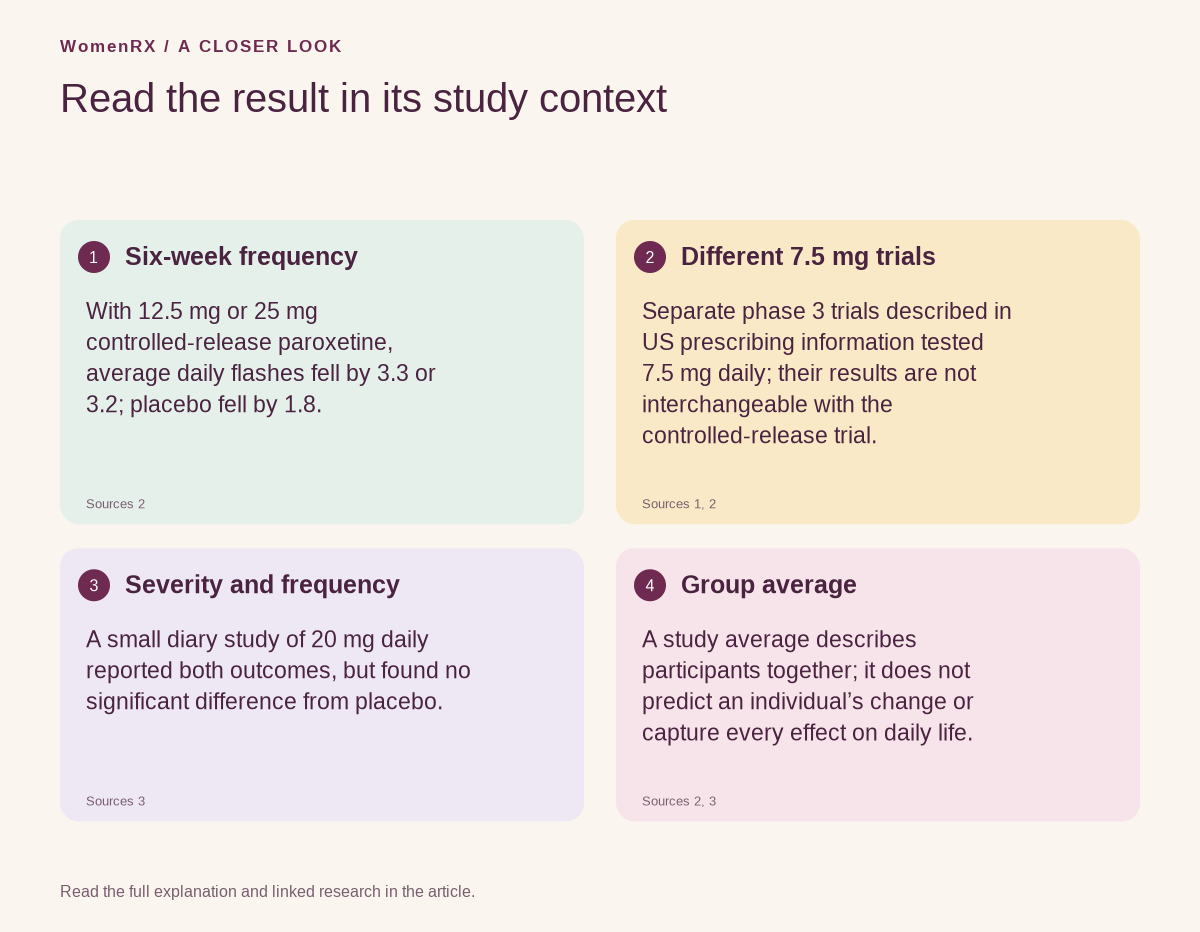
Read the result in its study context
Six-week frequency: With 12.5 mg or 25 mg controlled-release paroxetine, average daily flashes fell by 3.3 or 3.2; placebo fell by 1.8.2
Different 7.5 mg trials: Separate phase 3 trials described in US prescribing information tested 7.5 mg daily; their results are not interchangeable with the controlled-release trial.12
Severity and frequency: A small diary study of 20 mg daily reported both outcomes, but found no significant difference from placebo.3
Group average: A study average describes participants together; it does not predict an individual’s change or capture every effect on daily life.23
Read the figure as text
A study number is easiest to interpret when you know what it measured, what the placebo group did, and which paroxetine formulation was tested.- Six-week frequency: With 12.5 mg or 25 mg controlled-release paroxetine, average daily flashes fell by 3.3 or 3.2; placebo fell by 1.8.2
- Different 7.5 mg trials: Separate phase 3 trials described in US prescribing information tested 7.5 mg daily; their results are not interchangeable with the controlled-release trial.12
- Severity and frequency: A small diary study of 20 mg daily reported both outcomes, but found no significant difference from placebo.3
- Group average: A study average describes participants together; it does not predict an individual’s change or capture every effect on daily life.23
More questions, answered
What does a combined hot-flash score tell you?
It combines frequency and severity, so a change reflects the measure as a whole. It doesn’t by itself show how much of the change came from fewer episodes versus less severe ones. 2
Sources you can check
- BRISDELLE (PAROXETINE) CAPSULE [LEGACY PHARMA USA, INC.] | US prescribing information and patient instructionsAccessed 2026-09-25Return to first citation
- Paroxetine controlled release in the treatment of menopausal hot flashes: a randomized controlled trial.Stearns V, Beebe KL, Iyengar M, Dube E. · JAMA · 2003Return to first citation
- Diary of hot flashes reported upon occurrence: results of a randomized double-blind study of raloxifene, placebo, and paroxetine.Simon JA, Chandler J, Gottesdiener K, Lazarus N, He W, Rosenberg E, Wagner JA, Denker AE. · Menopause (New York, N.Y.) · 2014Return to first citation