Paroxetine for Hot Flashes: What It Does and Doesn’t Treat
Paroxetine can ease menopausal hot flashes by acting on brain signaling, but a prescription for flashes alone doesn’t mean you have depression or anxiety.
Paroxetine is a selective serotonin reuptake inhibitor (SSRI). In its low-dose menopause formulation, it’s used for moderate-to-severe hot flashes after menopause. Researchers think it may help by influencing the brain’s temperature-regulation system, though the mechanism isn’t fully settled. This use targets hot flashes, not depression or anxiety, and it doesn’t replace estrogen. 1 4
Why a medicine that affects serotonin can help with hot flashes
A hot flash is more than feeling warm. Menopause-related changes may affect the brain’s temperature-regulation system, narrowing the range in which the body feels comfortable. A small change in core temperature may then set off a heat-release response, such as flushing and sweating. Changes in serotonin and other neurotransmitter signaling are among the proposed contributors, but the biology isn’t fully understood. 4 5
Paroxetine is an SSRI, a medicine that affects serotonin signaling. Researchers think it may ease vasomotor symptoms by influencing central temperature regulation and the body’s responses to heat. That’s a proposed explanation, not a fully established account of exactly how paroxetine reduces hot flashes. 2 4
What paroxetine may help
The menopause-specific use is for vasomotor symptoms, meaning hot flashes and night sweats. A review of clinical trials found that paroxetine was associated with fewer and less severe hot flashes; the trials included women in perimenopause and after menopause, as well as some women with a history of breast cancer. Results vary, so benefit isn’t guaranteed for every person. 3 5
In the United States, a low-dose paroxetine product is indicated for moderate-to-severe hot flashes associated with menopause. This is a nonhormonal treatment: it aims to reduce these symptoms rather than replace estrogen or treat the broader range of changes that can happen during menopause. 1 4
A hot-flash prescription isn’t a mental-health diagnosis
Paroxetine is also used in other products and treatment plans for certain psychiatric conditions. But the menopause-specific product, Brisdelle, is not indicated to treat depression, anxiety, or other psychiatric conditions. Its prescribing information says the effectiveness of that lower dose hasn’t been established for psychiatric conditions. So if paroxetine is offered specifically for hot flashes, that prescription by itself doesn’t mean the prescriber thinks you have depression or anxiety. 1
The reason for prescribing matters: the same medicine can be used for different purposes, and a menopause-related prescription is meant to address hot flashes. If you’re already taking paroxetine for another reason, or the purpose of a new prescription isn’t clear, ask the prescriber or pharmacist which symptoms the treatment is intended to address. 1
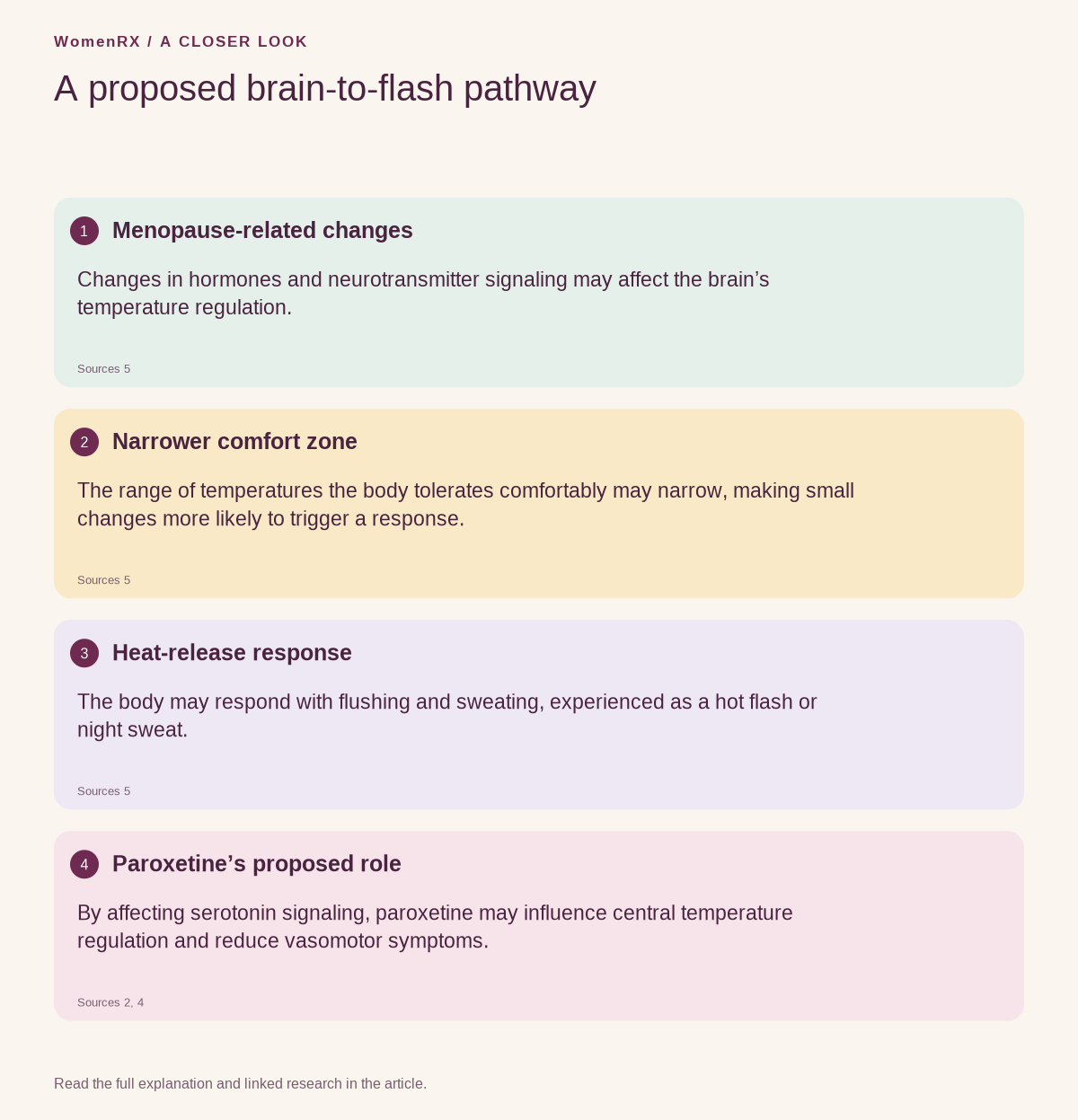
A proposed brain-to-flash pathway
Menopause-related changes: Changes in hormones and neurotransmitter signaling may affect the brain’s temperature regulation.5
Narrower comfort zone: The range of temperatures the body tolerates comfortably may narrow, making small changes more likely to trigger a response.5
Heat-release response: The body may respond with flushing and sweating, experienced as a hot flash or night sweat.5
Paroxetine’s proposed role: By affecting serotonin signaling, paroxetine may influence central temperature regulation and reduce vasomotor symptoms.24
Read the figure as text
This pathway shows one explanation for how serotonin-related signaling may connect menopause-related temperature sensitivity with hot flashes. It’s a proposed mechanism, not a complete account.- Menopause-related changes: Changes in hormones and neurotransmitter signaling may affect the brain’s temperature regulation.5
- Narrower comfort zone: The range of temperatures the body tolerates comfortably may narrow, making small changes more likely to trigger a response.5
- Heat-release response: The body may respond with flushing and sweating, experienced as a hot flash or night sweat.5
- Paroxetine’s proposed role: By affecting serotonin signaling, paroxetine may influence central temperature regulation and reduce vasomotor symptoms.24
Sources you can check
- BRISDELLE (PAROXETINE) CAPSULE [LEGACY PHARMA USA, INC.] | US prescribing information and patient instructionsAccessed 2026-09-25Return to first citation
- Paroxetine: a first for selective serotonin reuptake inhibitors - a new use: approved for vasomotor symptoms in postmenopausal women.Weber L, Thacker HL. · Women's health (London, England) · 2014Return to first citation
- The efficacy and tolerability of SSRI/SNRIs in the treatment of vasomotor symptoms in menopausal women: a systematic review.Handley AP, Williams M. · Journal of the American Association of Nurse Practitioners · 2015Return to first citation
- A Clinical Review on Paroxetine and Emerging Therapies for the Treatment of Vasomotor Symptoms.David PS, Smith TL, Nordhues HC, Kling JM. · International journal of women's health · 2022Return to first citation
- Critical appraisal of paroxetine for the treatment of vasomotor symptoms.Carroll DG, Lisenby KM, Carter TL. · International journal of women's health · 2015Return to first citation