SSRIs and SNRIs for Hot Flashes: What Differs
Some specific medicines in these classes may ease menopausal hot flashes, but their evidence, approval, and safety considerations aren’t interchangeable.
Paroxetine, citalopram, escitalopram, and venlafaxine have been identified in a review of medicines for menopausal hot flashes, but reviews disagree about how well SSRIs and SNRIs work overall. In the US, Brisdelle, a specific paroxetine product, is indicated for moderate-to-severe menopausal hot flashes. The particular medicine, your blood pressure, and medicines such as tamoxifen can shape the choice. 1 2 3
The medicine matters more than the class name
SSRIs affect serotonin signaling; SNRIs affect serotonin and norepinephrine signaling. Some medicines from both classes have been studied for hot flashes and night sweats, but a finding for one medicine doesn’t establish the same benefit for every SSRI or SNRI. 4
A 2017 review identified paroxetine, citalopram, and escitalopram as the most effective SSRIs in its assessment. It identified venlafaxine as its leading first-line SNRI, with desvenlafaxine as another option. Those are the review’s conclusions, not a guarantee that one medicine will work best for you. 3
There’s also a specific US indication to know about: Brisdelle, a paroxetine product, is indicated for moderate-to-severe vasomotor symptoms associated with menopause. Its label says it isn’t approved for psychiatric conditions. That indication applies to Brisdelle, not automatically to other paroxetine products or to either drug class as a whole. 1
Why expectations should stay measured
Reviews don’t reach one simple class-wide answer. A 2017 systematic review and network meta-analysis included 47 randomized trials across 16 treatment classes, involving 8,326 women overall. It found SSRIs and SNRIs ineffective for vasomotor symptoms and reported higher odds of stopping treatment than with placebo. Its analysis focused on women experiencing natural menopause and assessed hot-flash frequency over periods of up to 26 weeks. 2
Another 2017 review concluded that SSRIs and SNRIs reduced hot-flash frequency or severity. A broader comparative-effectiveness review found that they relieved vasomotor symptoms, though less effectively than estrogen. 3 5 Taken together, these findings make the evidence for the specific medicine more useful than a promise about the class.
Be clear about what you want treated
A prescription for hot flashes isn’t necessarily a prescription for depression. Brisdelle’s US indication is menopausal vasomotor symptoms, not a psychiatric condition. If depression or anxiety is also part of your care, ask whether the proposed medicine is intended to address hot flashes, mood symptoms, or both. 1
If you already take an SSRI or SNRI, its class name alone doesn’t tell you whether it will help your hot flashes. Share which medicine you take, why you take it, and what happened if you’ve tried a related medicine before. The aim is to make the decision about your actual treatment goals and prior response, rather than start from scratch. 2 3
Current medicines and health conditions change the tradeoff
If you take tamoxifen, bring that up before choosing a medicine for hot flashes. A review cautioned that SSRIs can interfere with tamoxifen metabolism and described SNRIs as safer in that context. The practical question is whether the particular combination being considered fits your cancer treatment plan, not whether you should stop a current medicine on your own. 3
Blood pressure matters when considering an SNRI such as venlafaxine. The same review reported blood-pressure increases in some patients and flagged hypertension as a factor in treatment selection. 3
Paroxetine has additional product-specific cautions in the Brisdelle label. It warns of increased bleeding risk when combined with medicines such as NSAIDs, aspirin, warfarin, and other anticoagulants. It also lists possible sexual problems, including reduced sexual desire or difficulty reaching orgasm. These are reasons to discuss your complete medicine list and what side effects would matter most to you, not a complete safety profile for every SSRI or SNRI. 1
Nausea and constipation were among the common side effects reported in a review of SSRIs and SNRIs for hot flashes. Ask about the side effects of the specific option you’re considering, alongside the benefit you’d hope to notice. 3
A focused discussion can start with four questions: Which medicine are we considering? Is the goal fewer hot flashes, help with mood symptoms, or both? Do my current medicines or blood pressure change the choice? And what improvement would make the treatment worthwhile to me?
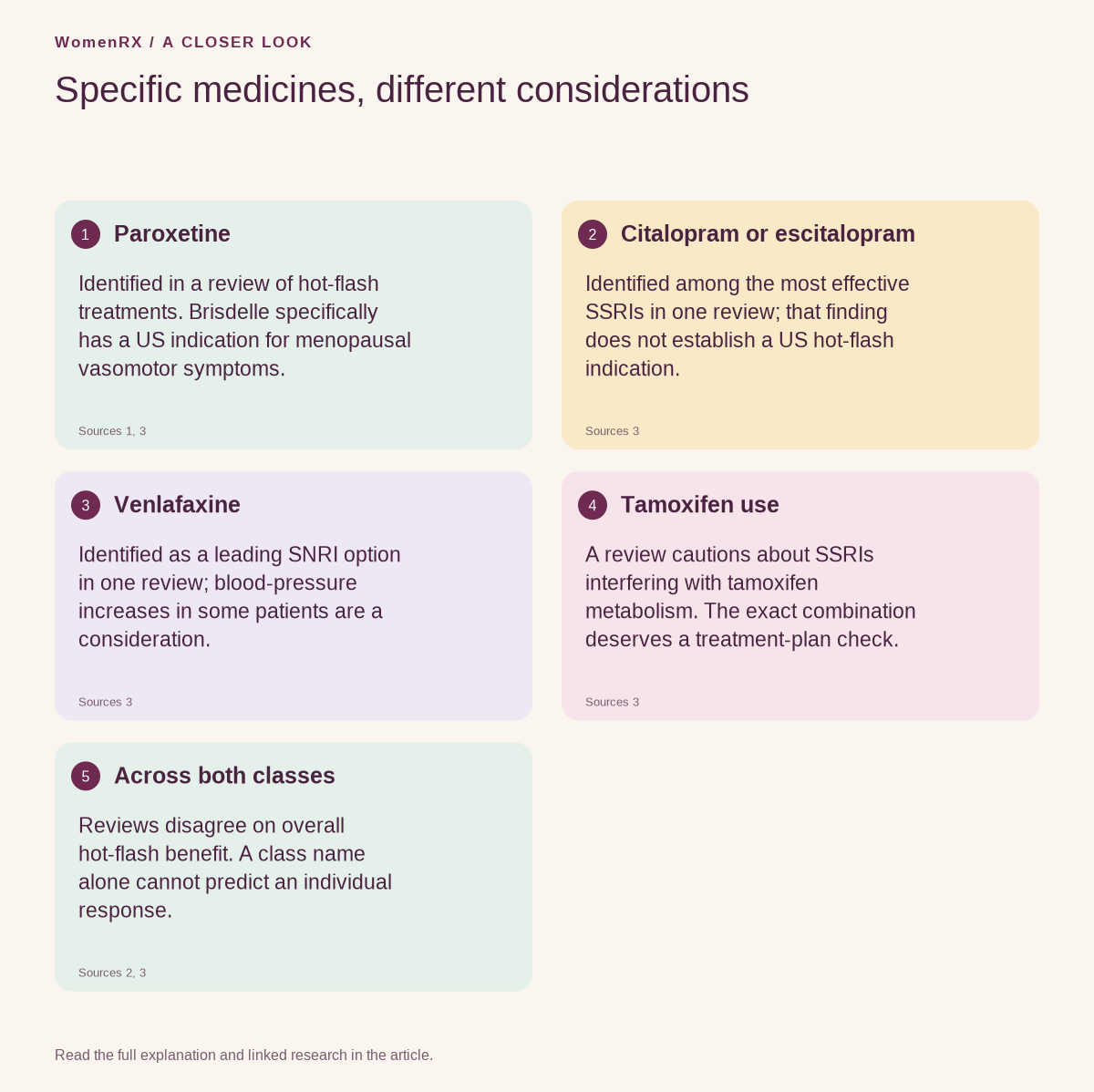
Specific medicines, different considerations
Paroxetine: Identified in a review of hot-flash treatments. Brisdelle specifically has a US indication for menopausal vasomotor symptoms.13
Citalopram or escitalopram: Identified among the most effective SSRIs in one review; that finding does not establish a US hot-flash indication.3
Venlafaxine: Identified as a leading SNRI option in one review; blood-pressure increases in some patients are a consideration.3
Tamoxifen use: A review cautions about SSRIs interfering with tamoxifen metabolism. The exact combination deserves a treatment-plan check.3
Across both classes: Reviews disagree on overall hot-flash benefit. A class name alone cannot predict an individual response.23
Read the figure as text
These examples distinguish medicine-specific review findings from a US product indication and factors that can affect treatment choice.- Paroxetine: Identified in a review of hot-flash treatments. Brisdelle specifically has a US indication for menopausal vasomotor symptoms.13
- Citalopram or escitalopram: Identified among the most effective SSRIs in one review; that finding does not establish a US hot-flash indication.3
- Venlafaxine: Identified as a leading SNRI option in one review; blood-pressure increases in some patients are a consideration.3
- Tamoxifen use: A review cautions about SSRIs interfering with tamoxifen metabolism. The exact combination deserves a treatment-plan check.3
- Across both classes: Reviews disagree on overall hot-flash benefit. A class name alone cannot predict an individual response.23
Sources you can check
- BRISDELLE (PAROXETINE) CAPSULE [LEGACY PHARMA USA, INC.] | US prescribing information and patient instructionsAccessed 2026-09-25Return to first citation
- Vasomotor symptoms resulting from natural menopause: a systematic review and network meta-analysis of treatment effects from the National Institute for Health and Care Excellence guideline on menopause.Sarri G, Pedder H, Dias S, Guo Y, Lumsden MA. · BJOG : an international journal of obstetrics and gynaecology · 2017Return to first citation
- Do SSRIs and SNRIs reduce the frequency and/or severity of hot flashes in menopausal women.Stubbs C, Mattingly L, Crawford SA, Wickersham EA, Brockhaus JL, McCarthy LH. · The Journal of the Oklahoma State Medical Association · 2017Return to first citation
- Precision pharmacology in menopause: advances, challenges, and future innovations for personalized management.Guo ZQ. · Frontiers in reproductive health · 2025Return to first citation
- Menopausal Symptoms: Comparative Effectiveness of TherapiesGrant MD, Marbella A, Wang AT, Pines E, Hoag J, Bonnell C, Ziegler KM, Aronson N. · 2015Return to first citation