Nonhormonal Treatments for Menopause Hot Flashes, Compared
Prescription medicines and behavioral treatments can help with hot flashes, but their safety checks and day-to-day trade-offs differ.
If you want to treat menopause-related hot flashes without hormones, evidence-supported options include certain SSRIs or SNRIs, gabapentin, fezolinetant, oxybutynin, cognitive behavioral therapy, and clinical hypnosis. They aren’t interchangeable: fezolinetant requires liver monitoring, gabapentin may affect alertness, and behavioral treatments avoid adding a medicine. Your health history and preferences can help narrow the choice. 1 2 7
First, decide what kind of treatment fits
Hot flashes that interrupt sleep, work, or ordinary moments of the day deserve more than a suggestion to dress in layers. If you prefer not to use hormones, the North American Menopause Society recommends several nonhormonal treatments: certain antidepressants called SSRIs and SNRIs, gabapentin, fezolinetant, oxybutynin, cognitive behavioral therapy (CBT), and clinical hypnosis. The guideline also supports weight loss, though at a lower evidence level. 7
These recommendations tell you which approaches have evidence behind them, not that they work equally well or that one is best for everyone. Hormone therapy remains the most effective treatment for hot flashes overall. You can still make a useful nonhormonal choice by comparing what each option asks of you and which risks matter in your life. 6 7
Prescription options have different trade-offs
SSRIs and SNRIs: These antidepressant medicines can also reduce menopause-related hot flashes. Paroxetine and venlafaxine are examples identified as potentially beneficial in a review of randomized trials, though that older review noted methodological weaknesses in many studies. 5 If you have cardiovascular disease, the specific medicine deserves a closer discussion: a review found that SSRIs and SNRIs should be used cautiously in women with conditions such as arrhythmia, atherosclerotic disease, or a prior stroke. That is a reason to assess your individual situation, not a blanket rule that everyone with heart disease must avoid the entire group. 4
Gabapentin: Menopause guidance recommends it for hot flashes, but sleepiness, tiredness, and dizziness are possible side effects. Think about what an alertness change would mean for you, whether that’s driving, working, or caring for someone else. Gabapentin also shouldn’t be stopped suddenly without discussing how to come off it, because withdrawal symptoms can occur. 2 3 7
Fezolinetant: This nonhormonal prescription medicine is specifically used for moderate to severe menopause-related hot flashes. Its most distinctive practical requirement is liver monitoring: the US prescribing information calls for blood tests before treatment, monthly for the first three months, then at months six and nine. Serious liver problems are possible. If you develop symptoms such as dark urine or yellowing of your eyes or skin while taking it, stop the medicine and contact your healthcare provider right away. It must not be used by people with cirrhosis, severe kidney problems or kidney failure, or those taking certain medicines that inhibit CYP1A2. A review of your medicines and whether the testing schedule is workable are central to this choice. 1
Oxybutynin: The menopause guideline also recommends it, with a somewhat lower evidence rating than the medicines above. That rating isn’t a direct measurement of how much relief you personally would get. If it’s being considered, ask about the side effects and suitability of the specific formulation rather than treating all the prescription options as equivalent. 7
Behavioral treatment is different from general lifestyle advice
CBT and clinical hypnosis are recommended hot-flash treatments. They may appeal if you don’t want to add a medicine, or if you’d like to discuss a behavioral option alongside other care. They’re distinct from simply being told to relax or avoid triggers. 7
That distinction matters when you’re spending time, effort, or money on a plan. The same guideline does not recommend cooling techniques, avoiding triggers, exercise, yoga, mindfulness-based interventions, relaxation, or paced breathing as treatments for hot flashes. You can still do something because it feels comfortable or benefits another part of your life. Just don’t expect it to stand in for a treatment with stronger hot-flash evidence. Supplements and herbal remedies aren’t recommended for this purpose either. 7
Narrow the choice to what matters to you
If you want to avoid another medicine, CBT or clinical hypnosis is a reasonable place to start the conversation. If you want a prescription option, the comparison becomes more personal: Would dizziness or sleepiness be disruptive? Could you manage fezolinetant’s scheduled blood tests? Do a heart condition, liver or kidney problems, or medicines you already take change the options worth considering? 1 2 4 7
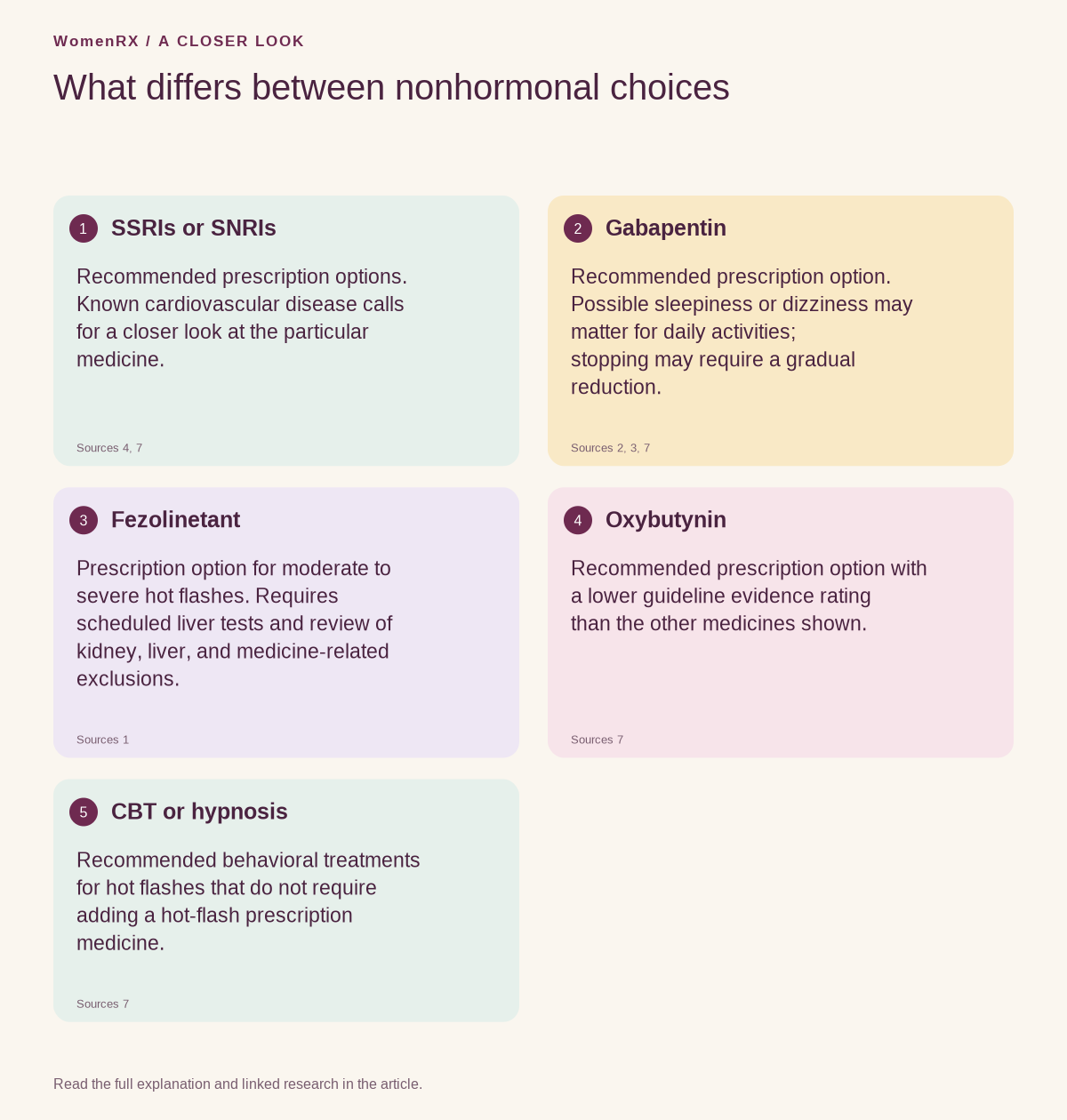
What differs between nonhormonal choices
SSRIs or SNRIs: Recommended prescription options. Known cardiovascular disease calls for a closer look at the particular medicine.47
Gabapentin: Recommended prescription option. Possible sleepiness or dizziness may matter for daily activities; stopping may require a gradual reduction.237
Fezolinetant: Prescription option for moderate to severe hot flashes. Requires scheduled liver tests and review of kidney, liver, and medicine-related exclusions.1
Oxybutynin: Recommended prescription option with a lower guideline evidence rating than the other medicines shown.7
CBT or hypnosis: Recommended behavioral treatments for hot flashes that do not require adding a hot-flash prescription medicine.7
Read the figure as text
Compare treatment type and the practical consideration most likely to shape a discussion; these are not effectiveness rankings.- SSRIs or SNRIs: Recommended prescription options. Known cardiovascular disease calls for a closer look at the particular medicine.47
- Gabapentin: Recommended prescription option. Possible sleepiness or dizziness may matter for daily activities; stopping may require a gradual reduction.237
- Fezolinetant: Prescription option for moderate to severe hot flashes. Requires scheduled liver tests and review of kidney, liver, and medicine-related exclusions.1
- Oxybutynin: Recommended prescription option with a lower guideline evidence rating than the other medicines shown.7
- CBT or hypnosis: Recommended behavioral treatments for hot flashes that do not require adding a hot-flash prescription medicine.7
More questions, answered
Is a cooling strategy worth trying if it isn’t a recommended treatment?
You can choose a cooling measure as a personal comfort preference, but menopause guidance does not recommend cooling techniques as a treatment for hot flashes. It shouldn’t replace an evidence-supported option if you’re seeking treatment. 7
Sources you can check
- VEOZAH (FEZOLINETANT) TABLET, FILM COATED [ASTELLAS PHARMA US, INC.] | US prescribing information and patient instructionsAccessed 2026-09-25Return to first citation
- About gabapentin - NHSAccessed 2026-09-25Return to first citation
- Side effects of gabapentin - NHSAccessed 2026-09-25Return to first citation
- Non-Hormonal Replacement Therapy Regimens: Do they have an Effect on Cardiovascular Risk?Mareti E, Ampatzi C, Paschou SA, Voziki E, Goulis DG. · Current vascular pharmacology · 2019Return to first citation
- Non-hormonal therapy of post-menopausal vasomotor symptoms: a structured evidence-based review.Cheema D, Coomarasamy A, El-Toukhy T. · Archives of gynecology and obstetrics · 2007Return to first citation
- The 2022 hormone therapy position statement of The North American Menopause Society.“The 2022 Hormone Therapy Position Statement of The North American Menopause Society” Advisory Panel. · Menopause (New York, N.Y.) · 2022Return to first citation
- The 2023 nonhormone therapy position statement of The North American Menopause Society.Menopause (New York, N.Y.) · 2023Return to first citation