Nonhormonal Hot Flash Treatments: How to Compare Your Options
Several nonhormonal treatments can help with menopause hot flashes, but the choice depends on evidence, preferences, and medicine-specific risks.
If hot flashes are disrupting your day or sleep, you have evidence-supported options that don’t use hormones. They include cognitive behavioral therapy, clinical hypnosis, certain antidepressants, gabapentin, and fezolinetant. The Menopause Society recommends each of these, but its evidence ratings don’t mean they work equally well. Supplements have less reliable support as a treatment category. 5
Start with the kind of treatment you’d consider
A hot flash can feel like heat rising suddenly through your face and chest, sometimes followed by sweating. At night, that interruption can make the next day harder, too. Changes in estrogen and the brain’s temperature-regulating signals help explain why these episodes happen during menopause. 7
If you want to avoid hormone therapy, you don’t have to choose between putting up with hot flashes and trying a supplement. The Menopause Society’s 2023 nonhormone therapy statement recommends several behavioral and prescription approaches. Its evidence levels tell you how well supported an option is, not how much relief every person will get or whether two options work equally well. Hormone therapy remains the most effective treatment overall, but it may not suit your health history or your preference. 45
What each option brings to the decision
| Option | Evidence for menopause hot flashes | What to weigh |
|---|---|---|
| Cognitive behavioral therapy (CBT) or clinical hypnosis | Both are recommended with Level I evidence. 5 | These are structured behavioral treatments, not medicines. Ask what a course of treatment involves and whether that format appeals to you. |
| SSRIs or SNRIs | These antidepressant categories are recommended with Level I evidence. 5 | The category isn’t a single medicine. Ask which specific drug is being considered and how it fits with your other medicines and health history. |
| Gabapentin | Recommended with Level I evidence. 5 | Sleepiness, tiredness, and dizziness are possible. Think about how those effects might affect work, driving, or other daily activities. 23 |
| Fezolinetant | Recommended with Level I evidence; it’s a nonhormonal prescription medicine for moderate to severe symptoms. 15 | It requires liver blood tests and a check for certain health conditions and medicine interactions. 1 |
| Oxybutynin | Recommended with Level I-II evidence. 5 | Ask about the risks of this specific medicine rather than assuming it shares the tradeoffs of the Level I options. |
| Weight loss | Recommended with Level II-III evidence. 5 | It has less certain support and is not a prerequisite for getting hot flash treatment. |
The practical split is between a structured treatment you participate in and a prescription medicine you take, sometimes with monitoring. If avoiding another medicine matters most to you, CBT or clinical hypnosis may be worth discussing first. If you’re considering a prescription, its particular risks matter more than the broad label “nonhormonal.”
Fezolinetant calls for a closer safety check
Fezolinetant is prescribed specifically to reduce moderate to severe menopause-related hot flashes. It isn’t a hormone. Its US prescribing information calls for liver blood testing before treatment, monthly for the first three months, and again at months six and nine. It says not to use the medicine if you have cirrhosis, severe kidney problems or kidney failure, or take certain medicines called CYP1A2 inhibitors. That makes your health history and a complete list of prescription medicines, over-the-counter medicines, and supplements particularly relevant to this choice. 1
The liver warning also gives you a concrete sign to act on: if you’re taking fezolinetant and develop yellowing of the eyes or skin, dark urine, or other symptoms listed in its patient information, the instructions say to stop taking it and call your healthcare provider. 1
Keep comfort measures and treatments in different categories
The Menopause Society does not recommend supplements or herbal remedies as a category for treating hot flashes. It also does not recommend cooling techniques, avoiding triggers, exercise, yoga, mindfulness, or relaxation as proven hot flash treatments. You can still use a fan if it makes an episode more comfortable. The distinction is whether an approach has reliable evidence for reducing the symptoms themselves. 5
Research on supplements can change, but one promising result isn’t proof for everything on the shelf. In a 12-week placebo-controlled trial of one specific multi-ingredient botanical formula, 74 menopausal women with at least five moderate to severe hot flashes a day were randomized and 68 completed the trial. The formula group had 2.2 fewer hot flashes per day than the placebo group. That finding does not tell you whether a different product works or what happens with longer use. 6
Questions that can narrow your choice
You don’t need to ask which nonhormonal option is universally best. A more useful conversation starts with what you want to change and what tradeoffs you can accept:
- Would I rather try a structured behavioral treatment or consider a prescription medicine?
- If you’re suggesting an SSRI or SNRI, which medicine do you mean, and how does it fit with what I already take?
- If gabapentin is an option, how might sleepiness or dizziness affect my usual day? 23
- If fezolinetant is an option, do my conditions or medicines rule it out, and can I complete the required liver testing? 1
- What improvement in my hot flashes or disrupted sleep would make this choice worthwhile to me?
Those answers can turn a long list of treatments into a decision that fits your symptoms and your life.
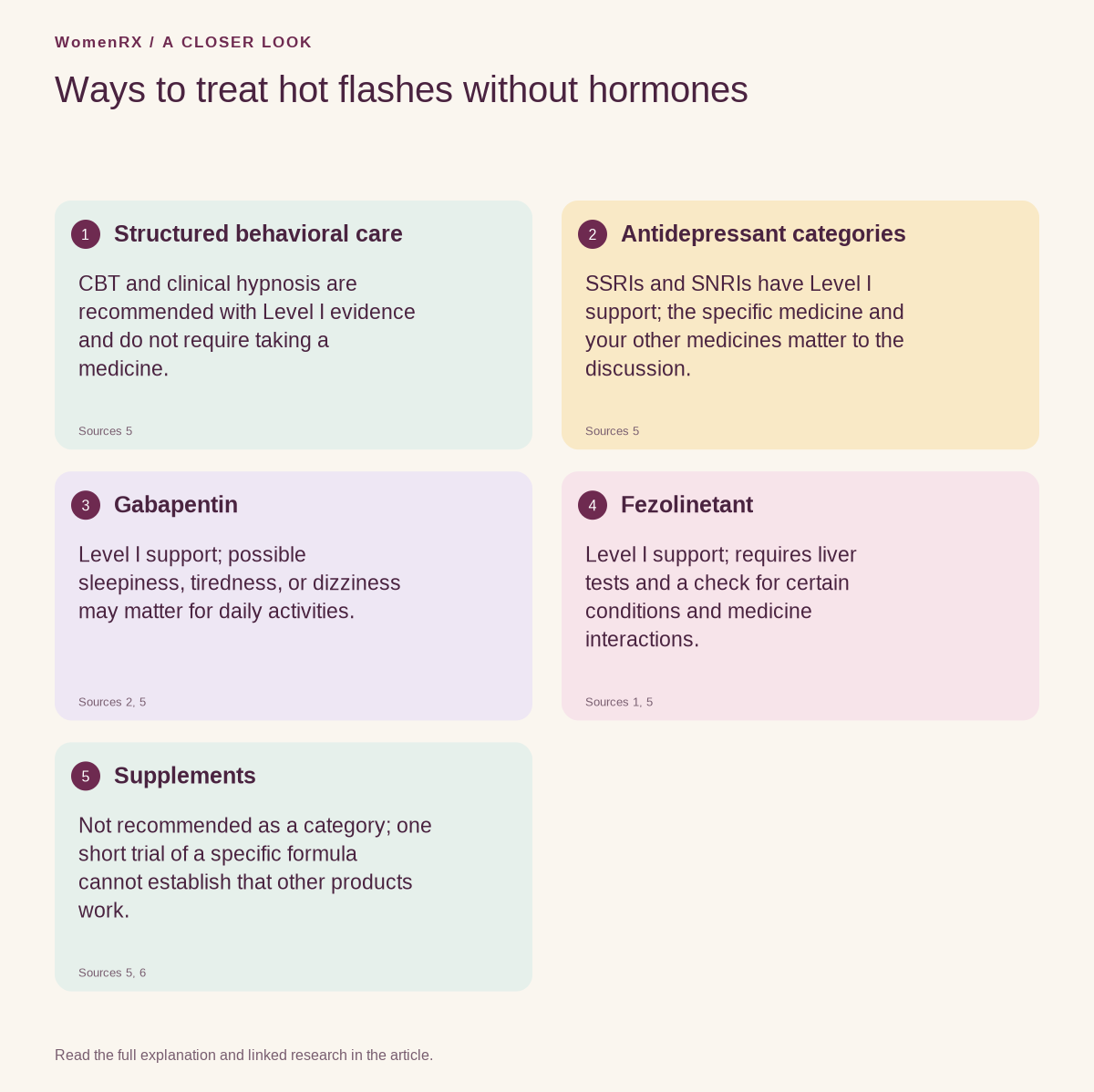
Ways to treat hot flashes without hormones
Structured behavioral care: CBT and clinical hypnosis are recommended with Level I evidence and do not require taking a medicine.5
Antidepressant categories: SSRIs and SNRIs have Level I support; the specific medicine and your other medicines matter to the discussion.5
Gabapentin: Level I support; possible sleepiness, tiredness, or dizziness may matter for daily activities.25
Fezolinetant: Level I support; requires liver tests and a check for certain conditions and medicine interactions.15
Supplements: Not recommended as a category; one short trial of a specific formula cannot establish that other products work.56
Read the figure as text
Use the evidence ratings alongside each option’s format and practical tradeoffs, not as a ranking of expected relief.- Structured behavioral care: CBT and clinical hypnosis are recommended with Level I evidence and do not require taking a medicine.5
- Antidepressant categories: SSRIs and SNRIs have Level I support; the specific medicine and your other medicines matter to the discussion.5
- Gabapentin: Level I support; possible sleepiness, tiredness, or dizziness may matter for daily activities.25
- Fezolinetant: Level I support; requires liver tests and a check for certain conditions and medicine interactions.15
- Supplements: Not recommended as a category; one short trial of a specific formula cannot establish that other products work.56
Sources you can check
- VEOZAH (FEZOLINETANT) TABLET, FILM COATED [ASTELLAS PHARMA US, INC.] | US prescribing information and patient instructionsAccessed 2026-09-25Return to first citation
- About gabapentin - NHSAccessed 2026-09-25Return to first citation
- Side effects of gabapentin - NHSAccessed 2026-09-25Return to first citation
- The 2022 hormone therapy position statement of The North American Menopause Society.“The 2022 Hormone Therapy Position Statement of The North American Menopause Society” Advisory Panel. · Menopause (New York, N.Y.) · 2022Return to first citation
- The 2023 nonhormone therapy position statement of The North American Menopause Society.Menopause (New York, N.Y.) · 2023Return to first citation
- Neurokinin pathway botanical antagonist for menopausal vasomotor symptoms: A randomized, double-blind, placebo-controlled study.Lederman S, Minkin MJ, Doyle AL, Rubio J, Recker S, Lin LX, VanDusseldorp T. · Maturitas · 2026Return to first citation
- Hot flashes: a review.Jamal S, Elsabagh A, Wani L, Issa M. · Frontiers in medicine · 2026Return to first citation