Menopause Mood Changes: Nonhormonal Support and Next Steps
Brief irritability and persistent depression or anxiety call for different kinds of support, and neither should be explained away by menopause alone.
A short-lived mood dip may pass, but low mood, loss of interest, or worry that persists or disrupts daily life deserves support. Options include psychotherapy such as cognitive behavioral therapy (CBT), medication, or both, depending on what you’re experiencing. Sleep problems, stress, hot flashes, and your past mood history are useful context to share, not proof of a cause. Thoughts of self-harm need immediate help. 1 2
Mood changes deserve attention, not assumptions
Irritability after a hard day is different from feeling low or anxious most days and struggling to get through your usual routine. Mood changes and sleep disruption are commonly reported during the menopause transition, but that overlap doesn’t show what is causing your symptoms. Menopause may be part of the picture; it shouldn’t automatically be treated as the whole explanation. 2 4
If you’re in perimenopause or postmenopause, either stage can be relevant when you seek support. A small CBT case series included women in both stages, but it doesn’t show that every mood change during menopause is caused by hormonal changes. Your current stress, sleep, hot flashes, and any past depression or anxiety can help describe the broader picture. 3
Choose support based on how it’s affecting you
For brief, manageable irritability: If you’re still managing daily life and the mood change eases, a support group or stress-management techniques may be useful, particularly if you’re under strain. These are options for support, not a substitute for assessment if symptoms persist or grow harder to manage. Anxiety care can also include support groups and stress-management techniques. 1
For ongoing low mood or anxiety: Psychotherapy is one nonhormonal option. CBT helps you notice and change patterns in thinking and behavior, including how you respond to distressing situations. In one small case series, 20 women in perimenopause or postmenopause began a general CBT program for mood symptoms, and 16 completed all eight sessions. Their depression and anxiety questionnaire scores declined over the sessions. Because this was a small case series without a comparison group, it’s preliminary evidence, not proof of how much CBT itself helped or what another person will experience. 1 3
When symptoms are affecting daily life: A clinician can assess whether depression, an anxiety disorder, or another issue may be involved. Psychotherapy, medication, or a combination may be considered. Antidepressants are among the medicines used for depression; medicines for anxiety can include certain antidepressants and anti-anxiety medicines. Finding a suitable medicine may take time, and side effects are worth discussing. Don’t stop a prescribed antidepressant without first talking with the prescriber. 1 2
Medication isn’t the only distinction between options. Therapy can focus on the thoughts, emotions, and behaviors involved in distress; medication may be part of treatment for depression or an anxiety disorder. A provider can discuss either or both based on your symptoms and needs. If sleep or hot flashes are also bothering you, mention them too, without assuming they explain your mood. 1 2 4
When to reach out, and when to get urgent help
Depression is more than feeling sad or irritable for a few days. A common pattern includes depressed mood or loss of interest, with symptoms affecting daily activities for at least two weeks. Anxiety merits attention when worry is hard to control, doesn’t go away, or interferes with work, relationships, or other everyday activities. You don’t have to wait for a particular diagnosis or timeline to ask for help if you’re struggling. 1 2
Assessment can include your symptoms and medical history. Some medical conditions, including thyroid disorders, and some medicines can cause symptoms that resemble depression, so it may be useful to review the whole picture rather than assume menopause is responsible. 2
If you’re thinking about hurting yourself or attempting suicide, get help right away. If there’s an immediate emergency, call 911. Those thoughts are not ordinary mood swings to wait out. 2
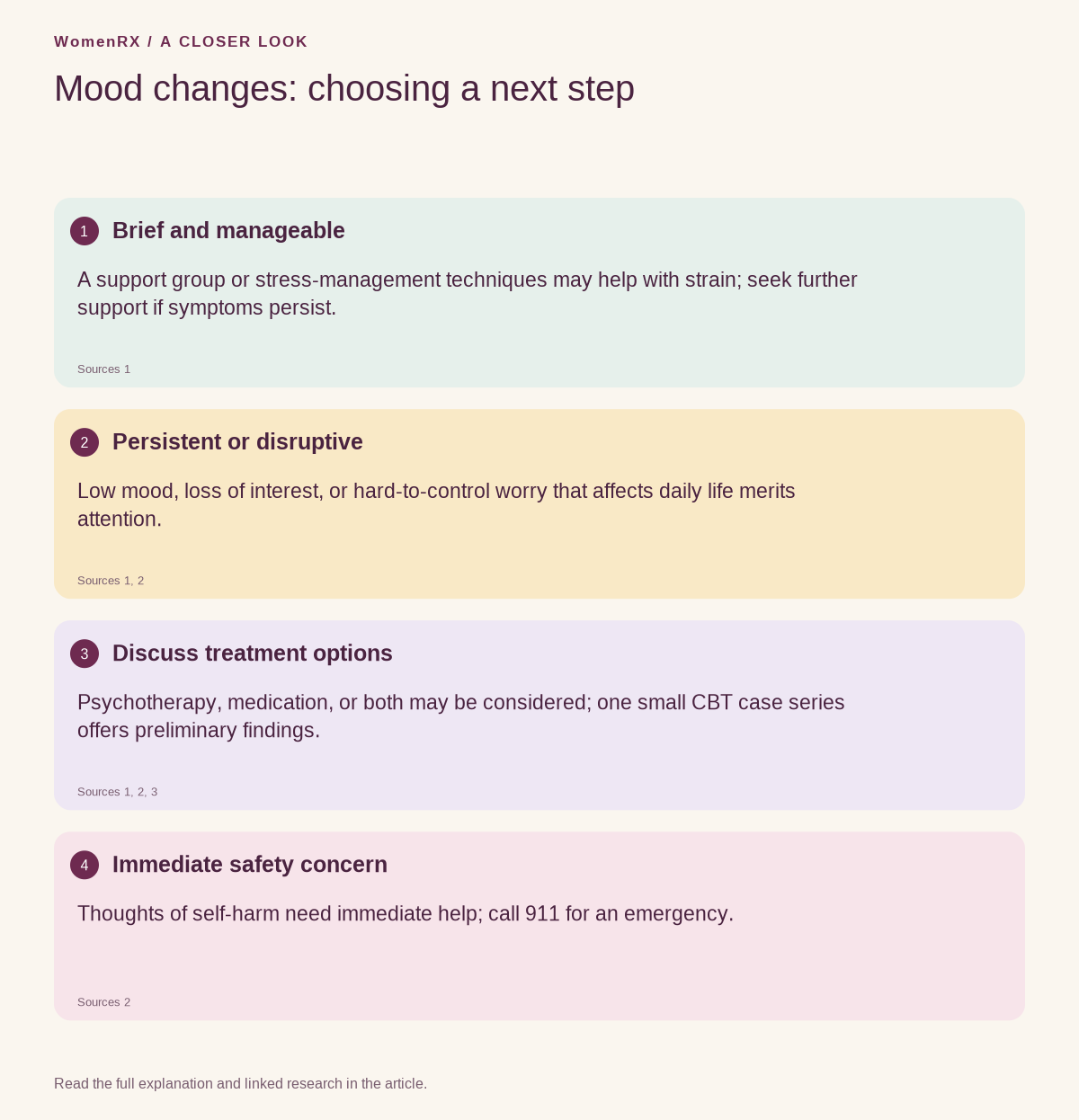
Mood changes: choosing a next step
Brief and manageable: A support group or stress-management techniques may help with strain; seek further support if symptoms persist.1
Persistent or disruptive: Low mood, loss of interest, or hard-to-control worry that affects daily life merits attention.12
Discuss treatment options: Psychotherapy, medication, or both may be considered; one small CBT case series offers preliminary findings.123
Immediate safety concern: Thoughts of self-harm need immediate help; call 911 for an emergency.2
Read the figure as text
Duration, daily impact, and safety concerns can help distinguish a passing rough patch from a reason to seek support.- Brief and manageable: A support group or stress-management techniques may help with strain; seek further support if symptoms persist.1
- Persistent or disruptive: Low mood, loss of interest, or hard-to-control worry that affects daily life merits attention.12
- Discuss treatment options: Psychotherapy, medication, or both may be considered; one small CBT case series offers preliminary findings.123
- Immediate safety concern: Thoughts of self-harm need immediate help; call 911 for an emergency.2
More questions, answered
Does CBT need to be menopause-specific?
The small case series described general CBT, not a program tailored to menopause, and included women in perimenopause and postmenopause. It suggests CBT may be an option, but the study design can’t establish how effective it is. 3
Do I need to wait two weeks before asking for help?
No. Two weeks is part of a common pattern used to assess major depression, not a rule that you must wait before reaching out. Ask for support sooner if symptoms concern you or interfere with daily life; thoughts of self-harm need immediate help. 2
Sources you can check
- Anxiety: MedlinePlusAccessed 2026-09-25Return to first citation
- Depression: MedlinePlusAccessed 2026-09-25Return to first citation
- Eight-session manualized cognitive behavioral therapy for anxiety and depression symptoms in perimenopause and postmenopause: a pilot study.Hantsoo L, Friedman-Wheeler DG, Lofland G, Harrison SA, Smith G, Shen W. · Menopause (New York, N.Y.) · 2026Return to first citation
- A Review of Cognitive, Sleep, and Mood Changes in the Menopausal Transition: Beyond Vasomotor Symptoms.Williams M, Maki PM. · Obstetrics and gynecology · 2025Return to first citation