Menopause Mood Changes: When to Get Help
Brief mood shifts can happen, but symptoms that persist, disrupt daily life, or raise safety concerns deserve support.
If a mood change passes and you can still manage daily life, it may be reasonable to notice whether it returns. Seek an assessment when low mood, loss of interest, or anxiety persists or interferes with work, sleep, relationships, or basic routines. Depression symptoms lasting at least two weeks are one reason to get evaluated, but you don’t need to wait if things are worsening. Thoughts of self-harm call for help right away. 1 2
A useful distinction: passing or taking over?
A difficult day, irritability, or a spell of worry doesn’t automatically mean you have depression or an anxiety disorder. Anxiety can be a normal response to stress; it becomes more concerning when fear or worry doesn’t let up, gets worse, or interferes with everyday activities. 1
Pay attention to what’s changing and how much it’s affecting you. Persistent sadness or emptiness, losing interest in things you usually enjoy, or finding ordinary tasks hard to manage are more concerning than a brief shift in mood. Depression symptoms that affect daily life and last at least two weeks warrant assessment. Don’t treat two weeks as a waiting period, though: seek help sooner if symptoms are severe, worsening, or disrupting your life. 2
Menopause may be part of the picture, not the whole picture
Mood symptoms can show up during the menopause transition, but they shouldn’t automatically be written off as “just hormones.” Prior depression, anxiety symptoms, and psychosocial stressors are among the factors associated with depressive symptoms during perimenopause. 4
Sleep trouble and mood changes can also occur together during perimenopause. That overlap doesn’t establish what’s causing your symptoms or rule out a separate mental health condition. Medicines and some medical conditions, including thyroid disorders, can also cause symptoms that resemble depression. An assessment can consider your mood, health history, sleep, life circumstances, and possible medical contributors. 2 3
This context matters if you’ve had depression or anxiety before, or if life has become especially stressful. It doesn’t mean you’ll necessarily become depressed, and you don’t need to figure out the cause before asking for help.
Choose the level of support that fits
Get help right away for thoughts of self-harm. Tell someone you trust and reach out for immediate help. If you may act on those thoughts or can’t stay safe, call 911. 2
Arrange an assessment when symptoms persist or interfere. Contact a primary care or mental health provider if low mood, loss of interest, or hard-to-control worry keeps returning or makes work, relationships, sleep, or daily tasks difficult. Anxiety disorders can involve persistent worry and physical symptoms such as a racing heartbeat, dizziness, or shortness of breath. 1 Depression can make even basic activities such as sleeping, eating, or working difficult. 2
Keep an eye on brief changes that settle. If a mood shift passes, doesn’t keep returning, and isn’t affecting your ability to function or stay safe, you can observe whether it follows a recognizable stressor or poor sleep. If it persists or starts to take over more of your life, move to an assessment rather than assuming it’s menopause.
Help can address mood, not just menopause symptoms
An assessment may include questions about how long symptoms have lasted, how they affect you, your health and family history, and medicines or conditions that could contribute. For depression, a provider may use this information and, when appropriate, tests to check for other causes. 2
Psychotherapy and medicines are common treatment options for depression; psychotherapy and medicines are also used for anxiety disorders. The right approach depends on the symptoms and your needs. 1 2 You can ask directly for help with mood or anxiety during the menopause transition. You don’t have to wait for hot flashes or other physical symptoms to be treated first, and you don’t have to prove that hormones are the cause before getting support.
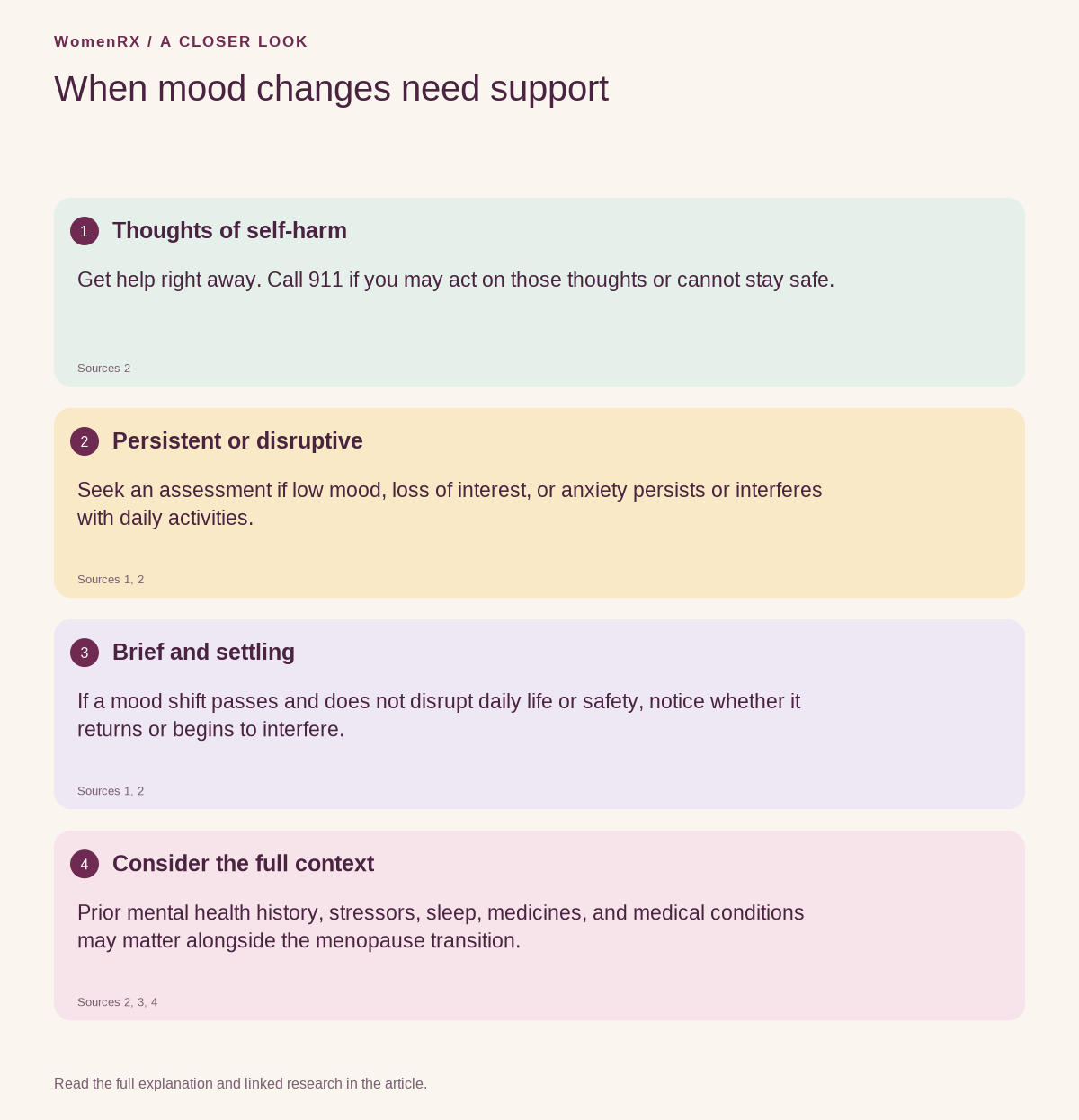
When mood changes need support
Thoughts of self-harm: Get help right away. Call 911 if you may act on those thoughts or cannot stay safe.2
Persistent or disruptive: Seek an assessment if low mood, loss of interest, or anxiety persists or interferes with daily activities.12
Brief and settling: If a mood shift passes and does not disrupt daily life or safety, notice whether it returns or begins to interfere.12
Consider the full context: Prior mental health history, stressors, sleep, medicines, and medical conditions may matter alongside the menopause transition.234
Read the figure as text
Use safety, persistence, and impact on daily life to choose a next step. This is a practical guide, not a diagnostic test.- Thoughts of self-harm: Get help right away. Call 911 if you may act on those thoughts or cannot stay safe.2
- Persistent or disruptive: Seek an assessment if low mood, loss of interest, or anxiety persists or interferes with daily activities.12
- Brief and settling: If a mood shift passes and does not disrupt daily life or safety, notice whether it returns or begins to interfere.12
- Consider the full context: Prior mental health history, stressors, sleep, medicines, and medical conditions may matter alongside the menopause transition.234
Sources you can check
- Anxiety: MedlinePlusAccessed 2026-09-25Return to first citation
- Depression: MedlinePlusAccessed 2026-09-25Return to first citation
- Can acupuncture improve sleep quality and anxiety among women during perimenopause?: A protocol for systematic review and meta-analysis.Ping Y, Liang C, Fan X, Zhang L, Ying D, Wang Z. · Medicine · 2022Return to first citation
- Association analysis between vitamin D level and depression in women perimenopause: A protocol of systematic review and meta-analysis.Yuan J, Chen T, Lei Y, Wei S, Yu P, Cao Y, Zhao Y, Chen J. · Medicine · 2020Return to first citation