Mood Changes Before and After Menopause
The final period changes your reproductive stage, but it doesn’t set a deadline for mood symptoms to end.
Perimenopause is the transition toward the final menstrual period; postmenopause describes the years beyond the transition. Mood symptoms can occur in either stage, but stage alone doesn’t tell you whether they’re more common or severe in one than the other. Notice whether a change comes and goes with your cycle, persists regardless of bleeding, or disrupts daily life. 1 2 5 6
The final period is a stage marker, not a mood cutoff
Perimenopause describes the transition toward the final menstrual period. Changes in bleeding patterns help researchers identify where someone is in that transition. Postmenopause describes the years beyond it. Those labels describe reproductive timing; they don’t tell you when a mood change should begin or end. 1 2
For example, you might notice irritability that comes and goes while your cycles are changing. Or you might have low mood that stays with you even after periods have stopped. Either pattern is worth understanding on its own terms. Neither proves that a reproductive stage is the cause.
Is mood different after menopause?
A review of hormone therapy and mood reported depressive symptoms during the menopausal transition. It also found that estrogen therapy’s effects on mood appeared more consistent in perimenopause than in postmenopause. That is a finding about treatment response, not proof that mood symptoms are more common before the final period or that they disappear afterward. The review described hormonal fluctuations as a possible contributor to depressive symptoms, not a complete explanation for any one person’s mood. 5
A small study of cognitive behavioral therapy included people with mood symptoms in both perimenopause and postmenopause. Depression and anxiety scores fell over the course of therapy. The report describes a case series with before-and-after scores but does not describe a comparison group or report results separately by reproductive stage. It cannot tell us which stage carries a greater risk or how much of the change was due to therapy. 6
The practical distinction, then, isn’t “mood changes before menopause, no mood changes after.” It’s what your symptoms are doing now and how much they’re affecting you.
Compare the pattern, not just the stage
If you still have periods, bleeding dates can give mood changes some context. Does a change seem to recur around a similar point in a cycle, or does it remain steady regardless of bleeding? Is it an occasional difficult day, or has it become a persistent change that interferes with work, relationships, or ordinary routines? These questions help describe the pattern without turning a calendar into a diagnosis.
Cycle timing can also become less straightforward during perimenopause. Research staging criteria use changes in cycle length and longer gaps without bleeding, but researchers have found that reproductive stages are not always defined consistently across studies. That is one reason to be cautious about treating a stage label as an explanation for mood. 2
If cancer treatment has changed or stopped your bleeding, a period-based comparison may be especially misleading. In a study of adolescent and young adult cancer survivors, bleeding patterns and hormone markers sometimes suggested different reproductive stages. The study did not examine mood, and its findings cannot predict what happens after every treatment. 3
Give persistent symptoms their own attention
You don’t need to settle whether a mood change is “from menopause” before taking it seriously. If you choose to discuss low mood, anxiety, or irritability with a clinician, you can describe whether it has persisted, worsened, or made daily life harder. Mention when it began and whether it comes in episodes or stays present. If cycles are still happening, their timing may be useful context, but it is only one part of the picture.
Treatment questions also depend on the problem you’re trying to address. Hormone therapy is well supported for bothersome hot flashes and night sweats, while its effects on mood are less clear, particularly after menopause. A response to any treatment would not, by itself, establish why the mood symptoms began. 4 5
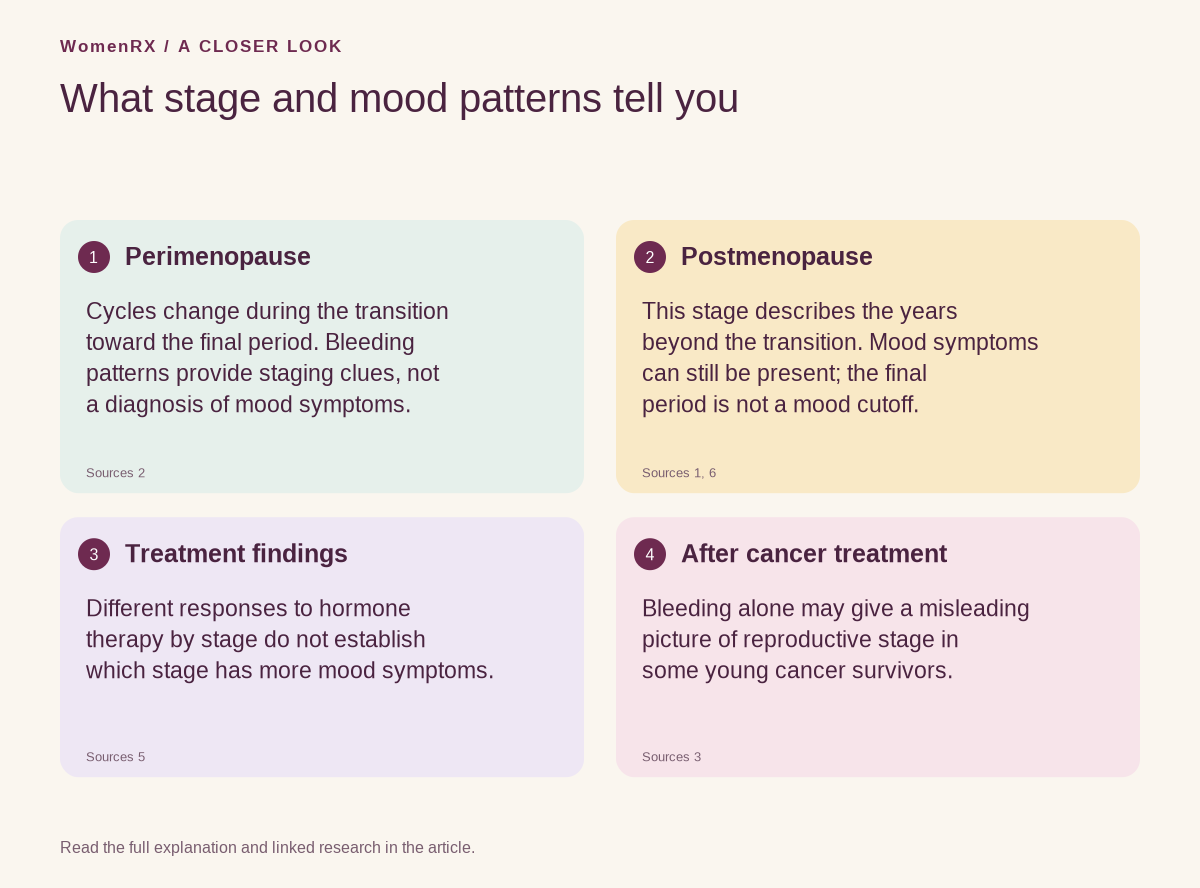
What stage and mood patterns tell you
Perimenopause: Cycles change during the transition toward the final period. Bleeding patterns provide staging clues, not a diagnosis of mood symptoms.2
Postmenopause: This stage describes the years beyond the transition. Mood symptoms can still be present; the final period is not a mood cutoff.16
Treatment findings: Different responses to hormone therapy by stage do not establish which stage has more mood symptoms.5
After cancer treatment: Bleeding alone may give a misleading picture of reproductive stage in some young cancer survivors.3
Read the figure as text
Reproductive stage describes timing; the pattern of a mood change answers a different question.- Perimenopause: Cycles change during the transition toward the final period. Bleeding patterns provide staging clues, not a diagnosis of mood symptoms.2
- Postmenopause: This stage describes the years beyond the transition. Mood symptoms can still be present; the final period is not a mood cutoff.16
- Treatment findings: Different responses to hormone therapy by stage do not establish which stage has more mood symptoms.5
- After cancer treatment: Bleeding alone may give a misleading picture of reproductive stage in some young cancer survivors.3
Sources you can check
- Women in healthy transition deep phenotyping cohort study protocol (KiSO-DP): a within-participant multidisciplinary longitudinal cohort study across the menopausal transition.Tamariz-Ellemann A, Kleis-Olsen AS, Andersen AB, Thomsen LB, Rocha MP, Frydenholm JF, Jensen JS, Loekkegaard ECL, Hellsten Y, Hybholt M, Gliemann L. · BMJ open · 2026Return to first citation
- Considerations and practical recommendations for identifying perimenopause in longitudinal research.Huibregtse ME, Taylor L, Prochaska T, Arnold AR, Epperson CN, Chahine EB, Smith AK, Powers A, Michopoulos V, Stevens JS. · Psychoneuroendocrinology · 2026Return to first citation
- Beyond Premature Ovarian Insufficiency: Staging Reproductive Aging in Adolescent and Young Adult Cancer Survivors.Medica ACO, Whitcomb BW, Shliakhsitsava K, Dietz AC, Pinson K, Lam C, Romero SAD, Sluss P, Sammel MD, Su HI. · The Journal of clinical endocrinology and metabolism · 2021Return to first citation
- The 2022 hormone therapy position statement of The North American Menopause Society.“The 2022 Hormone Therapy Position Statement of The North American Menopause Society” Advisory Panel. · Menopause (New York, N.Y.) · 2022Return to first citation
- Hormone therapy and mood in perimenopausal and postmenopausal women: a narrative review.Toffol E, Heikinheimo O, Partonen T. · Menopause (New York, N.Y.) · 2015Return to first citation
- Eight-session manualized cognitive behavioral therapy for anxiety and depression symptoms in perimenopause and postmenopause: a pilot study.Hantsoo L, Friedman-Wheeler DG, Lofland G, Harrison SA, Smith G, Shen W. · Menopause (New York, N.Y.) · 2026Return to first citation