Perimenopause Mood Changes: When to Look Beyond Hormones
Mood changes can happen during the menopause transition, but their duration, impact, sleep context, and your mental health history help shape what to do next.
Perimenopause can coincide with depression, but a mood change isn’t automatically caused by hormones. Notice whether it passes or persists, whether it affects daily life, and whether sleep disruption or stress is part of the picture. Low mood or loss of interest lasting at least two weeks, or symptoms disrupting everyday activities, deserve assessment. Get urgent help for thoughts of suicide or self-harm. 2 3
The transition can matter, but it isn’t the whole explanation
Some women experience depression during the menopause transition, a time of hormone change. That connection is worth considering, but it doesn’t show that estradiol or another hormone is the only cause of a particular mood shift. Biological, psychological, and social factors can all matter, and researchers are still working to understand how they interact. 3
Depression can also have more than one contributor. Stressful life events, a personal or family history of mental health conditions, some medicines, and certain medical conditions may be relevant. For perimenopause specifically, prior major depression and psychosocial factors are identified as potential risk factors, though that evidence does not tell you what is causing your symptoms individually. 2 4
Sleep is another piece of the picture. Poor-quality or interrupted sleep can affect mental health, thinking, and daily functioning. Depression and anxiety can also be associated with sleep disorders, so sleep and mood may affect each other; noticing both is useful, but it doesn’t establish which came first. 1
Compare the pattern, not just the feeling
A brief spell of irritability or sadness is different from a persistent change that is affecting your life. There isn’t a single mood pattern here that proves a hormonal cause. Instead, consider how long the change lasts, whether it returns, and what it’s getting in the way of.
Depression may involve ongoing low mood or losing interest in activities. For a major depression diagnosis, symptoms occur most of the day, nearly every day, for at least two weeks, and affect daily life. Sleep, eating, or work may become harder, too. You don’t need to wait until two weeks have passed to seek help if the symptoms are troubling or getting worse. 2
A short note on mood, sleep, daily impact, recent stress, and any relevant personal history can help you describe the pattern. For example, note whether irritability follows several nights of interrupted sleep, or whether low mood stays present even when sleep improves. These observations can help guide a conversation; they can’t diagnose the cause.
Choose support based on what’s happening
If the change is mild and passes, keep an eye on whether it returns and whether sleep or a stressful period seems to coincide with it. If sleep is repeatedly interrupted, or you regularly struggle to fall asleep or return to sleep, mention that as well as the mood change. A primary care provider can be a starting point for discussing symptoms and possible medical contributors; a mental health professional can assess mood symptoms and discuss treatment. 1 2 3
If low mood, loss of interest, anxiety, irritability, or changes in sleep are persistent or interfering with work, relationships, or daily routines, arrange an assessment rather than assuming it is “just hormones.” A clinician may ask about your symptoms and history and consider whether a medicine or medical condition could be contributing. If you take prescribed psychiatric medication, don’t stop it on your own; raise your concerns with the prescriber. 2 3
Thoughts of suicide or self-harm call for immediate support, whatever you think may be causing the mood change. In the U.S., call or text 988 for the Suicide & Crisis Lifeline. If there is an immediate emergency, call 911. 2 3
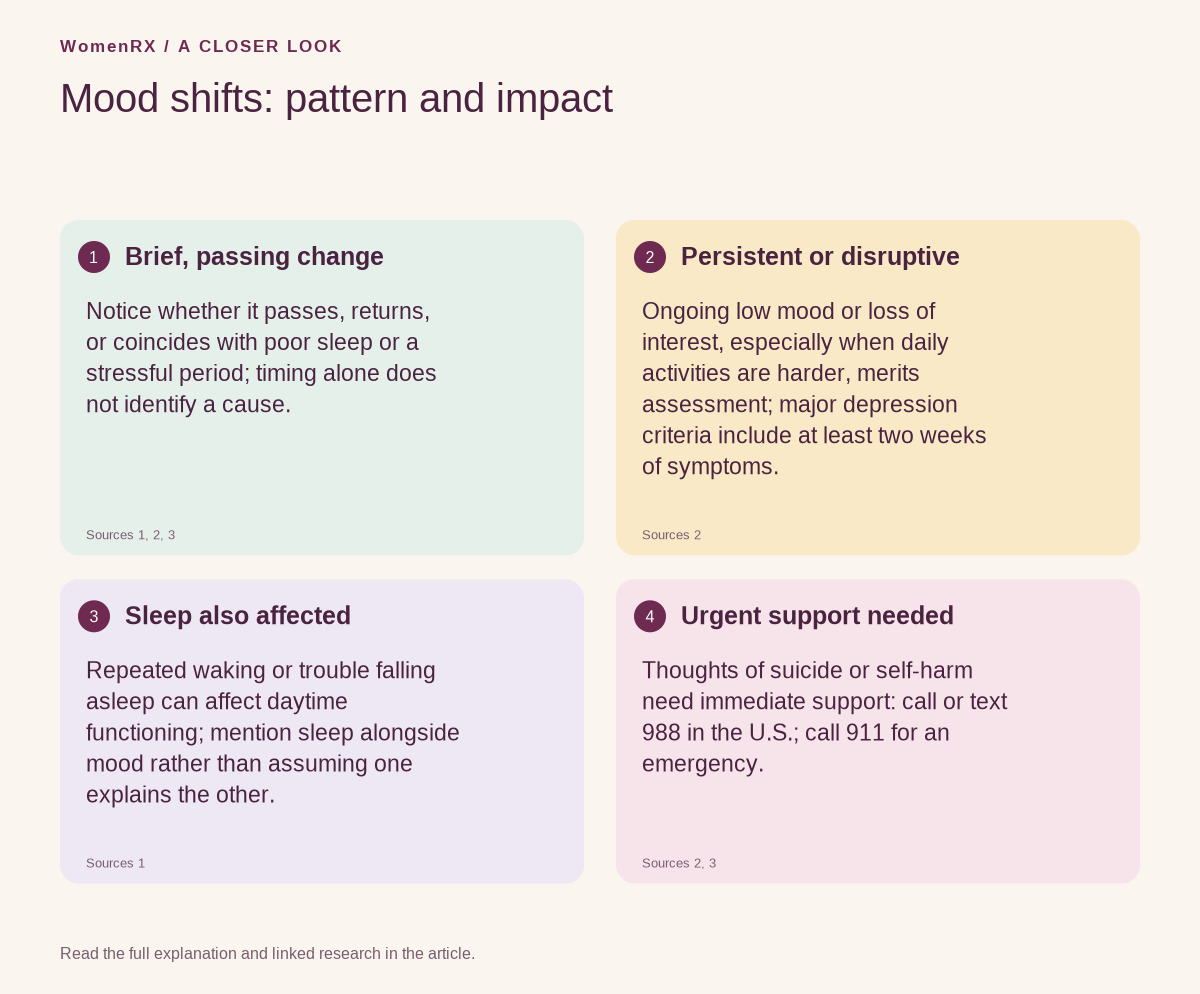
Mood shifts: pattern and impact
Brief, passing change: Notice whether it passes, returns, or coincides with poor sleep or a stressful period; timing alone does not identify a cause.123
Persistent or disruptive: Ongoing low mood or loss of interest, especially when daily activities are harder, merits assessment; major depression criteria include at least two weeks of symptoms.2
Sleep also affected: Repeated waking or trouble falling asleep can affect daytime functioning; mention sleep alongside mood rather than assuming one explains the other.1
Urgent support needed: Thoughts of suicide or self-harm need immediate support: call or text 988 in the U.S.; call 911 for an emergency.23
Read the figure as text
Compare duration and effect on daily life to choose a sensible next step. The pattern can guide a conversation, but it cannot identify a hormonal cause.- Brief, passing change: Notice whether it passes, returns, or coincides with poor sleep or a stressful period; timing alone does not identify a cause.123
- Persistent or disruptive: Ongoing low mood or loss of interest, especially when daily activities are harder, merits assessment; major depression criteria include at least two weeks of symptoms.2
- Sleep also affected: Repeated waking or trouble falling asleep can affect daytime functioning; mention sleep alongside mood rather than assuming one explains the other.1
- Urgent support needed: Thoughts of suicide or self-harm need immediate support: call or text 988 in the U.S.; call 911 for an emergency.23
More questions, answered
Does a mood change during perimenopause mean I have depression?
No. Mood changes can occur during the menopause transition, but timing alone doesn’t establish a diagnosis or prove hormones are the cause. A professional assessment can consider how long symptoms last, their effect on daily life, your history, and possible medical or medication-related contributors. 2 3
Should I stop my antidepressant if my mood changes?
Don’t stop prescribed medication on your own. If you’re concerned about symptoms or side effects, contact the prescriber to discuss them. 2
Sources you can check
- Sleep Disorders | MedlinePlusAccessed 2026-09-25Return to first citation
- Depression: MedlinePlusAccessed 2026-09-25Return to first citation
- NIMH: Women and mental healthAccessed 2026-09-25Return to first citation
- Association analysis between vitamin D level and depression in women perimenopause: A protocol of systematic review and meta-analysis.Yuan J, Chen T, Lei Y, Wei S, Yu P, Cao Y, Zhao Y, Chen J. · Medicine · 2020Return to first citation