Crying More During Perimenopause: What Your Mood May Mean
Tearfulness can show up during the menopause transition, but how long it lasts and how much it affects daily life matter more than crying alone.
Perimenopause can be a time of greater vulnerability to mood and anxiety symptoms, and stress, sleep changes, and prior mental health history may also matter. Crying by itself doesn’t diagnose depression. Pay attention to whether low mood or loss of interest is lasting most days, disrupting your life, or getting worse, and seek support sooner if you’re struggling. 351
A tearful day isn’t the same as depression
You might find yourself crying more easily, feeling unusually raw, or having stronger reactions than you expect. Mood changes are reported during the menopause transition, but a tearful moment or a difficult day alone doesn’t tell you whether you have depression. What matters is the broader pattern: your mood, other symptoms, how long they’ve lasted, and what’s become harder to do. 31
A review of studies on perimenopausal women found that mental health history, family history of major depression, chronic stress, and stressful life events were associated with depression symptoms. Social support was associated with protection. These are risk factors, not a prediction of what will happen to you. If you’ve had depression or anxiety before, that history is useful context, not a reason to dismiss how you feel now. 5
Look at the pattern, not just the crying
For a few days, make a brief record you can bring to an appointment. Jot down:
- Mood and duration: When did the tearfulness or low mood begin? Does it pass, come and go, or stay most of the day?
- Other changes: Note loss of interest, anxiety, sleep changes, or changes in everyday habits.
- Impact: What’s harder at work, at home, or in relationships? Are basic routines becoming difficult?
- Context: Note major stress, menstrual or menopause-related changes you’ve noticed, and any relevant past mental health concerns.
This isn’t a diagnostic test. It’s a way to make a vague, unsettling change easier to describe and to help you and a clinician consider the whole picture. Mental health can be affected by biology, life experiences, family history, and current circumstances. 25
When low mood deserves attention
MedlinePlus describes major depression symptoms as a depressed mood or loss of interest that affects daily activities and lasts at least two weeks. For diagnosis, symptoms occur most of the day, nearly every day, and include depressed mood or loss of interest. That timeframe is a description used in assessment, not a rule that you must wait two weeks to ask for help. If distress is affecting your daily life or getting worse, reach out sooner. 1
Depression can also involve changes in mood or behavior, increased use of alcohol or drugs, or thoughts of death or suicide. If you’re having thoughts of harming yourself or ending your life, seek urgent help now. You deserve support for the distress itself, whether or not you know what’s causing it. 1
Keep other explanations in view
The menopause transition may be part of the picture, but it isn’t the only possible explanation. Some medical conditions, including thyroid disorders, and some medicines can cause symptoms that resemble depression. A clinician can ask about your health and symptoms and decide whether evaluation for another cause makes sense. 1
It’s reasonable to mention menopause-related changes, sleep difficulties, stress, prior mood concerns, and any new or changed medicines when you discuss what’s happening. You don’t need to prove that hormones caused your tears before asking for help.
Support can be tailored to you
Support might involve assessing for depression or another health cause, addressing menopause symptoms that are affecting your well-being, or getting mental health care. FIGO’s recommendations describe individualized care and psychological support as part of attention to mental health during the menopause transition. 3
A small pilot case series offers an early, limited example of one option: among 16 perimenopausal or postmenopausal participants who completed an eight-session cognitive behavioral therapy program, reported depression and anxiety symptom scores fell from the first to the eighth session. Because this was a small case series without a clinical-trial design, it can’t establish how well the approach works for everyone. It does show that mood symptoms can be addressed directly rather than simply written off as hormones. 4
The useful next step isn’t to label every tear as depression or menopause. It’s to notice the pattern, take its impact seriously, and ask for help when you need it.
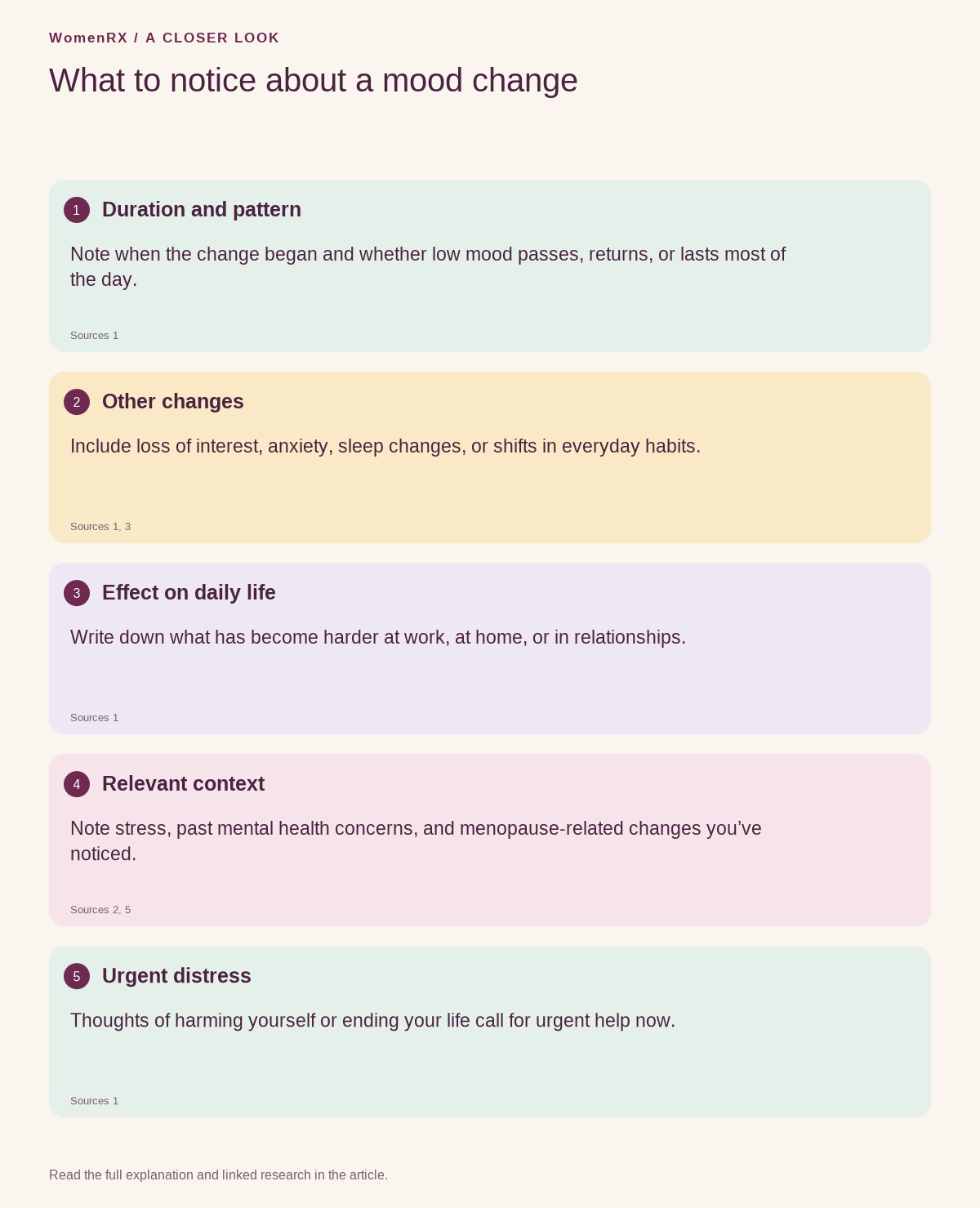
What to notice about a mood change
Duration and pattern: Note when the change began and whether low mood passes, returns, or lasts most of the day.1
Other changes: Include loss of interest, anxiety, sleep changes, or shifts in everyday habits.13
Effect on daily life: Write down what has become harder at work, at home, or in relationships.1
Relevant context: Note stress, past mental health concerns, and menopause-related changes you’ve noticed.25
Urgent distress: Thoughts of harming yourself or ending your life call for urgent help now.1
Read the figure as text
A short record can help describe what’s happening without treating tearfulness as a diagnosis.- Duration and pattern: Note when the change began and whether low mood passes, returns, or lasts most of the day.1
- Other changes: Include loss of interest, anxiety, sleep changes, or shifts in everyday habits.13
- Effect on daily life: Write down what has become harder at work, at home, or in relationships.1
- Relevant context: Note stress, past mental health concerns, and menopause-related changes you’ve noticed.25
- Urgent distress: Thoughts of harming yourself or ending your life call for urgent help now.1
More questions, answered
Does crying more mean I have depression?
No. Crying alone doesn’t establish depression. Assessment considers the wider pattern, including low mood or loss of interest, how long symptoms have lasted, and whether they affect daily life. 1
Should I wait two weeks before asking for help?
No. Two weeks is part of the description used to assess major depression, not a requirement to put off support. If your distress is affecting daily life, getting worse, or feels hard to manage, reach out sooner. 1
Sources you can check
- Depression: MedlinePlusAccessed 2026-09-25Return to first citation
- Mental Health: MedlinePlusAccessed 2026-09-25Return to first citation
- FIGO best practice recommendations for the mental health of women at menopausal age.Khadilkar S, Divakar H, Benedetto C, Genazzani A, Ramos D, Argale E, Deshpande G, Hicky M, Filho ALDS, Herrera E, Balkrishnan M. · International journal of gynaecology and obstetrics: the official organ of the International Federation of Gynaecology and Obstetrics · 2026Return to first citation
- Eight-session manualized cognitive behavioral therapy for anxiety and depression symptoms in perimenopause and postmenopause: a pilot study.Hantsoo L, Friedman-Wheeler DG, Lofland G, Harrison SA, Smith G, Shen W. · Menopause (New York, N.Y.) · 2026Return to first citation
- Protective and harmful social and psychological factors associated with mood and anxiety disorders in perimenopausal women: A narrative review.McElhany K, Aggarwal S, Wood G, Beauchamp J. · Maturitas · 2024Return to first citation