Yoga for Perimenopause: What It May Help, and What It May Not
Yoga may be worth trying for sleep or mood, but research doesn’t show reliable relief from hot flashes.
Yoga research doesn’t treat all perimenopause symptoms alike. In a review of randomized trials in women experiencing menopause, yoga improved pooled sleep and mood measures, but it didn’t significantly improve hot flashes or quality of life compared with usual care. The studies don’t establish how well those results apply specifically to perimenopause, so consider yoga a possible support, not a dependable hot-flash treatment. 3
Yoga may be worth trying if you’re looking for a movement practice that could support sleep or mood. But the evidence doesn’t support expecting it to reliably reduce hot flashes, and findings from women described as menopausal don’t necessarily predict what you’ll experience during perimenopause.
The symptom makes a difference
A 2025 systematic review pooled 24 randomized trials involving 2,028 women experiencing menopause. Yoga was associated with statistically significant improvements in pooled measures of sleep quality, anxiety, and depressive symptoms. The review also found improvements in overall, psychological, somatic, and urogenital symptom measures. But it found no significant difference from usual care for hot flashes or quality of life. 3
Those findings are not a promise of noticeable relief for any one person. The review’s summary doesn’t report a separate perimenopause result, and it calls for more research on yoga’s optimal format, duration, and longer-term effects. The results therefore speak to women experiencing menopause as a broader group, not clearly to perimenopausal women alone. 3
For hot flashes and night sweats, the conclusion is clearer: yoga isn’t a well-supported treatment. The North American Menopause Society’s 2023 position statement does not recommend yoga for vasomotor symptoms, based on Level II evidence. That doesn’t mean no one will feel better after a class. It does mean you shouldn’t count on yoga to reduce hot flashes. 1
Sleep and mood: a possible reason to try it
Sleep is a more promising, though still qualified, reason to give yoga a try. In a systematic review focused on chronic insomnia in perimenopausal and postmenopausal women, non-drug approaches improved questionnaire-based sleep measures overall. The review discussed yoga alongside other approaches, including acupuncture and massage, so its summary can’t tell us how much of the benefit came from yoga specifically. It identified cognitive behavioral therapy for insomnia and non-pharmacological approaches that include yoga as promising, but its summary doesn’t provide a yoga-only estimate or rank yoga against cognitive behavioral therapy for insomnia. 4
For mood, the menopause yoga review found improvements in pooled anxiety and depressive-symptom measures, but it doesn’t establish that these effects apply specifically to perimenopause or that they will be large enough to change daily life. A small qualitative study of 12 women aged 40 to 65 described yoga as a possible way of coping with stress and supporting mood; it offers context, not proof of a treatment effect. 3 5
Don’t confuse laughter yoga with a regular class
Some menopause studies examine laughter yoga, a distinct intervention rather than evidence about standard yoga classes. One randomized trial included 36 women attending a menopause program. After eight online laughter-yoga sessions over four weeks, the group reported lower vasomotor-symptom and sleep-quality scores than a control group. The small study is interesting, but it doesn’t establish that conventional yoga reduces hot flashes or sleep problems. 2
Set your expectations around your reason for practicing
If you enjoy yoga, it can be reasonable to try it for the experience of moving, unwinding, or building a regular practice, while keeping expectations modest about symptom relief. You might pay attention to the outcome you care about: for example, whether sleep feels better, mood feels steadier, or hot flashes change. That’s a personal way to assess whether the practice is worthwhile, not a validated test of treatment effect.
If your main concern is hot flashes, yoga shouldn’t be your only plan. Evidence-based options for bothersome vasomotor symptoms include treatments other than yoga; the right choice depends on your situation and preferences. 1 If your main concern is persistent insomnia, the review identifies cognitive behavioral therapy for insomnia and non-pharmacological approaches that include yoga as promising, but it doesn’t establish which is more effective. 4
The practical takeaway: yoga is a more plausible experiment for sleep or mood than for hot flashes, but perimenopause-specific evidence remains limited. You can decide whether the practice feels valuable without treating it as a substitute for symptom care.
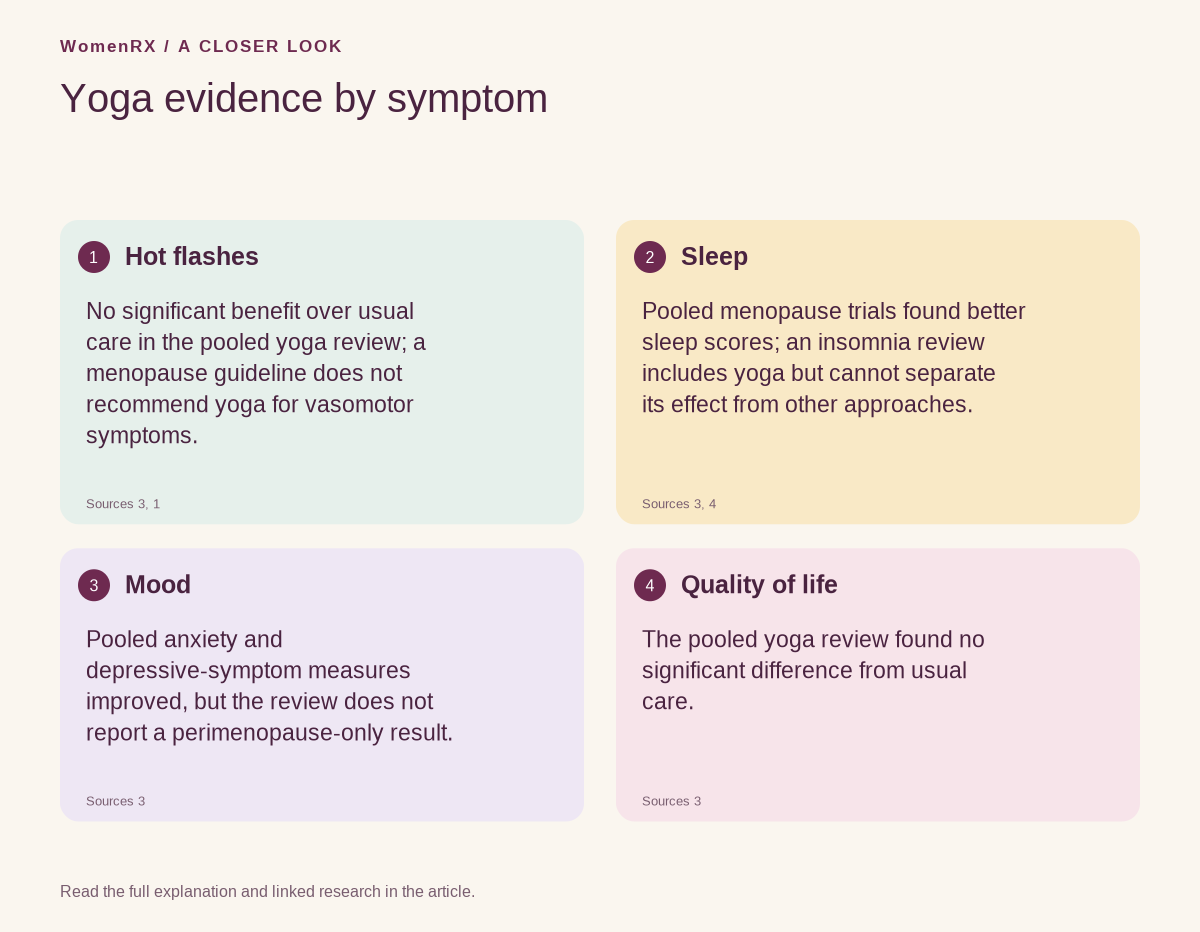
Yoga evidence by symptom
Hot flashes: No significant benefit over usual care in the pooled yoga review; a menopause guideline does not recommend yoga for vasomotor symptoms.31
Sleep: Pooled menopause trials found better sleep scores; an insomnia review includes yoga but cannot separate its effect from other approaches.34
Mood: Pooled anxiety and depressive-symptom measures improved, but the review does not report a perimenopause-only result.3
Quality of life: The pooled yoga review found no significant difference from usual care.3
Read the figure as text
The findings differ by symptom, and most yoga results aren’t reported separately for perimenopause.- Hot flashes: No significant benefit over usual care in the pooled yoga review; a menopause guideline does not recommend yoga for vasomotor symptoms.31
- Sleep: Pooled menopause trials found better sleep scores; an insomnia review includes yoga but cannot separate its effect from other approaches.34
- Mood: Pooled anxiety and depressive-symptom measures improved, but the review does not report a perimenopause-only result.3
- Quality of life: The pooled yoga review found no significant difference from usual care.3
Sources you can check
- The 2023 nonhormone therapy position statement of The North American Menopause Society.Menopause (New York, N.Y.) · 2023Return to first citation
- The Effect of Laughter Yoga on Vasomotor Symptoms and Sleep Quality in Menopausal Women: A Randomized Controlled Trial.Aksoy-Can A, Güner-Emül T, Değirmenci F, Buldum A, Aksu A, Vefikuluçay-Yılmaz D. · Holistic nursing practice · 2025Return to first citation
- The effectiveness of yoga on menopausal symptoms: A systematic review and meta-analysis of randomized controlled trials.Wang H, Liu Y, Kwok JYY, Xu F, Li R, Tang J, Tang S, Sun M. · International journal of nursing studies · 2025Return to first citation
- Pharmacological and non-pharmacological treatments for chronic insomnia in perimenopausal and postmenopausal women: a systematic review and meta-analysis.Bruyneel M, Rozenberg S, Sanida C, Demaeyer N, Castermans E, Bruyneel AV. · Sleep medicine · 2026Return to first citation
- Enhancing Problem- and Emotion-Focused Coping in Menopausal Women Through Yoga.Crowe BM, Van Puymbroeck M. · International journal of yoga therapy · 2019Return to first citation