Fibromyalgia and Perimenopause: What May Be Changing
Pain, fatigue, brain fog, and sleep trouble can overlap, but that overlap doesn’t prove perimenopause is causing fibromyalgia to worsen.
Fibromyalgia and perimenopause can bring similar symptoms, especially disrupted sleep, fatigue, and pain. One study found that people with greater fibromyalgia impact also reported worse menopause symptoms, but that association doesn’t show that hormonal changes caused their fibromyalgia to worsen. A brief record of cycle changes, sleep, and symptoms can help you and your care team see what is changing together. 5
Why the symptoms can blur together
Fibromyalgia commonly involves widespread pain, fatigue, stiffness, unrefreshing sleep, and trouble concentrating. Its symptoms can wax and wane, and the main symptom is usually widespread pain. 12 Menopause-related symptoms can overlap with several of these, particularly sleep disturbance and musculoskeletal discomfort. A literature review found that sleep problems during menopause may be related to hot flashes and night sweats, but may also occur for other reasons. 7
That overlap can make a rough stretch feel like proof that one condition is driving the other. It isn’t. If sleep is interrupted, for example, you might notice more fatigue and difficulty concentrating the next day. Those experiences can fit the symptom picture of fibromyalgia, but they don’t identify the cause of the sleep disruption or establish that hormones changed your fibromyalgia. 27
What the research says about a direct hormone effect
A study of 169 people with fibromyalgia found that higher fibromyalgia impact scores were associated with more severe menopause symptoms. The finding describes symptoms occurring together; it cannot establish that perimenopause caused worse fibromyalgia. The participants included peri- and postmenopausal women, so the result isn’t specific to perimenopause alone. 5
A small, open study of menopausal women reported better fibromyalgia impact scores after 12 weeks of hormone therapy. Because it was not a placebo-controlled trial, improvement over time does not prove that hormone therapy caused the change or that it treats fibromyalgia. 6 A 2019 review also described mixed findings: hormone therapy improved subjective sleep in symptomatic menopausal women, while a study of transdermal estrogen did not find improvement in pain measures. The review called for better prospective, placebo-controlled research. 7
So it’s useful to keep two questions separate: “Could menopause treatment help a bothersome menopause symptom?” and “Does hormone therapy treat fibromyalgia?” Hormone therapy is an established option for certain menopause symptoms, including hot flashes and night sweats, but current research does not establish it as a fibromyalgia treatment. 47
Look for patterns, not a single explanation
For a few weeks, make a simple daily note. Include:
- Any bleeding or change in your menstrual pattern
- Hot flashes or night sweats, if you have them
- Pain, fatigue, and concentration on a simple scale you choose
- Whether sleep was interrupted, and what you noticed the next day
- Major changes in activity or treatment
This isn’t a validated test or a way to diagnose the cause. It’s a practical way to compare timing. For instance, you might notice that poor sleep and next-day fatigue tend to coincide with night sweats, or that pain flares don’t track with those nights. Either pattern is useful information, not proof of a cause.
When you discuss the pattern with your care team, be specific about what changed and when. If menopause symptoms are bothering you, ask about options for those symptoms separately from your fibromyalgia plan. Fibromyalgia care may use a combination of approaches; no single treatment works for everyone, and regular physical activity has been shown to help reduce pain and improve quality of life. 3
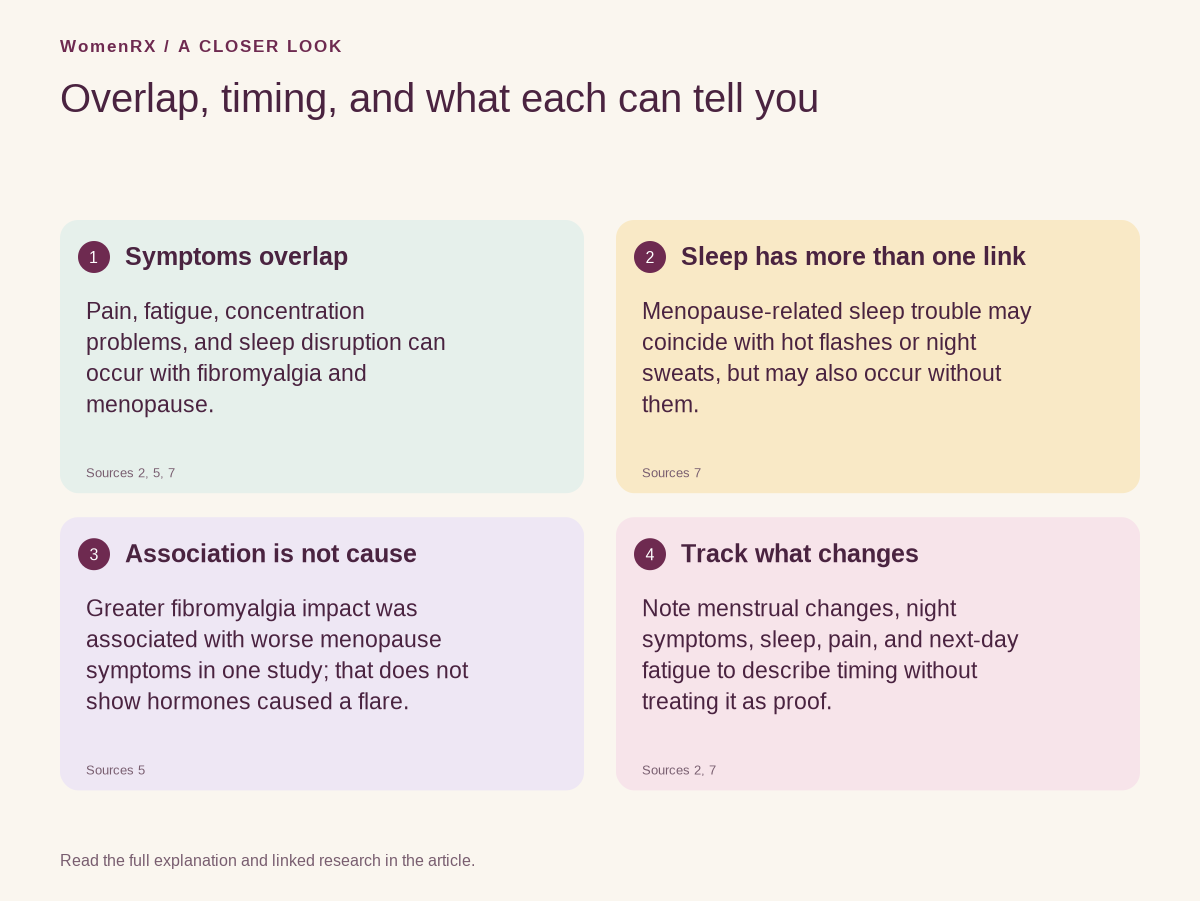
Overlap, timing, and what each can tell you
Symptoms overlap: Pain, fatigue, concentration problems, and sleep disruption can occur with fibromyalgia and menopause.257
Sleep has more than one link: Menopause-related sleep trouble may coincide with hot flashes or night sweats, but may also occur without them.7
Association is not cause: Greater fibromyalgia impact was associated with worse menopause symptoms in one study; that does not show hormones caused a flare.5
Track what changes: Note menstrual changes, night symptoms, sleep, pain, and next-day fatigue to describe timing without treating it as proof.27
Read the figure as text
These patterns can help distinguish shared symptoms from evidence about cause.- Symptoms overlap: Pain, fatigue, concentration problems, and sleep disruption can occur with fibromyalgia and menopause.257
- Sleep has more than one link: Menopause-related sleep trouble may coincide with hot flashes or night sweats, but may also occur without them.7
- Association is not cause: Greater fibromyalgia impact was associated with worse menopause symptoms in one study; that does not show hormones caused a flare.5
- Track what changes: Note menstrual changes, night symptoms, sleep, pain, and next-day fatigue to describe timing without treating it as proof.27
More questions, answered
Does hormone therapy treat fibromyalgia?
Research does not establish hormone therapy as a fibromyalgia treatment. A small open study reported improvement after therapy, but it can’t show that the therapy caused the improvement; a review also found mixed results for pain. Hormone therapy may still be discussed for menopause symptoms, which is a separate treatment question. 467
Why track sleep along with pain?
Sleep problems occur in both fibromyalgia and menopause, and menopause-related sleep disruption may or may not be linked to hot flashes or night sweats. Recording sleep and next-day symptoms can help you describe whether they seem to move together, without assuming one caused the other. 27
Sources you can check
- Fibromyalgia - NHSAccessed 2026-09-25Return to first citation
- Fibromyalgia - Symptoms - NHSAccessed 2026-09-25Return to first citation
- Fibromyalgia - Treatment - NHSAccessed 2026-09-25Return to first citation
- The 2022 hormone therapy position statement of The North American Menopause Society.“The 2022 Hormone Therapy Position Statement of The North American Menopause Society” Advisory Panel. · Menopause (New York, N.Y.) · 2022Return to first citation
- Fibromyalgia and menopause: Friends with benefits?Gkouvi A, Kontouli KM, Pardali EC, Patrikiou E, Lambrinoudaki I, Goulis DG, Bogdanos DP, Grammatikopoulou MG. · Maturitas · 2026Return to first citation
- Fibromyalgia and menopause: an open study on postmenopausal hormone therapy.Dias RC, Costa EH, Chrisostomo KR, Junior JK, Paiva ES, Azevedo PM, Skare TL, Nisihara RM. · Minerva obstetrics and gynecology · 2023Return to first citation
- Fibromyalgia, sleep disturbance and menopause: Is there a relationship? A literature review.Dias RCA, Kulak Junior J, Ferreira da Costa EH, Nisihara RM. · International journal of rheumatic diseases · 2019Return to first citation