Metabolism in Your 40s: What May Be Changing
A shift in weight or energy needs can have several causes, and age alone doesn’t explain what’s happening to you.
The available age-related evidence doesn’t establish a predictable metabolic drop at 40. One small study across a broad adult age range found an association between age and resting energy use, but it can’t predict what will happen to one woman in her 40s. Perimenopause may bring sleep disruption and changes in body-fat distribution for some people; activity, health conditions, medications, and body composition can also matter. 2 4 1
First, separate metabolism from body weight
“Metabolism” often gets used to mean how many calories your body uses. One part of that is resting metabolic rate (RMR): the energy your body uses at rest. Daily energy use also reflects activity. RMR is a major part of daily expenditure, but neither it nor your weight tells the whole story about your health. 2 3
Weight is made up of fat, muscle, bone, and water. So a change on the scale doesn’t, by itself, show whether your metabolism changed, what tissue changed, or why. Waist size can add useful context because abdominal fat is associated with higher risk of heart disease and type 2 diabetes, but it is only one part of a health picture. 1
What age-related evidence can, and can’t, say
A 2026 study measured resting metabolic rate and body composition in 80 healthy adults aged 23 to 82. Its model found that RMR was associated with a decrease of 62.6 calories per day per decade, even after adjustments for body composition and sex. That is an average association across a small, wide-age-range group, not a forecast for women specifically in their 40s or a personal calorie target. 2
That distinction matters: this study doesn’t establish a predictable metabolic drop that starts at 40. It also found that differences in several body-composition measures together explained the observed average RMR difference between females and males. It did not establish that a particular change in muscle or fat causes a particular woman’s weight to change. 2
Where perimenopause may fit
Perimenopause is the transition before the final menstrual period. That definition means being in your 40s, by itself, doesn’t establish whether you’re in the transition. A 2026 review describes hormonal fluctuations and associated changes that may include hot flashes, night sweats, disrupted sleep, mood or cognitive symptoms, and increased visceral fat. Those experiences can be relevant context for midlife changes, but they don’t mean every weight or energy shift is caused by menopause. 4
It also helps to distinguish fat distribution from metabolic rate. Evidence about body-fat distribution during the menopause transition is not the same as evidence that the transition causes a predictable drop in resting metabolism. If sleep or temperature symptoms are affecting your rest or daily life, that may be worth discussing as its own concern, rather than assuming a “slow metabolism” explains everything. 4
A practical way to sort out what changed
Think about the change itself before settling on a cause:
- Weight changed, but nothing else feels different: Remember that weight includes water and lean tissue as well as fat. Consider whether the change is gradual or sudden, and whether your waist or how your clothes fit has changed too. 1
- Sleep or temperature symptoms changed: Hot flashes and night sweats can disrupt sleep during perimenopause. Consider those symptoms separately rather than treating them as proof that your metabolism has slowed. 4
- Your usual movement or routine changed: Daily activity contributes to energy expenditure. If work, caregiving, pain, or another life change has altered how much you move, that is a different explanation from an age-related change in resting metabolism. 3
- A medicine or health condition may be involved: MedlinePlus lists thyroid problems and certain medicines as possible causes of sudden weight loss, and heart failure as a possible cause of sudden weight gain. Review new or changed medicines and relevant health changes with a clinician rather than trying to infer the cause from the scale. 1
This isn’t a diagnostic checklist. It’s a way to notice whether the main change seems to be weight, sleep, symptoms, movement, or something else, so you can focus the next conversation. If you’ve had an unexpected gain or loss, MedlinePlus advises talking with a healthcare provider; a sudden change can signal a medical problem. 1
What to take away
Your 40s don’t come with one predictable metabolic setting. Age-related RMR findings are averages, while midlife can also bring changes in symptoms, sleep, body composition, activity, health, or medicines. Looking at those pieces separately is more useful than treating every change as proof that your metabolism has slowed.
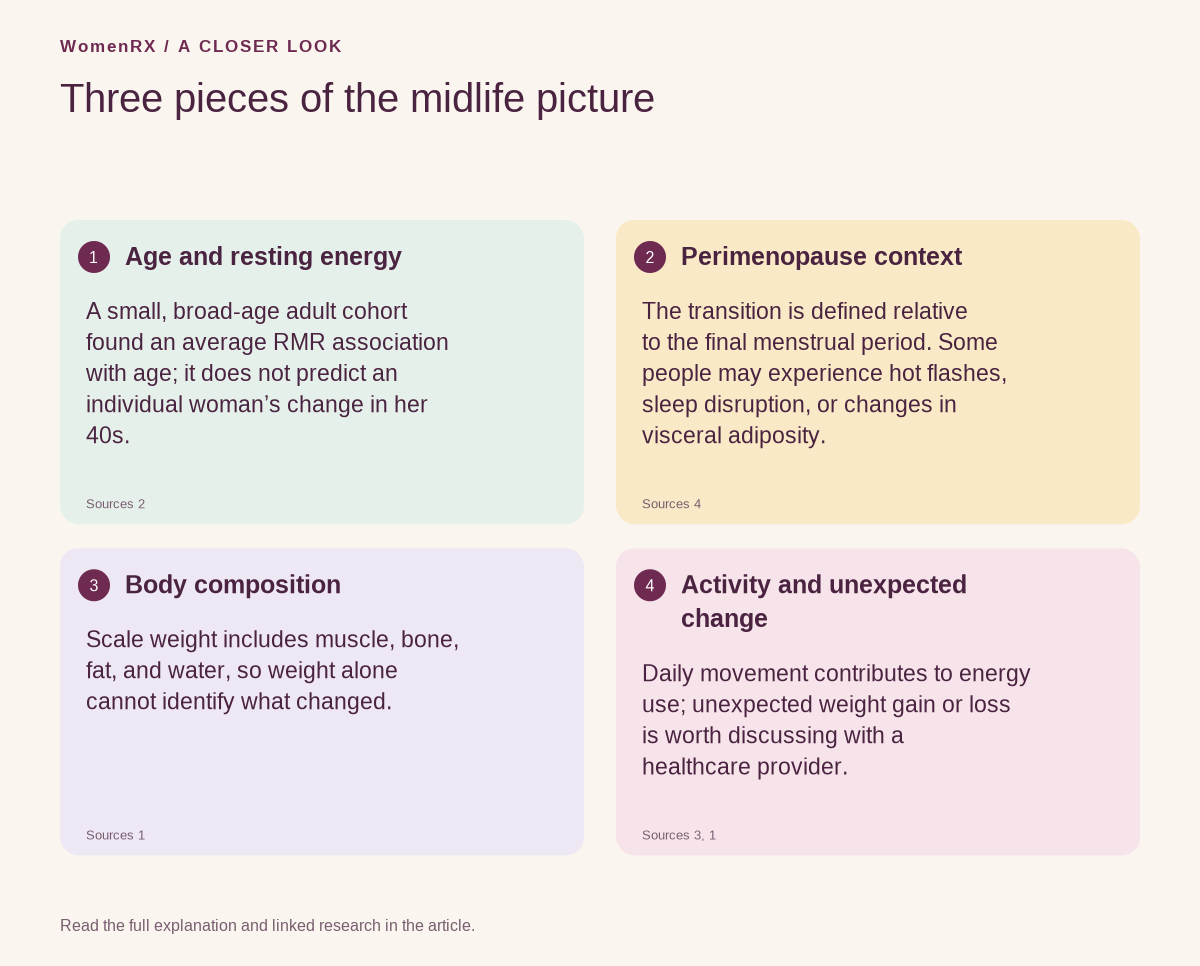
Three pieces of the midlife picture
Age and resting energy: A small, broad-age adult cohort found an average RMR association with age; it does not predict an individual woman’s change in her 40s.2
Perimenopause context: The transition is defined relative to the final menstrual period. Some people may experience hot flashes, sleep disruption, or changes in visceral adiposity.4
Body composition: Scale weight includes muscle, bone, fat, and water, so weight alone cannot identify what changed.1
Activity and unexpected change: Daily movement contributes to energy use; unexpected weight gain or loss is worth discussing with a healthcare provider.31
Read the figure as text
These distinctions help keep age-related resting-energy findings, possible perimenopause changes, and individual health factors from being treated as one cause.- Age and resting energy: A small, broad-age adult cohort found an average RMR association with age; it does not predict an individual woman’s change in her 40s.2
- Perimenopause context: The transition is defined relative to the final menstrual period. Some people may experience hot flashes, sleep disruption, or changes in visceral adiposity.4
- Body composition: Scale weight includes muscle, bone, fat, and water, so weight alone cannot identify what changed.1
- Activity and unexpected change: Daily movement contributes to energy use; unexpected weight gain or loss is worth discussing with a healthcare provider.31
More questions, answered
Does perimenopause always cause weight gain?
No. A review describes increased visceral adiposity as one possible change, alongside symptoms such as hot flashes, night sweats, and sleep disturbance. That doesn’t establish that everyone gains weight or that menopause is the only explanation for a change. 4
When should I get an unexpected weight change checked?
If you gain or lose weight without trying, especially if the change is sudden, MedlinePlus recommends talking with a healthcare provider. It lists thyroid problems and certain medicines as possible causes of sudden weight loss, and heart failure as a possible cause of sudden weight gain. 1
Sources you can check
- Body Weight: MedlinePlusAccessed 2026-09-25Return to first citation
- Effects of body composition on age- and sex-related differences in resting metabolic rate from a healthy aging cohort.Moliné M, Heimler SR, Bergstrom J, Scandalis L, Wing D, Moreno D, Phang HJ, Molina AJA. · Experimental gerontology · 2026Return to first citation
- Walking as a Contributor to Physical Activity in Healthy Older Adults: 2 Week Longitudinal Study Using Accelerometry and the Doubly Labeled Water Method.Valenti G, Bonomi AG, Westerterp KR. · JMIR mHealth and uHealth · 2016Return to first citation
- Perimenopause and Lifestyle Medicine: A Window of Opportunity.Pangalangan JML, Tollefson M. · American journal of lifestyle medicine · 2026Return to first citation