Sexual Desire Around 40: What May Be Changing
A change in desire can have several possible contributors; cycle shifts may make perimenopause worth discussing, but they don’t identify the cause on their own.
Desire varies, and being around 40 doesn’t by itself mean perimenopause is the reason it has changed. Cycles can become less regular as menopause approaches, but irregular periods can have other causes too. Sleep, mood, relationships, medicines, and sexual pain may also matter. If the change is ongoing or troubling, discussing its timing and accompanying symptoms can help clarify what to address. 1 2 3 4
A change in desire isn’t a diagnosis
There isn’t one level of sexual desire that everyone should have. What matters for deciding whether to seek help is whether a change is bothering you, affecting your well-being, or making sex less comfortable or satisfying. Menopause-related sexual changes can involve desire, arousal, orgasm, satisfaction, or pain, and biological, emotional, and relationship factors can overlap. 3
So, a lower interest in sex around 40 doesn’t automatically point to a hormone change. It can be useful to look at what else has changed and when. For example, desire may feel different during a stretch of poor sleep, a relationship change, or after starting or changing a medicine. Medicines can affect sexual desire, though the effect depends on the medicine and the person. 2 3 4
When cycle changes make perimenopause worth discussing
Menstrual cycles may become less predictable as menopause approaches. That can be one clue to raise in a conversation, especially if other changes are happening too. But a less regular period does not, by itself, establish that you’re in perimenopause or explain a change in desire. Irregular periods can also have causes such as thyroid problems or PCOS. 1
The reproductive transition can involve hormonal fluctuations and changes in several areas of sexual function, but experiences vary. Sexual concerns during perimenopause and menopause may also relate to sleep, mood, other physical symptoms, or relationship and social factors. A cycle change is useful context, not a stand-alone answer. 3 4
If sex has become uncomfortable, mention that directly rather than describing the concern only as low desire. Menopausal changes in vaginal tissue can contribute to dryness, irritation, and pain, which may affect sexual satisfaction. Pain has its own possible causes and deserves attention in its own right. 4
What to bring into the conversation
You don’t need to arrive with a theory about what’s causing the change. A few concrete details can help make the discussion more useful:
- Timing: When did you first notice a difference? Was it sudden or gradual, and has it continued or come and gone?
- Cycle and reproductive context: Have your periods changed in timing or pattern? Note any other changes you’ve noticed, but don’t treat them as proof of perimenopause. A simple period record can help you describe the pattern. 1
- Sleep, mood, and other symptoms: Have sleep, mood, or other menopause-related symptoms changed around the same time? These can be part of the broader picture without proving a single cause. 3 4
- Medicines and health changes: Mention new medicines, dose changes, or health conditions. Some medicines can affect desire, so it’s worth reviewing timing with the person who prescribed them. 2
- Comfort and context: Say whether there’s dryness or pain, and whether relationship circumstances seem relevant. Sexual function has more than one domain, and more than one factor can contribute. 3 4
If the change is troubling or persistent, you can ask for help even if you’re unsure whether it’s related to menopause. An assessment can consider the specific concern, such as desire versus pain, alongside menstrual changes, medicines, health, and life context. Treatment approaches vary with the issue and its contributors; sexual concerns across the menopause transition are not limited to one treatment type. 3
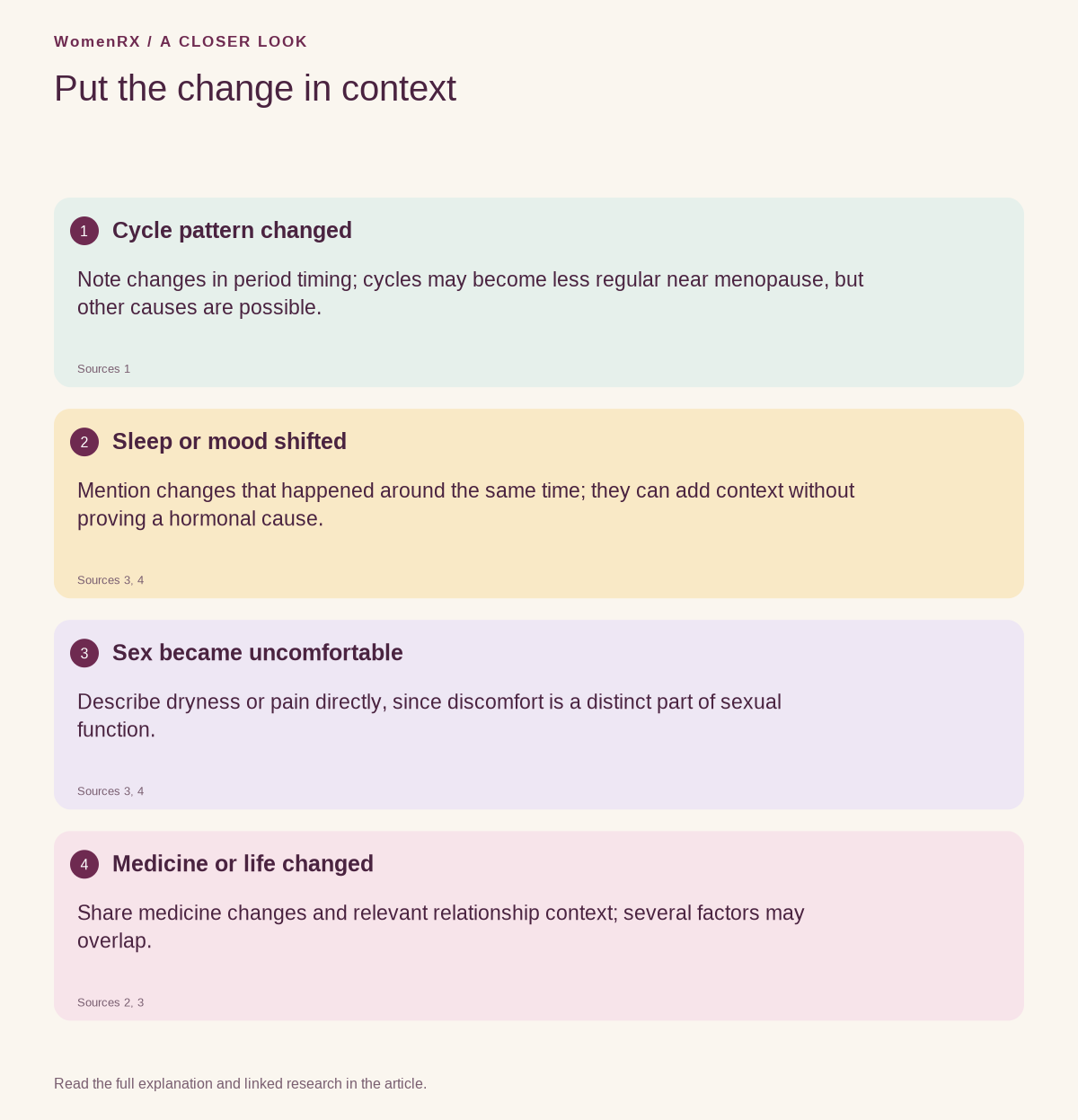
Put the change in context
Cycle pattern changed: Note changes in period timing; cycles may become less regular near menopause, but other causes are possible.1
Sleep or mood shifted: Mention changes that happened around the same time; they can add context without proving a hormonal cause.34
Sex became uncomfortable: Describe dryness or pain directly, since discomfort is a distinct part of sexual function.34
Medicine or life changed: Share medicine changes and relevant relationship context; several factors may overlap.23
Read the figure as text
These are useful discussion paths, not a diagnostic flowchart. More than one may fit, and none identifies the cause on its own.- Cycle pattern changed: Note changes in period timing; cycles may become less regular near menopause, but other causes are possible.1
- Sleep or mood shifted: Mention changes that happened around the same time; they can add context without proving a hormonal cause.34
- Sex became uncomfortable: Describe dryness or pain directly, since discomfort is a distinct part of sexual function.34
- Medicine or life changed: Share medicine changes and relevant relationship context; several factors may overlap.23
More questions, answered
Do irregular periods mean I’m in perimenopause?
Not on their own. Period patterns may change as menopause approaches, but irregular periods can also have other causes. The pattern is useful context to discuss, not a diagnosis by itself. 1
Should I mention pain if my main concern is low desire?
Yes. Pain and desire are separate parts of sexual function, and pain or vaginal dryness can affect how satisfying sex feels. Describing discomfort can help keep the conversation from focusing on desire alone. 3 4
Sources you can check
- Irregular periods - NHSAccessed 2026-09-25Return to first citation
- Sexual Health | MedlinePlusAccessed 2026-09-25Return to first citation
- Sexual Function Through Menopause: A Review of Basic Evaluation and Treatment.Pope R. · BJOG : an international journal of obstetrics and gynaecology · 2025Return to first citation
- Cognitive Behavioral Therapy for Sexual Concerns During Perimenopause: A Four Session Study Protocol.Green SM, Furtado M. · Frontiers in global women's health · 2021Return to first citation