Can Perimenopause Affect Sexual Desire?
Yes, desire can change during perimenopause, but hormones are only one part of a picture that may also include sleep, mood, pain, medicines, and relationship context.
Perimenopause can coincide with lower sexual desire, but it doesn’t affect everyone the same way, and hormones aren’t the only influence. Vaginal dryness or pain, disrupted sleep, anxiety or depression, relationship circumstances, general health, and some medicines may all play a part. Noticing what changed alongside desire can help you discuss the right concern, rather than treating libido as a hormone-only issue. 3 5
Desire doesn’t follow one menopause script
You may notice less interest in sex during perimenopause, or no change at all. Some women report stable or increased desire during menopause, too. A change in desire is worth attention if it bothers you, but desire by itself doesn’t establish a disorder. Your own experience, circumstances, and whether the change causes distress matter. 3 5
Hormonal changes can contribute, but they don’t explain every change in desire. Research reviews describe sexual desire during menopause as connected to biological, psychological, and social factors, including other sexual difficulties and relationship context. 3 4
Look at what’s happening around the change
Pain or vaginal symptoms: Dryness or pain during sex can make intimacy uncomfortable, which may affect interest or anticipation. Desire, arousal, lubrication, and pain are related parts of sexual experience, but they aren’t interchangeable. If sex hurts, say so directly; you don’t have to describe it only as low libido. 3 4
Sleep and mood: Menopause-related sleep disruption, anxiety, and depression have been associated with lower desire. If your interest shifted alongside poor sleep, low mood, or worry, mention that connection. These are potential contributors, not proof of a single cause. 3
Medicines and general health: Some medicines can affect sexual desire or sexual function. An older review specifically flags antidepressants as one example to consider; don’t stop a medicine on your own, but note whether the timing of a change in desire overlaps with starting or changing one. General health and chronic conditions may also matter. 1 5 3
Relationship and personal context: Relationship satisfaction and relationship length have been associated with changes in desire. Stress, how intimacy feels in your relationship, and your own feelings about sex can be part of the picture, alongside physical changes. 3
These factors can overlap. For example, vaginal discomfort may affect interest, while poor sleep or relationship stress is happening at the same time. That doesn’t mean you need to identify one “real” cause before asking for help.
Make the conversation specific
Instead of leading only with “My libido is low,” you might say what has changed: “My desire dropped around the time sex became painful,” or “I’m less interested since my sleep and mood worsened.” You can also mention whether the change is distressing to you, whether you have dryness or pain, and any medicine changes that seem relevant. This gives a clinician more to work with than a hormone explanation alone. 3 5
If vaginal dryness or discomfort is part of the problem, bring that up as its own concern. The North American Menopause Society’s 2022 position statement describes treatment options for bothersome genitourinary symptoms, including low-dose vaginal estrogen and other therapies in appropriate circumstances. That guidance addresses those symptoms; it isn’t a promise that hormone treatment will restore desire. 2
You can ask: “Could pain, dryness, sleep, mood, or a medicine be contributing?” and “What options address the symptom that’s bothering me most?” If your desire is different but not troubling to you, it doesn’t need to be treated just because it changed.
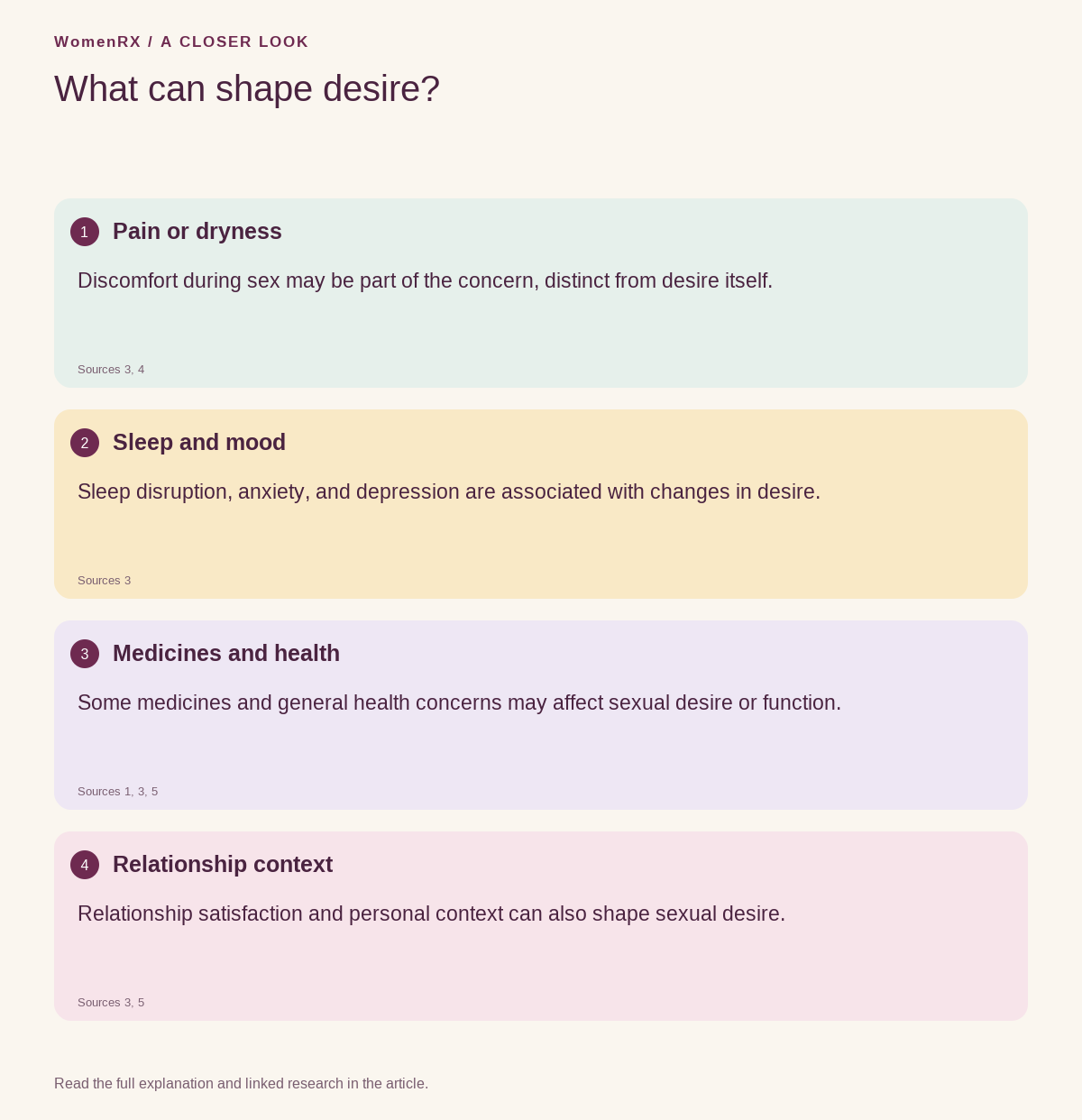
What can shape desire?
Pain or dryness: Discomfort during sex may be part of the concern, distinct from desire itself.34
Sleep and mood: Sleep disruption, anxiety, and depression are associated with changes in desire.3
Medicines and health: Some medicines and general health concerns may affect sexual desire or function.135
Relationship context: Relationship satisfaction and personal context can also shape sexual desire.35
Read the figure as text
A change in desire can reflect several overlapping parts of life and health, rather than one hormone-related cause.- Pain or dryness: Discomfort during sex may be part of the concern, distinct from desire itself.34
- Sleep and mood: Sleep disruption, anxiety, and depression are associated with changes in desire.3
- Medicines and health: Some medicines and general health concerns may affect sexual desire or function.135
- Relationship context: Relationship satisfaction and personal context can also shape sexual desire.35
More questions, answered
Does lower desire mean my hormones are low?
Not necessarily. Hormonal changes may contribute, but desire during menopause is also associated with factors such as pain, vaginal dryness, sleep, mood, general health, medicines, and relationship context. A change in desire alone can’t identify its cause. 3 5
Should I mention pain or dryness if I’m asking about libido?
Yes. Pain and vaginal dryness are separate symptoms that can affect sexual experience and may be relevant to a change in desire. Naming them can help focus the discussion on what’s actually uncomfortable, not just on libido. 3 2
Sources you can check
- Sexual Health | MedlinePlusAccessed 2026-09-25Return to first citation
- The 2022 hormone therapy position statement of The North American Menopause Society.“The 2022 Hormone Therapy Position Statement of The North American Menopause Society” Advisory Panel. · Menopause (New York, N.Y.) · 2022Return to first citation
- A scoping review of the biopsychosocial factors influencing sexual desire in menopause.Metcalfe KB, Meston CM. · Sexual medicine reviews · 2026Return to first citation
- Sexual Function Through Menopause: A Review of Basic Evaluation and Treatment.Pope R. · BJOG : an international journal of obstetrics and gynaecology · 2025Return to first citation
- Sex and perimenopause.Davis SR, Jane F. · Australian family physician · 2011Return to first citation