Low Libido in Perimenopause: What Can Affect Desire
Desire can change during perimenopause, and physical comfort, sleep, mood, medicines, and relationship context may all be part of the picture.
There’s no single timeline or cause for lower desire during perimenopause. Menopause-related changes may play a part, but pain or dryness, disrupted sleep, mood, general health, medicines, and relationship circumstances can also matter. A useful next step is to notice what else has changed and whether the change bothers you. Your goals can guide which options to discuss. 1 3
Desire isn’t a single hormone signal
Desire can shift during perimenopause, but it doesn’t follow one pattern. Some women experience less interest, while others report stable or increased desire. Hormonal changes may contribute, but research on menopause also links desire with physical comfort, sleep, mood, general health, and social factors. Those connections don’t identify the cause for any one woman. 3
It may help to start with your own experience: Is the change bothering you, or does it feel mainly concerning because someone else expects more interest? You may want desire to return to an earlier level, want sex to feel more comfortable, or simply want to understand a change. There’s no need to treat a change as a problem unless addressing it fits your needs.
Look at what else has changed
Physical comfort and arousal. Vaginal dryness or pain during sex can affect desire. If interest has changed alongside discomfort, consider raising both concerns rather than treating them as unrelated. Desire, arousal and lubrication, orgasm, satisfaction, and pain are distinct parts of sexual function, though one change can affect how another feels. 3 4
Sleep and general health. Sleep disruption and poorer general health have been associated with lower desire in menopause research. If nights are broken by menopause symptoms, or your health has changed, mention that context. It may point toward a concern worth addressing even if it doesn’t explain everything. 3
Mood and how you feel about sex. Anxiety and depression are associated with lower desire in the scoping review. Body image and attitudes about sex also appeared as relevant factors, though they were less researched. These are not personal shortcomings or proof of a cause; they’re possible parts of a complex picture. 3
Medicines and health conditions. Some medicines can affect sexual desire or performance, and chronic conditions can affect sexual health. If the timing of a change seems to coincide with a new medicine or a health change, bring that up rather than stopping a prescribed medicine on your own. 1
Relationship context. Relationship dissatisfaction and relationship length have been associated with changes in desire. You might consider whether closeness, satisfaction, stress, or the circumstances around intimacy have shifted. That context matters alongside physical symptoms. 3
More than one factor can be relevant at once. This is a way to organize your thoughts, not a test that can diagnose the cause.
Choose a conversation that fits your concern
If dryness or pain is part of the change, say so plainly. The 2022 North American Menopause Society position statement describes low-dose vaginal estrogen and certain other therapies as options for bothersome genitourinary symptoms that haven’t improved with over-the-counter treatments, for women without an indication for systemic hormone therapy. That guidance addresses genitourinary symptoms; it doesn’t promise that treatment will restore desire. 2
If hot flashes are disrupting your sleep or daily life, you can discuss treatment for those symptoms. The same position statement describes hormone therapy as the most effective treatment for bothersome vasomotor symptoms, with benefits and risks that vary by individual circumstances. That’s a different treatment goal from treating low desire itself. 2
If mood or relationship circumstances feel more central, include them in the conversation too. Menopause reviews describe psychosocial and relationship factors as relevant to sexual function, but they don’t establish one approach that works for everyone. 3 4
You could say: “My desire has changed, and I’d like to talk about whether pain, sleep, mood, a medicine, or relationship circumstances could be contributing.” Then name what you want help with, such as reducing discomfort, addressing hot flashes, or understanding whether a change that doesn’t distress you needs attention.
There’s no required level of desire
A change in desire by itself doesn’t show that a particular hormone is responsible. It can help to describe the change and its effect on you rather than assume a single cause. If it is distressing, persistent, or affecting a relationship in a way you want to address, you can ask about options that match the factors you’ve noticed.
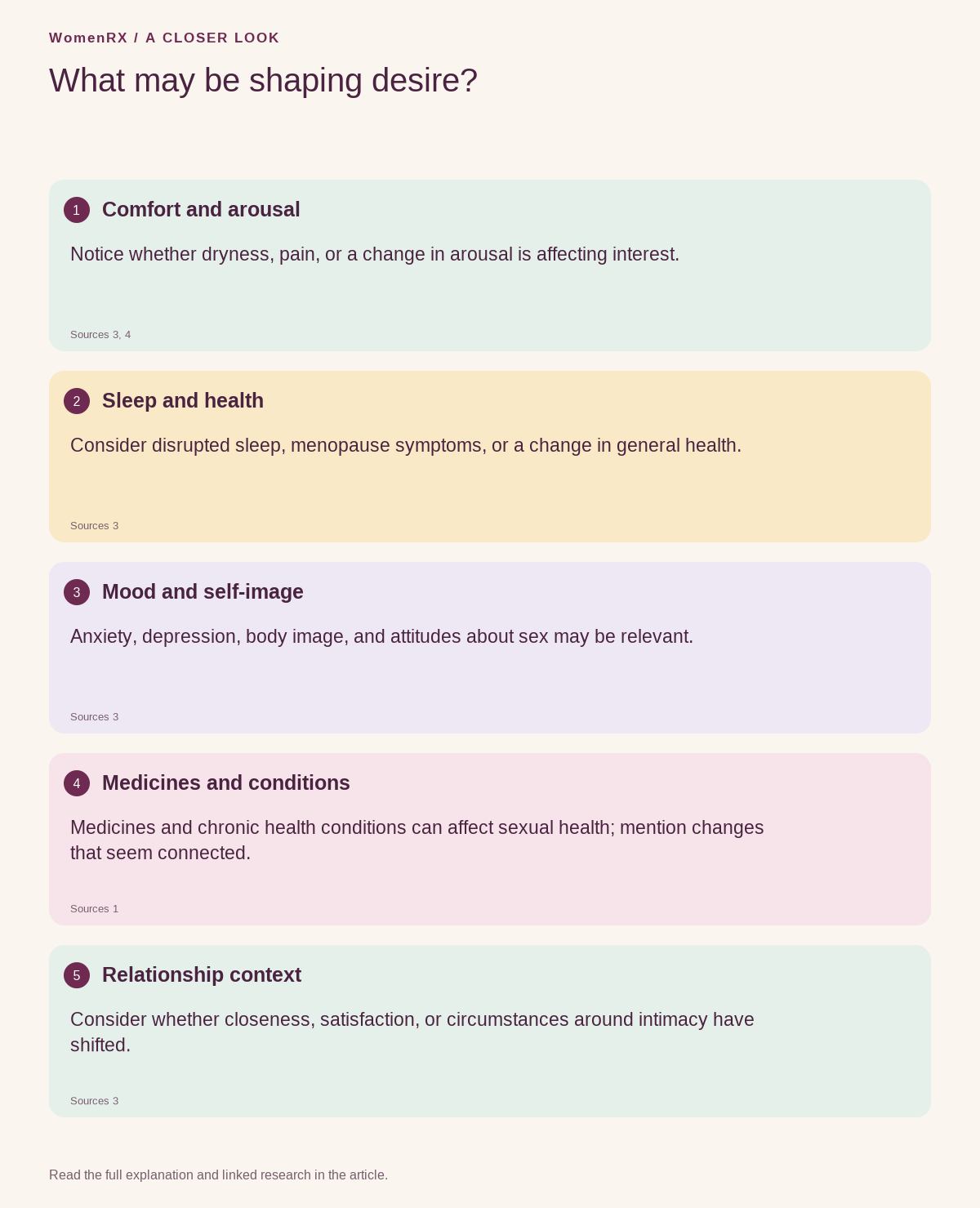
What may be shaping desire?
Comfort and arousal: Notice whether dryness, pain, or a change in arousal is affecting interest.34
Sleep and health: Consider disrupted sleep, menopause symptoms, or a change in general health.3
Mood and self-image: Anxiety, depression, body image, and attitudes about sex may be relevant.3
Medicines and conditions: Medicines and chronic health conditions can affect sexual health; mention changes that seem connected.1
Relationship context: Consider whether closeness, satisfaction, or circumstances around intimacy have shifted.3
Read the figure as text
Use these areas to describe what has changed and what kind of help would fit your goals. More than one may apply.- Comfort and arousal: Notice whether dryness, pain, or a change in arousal is affecting interest.34
- Sleep and health: Consider disrupted sleep, menopause symptoms, or a change in general health.3
- Mood and self-image: Anxiety, depression, body image, and attitudes about sex may be relevant.3
- Medicines and conditions: Medicines and chronic health conditions can affect sexual health; mention changes that seem connected.1
- Relationship context: Consider whether closeness, satisfaction, or circumstances around intimacy have shifted.3
More questions, answered
How long does low libido last in perimenopause?
There isn’t one expected timeline. Desire varies, and the factors connected with it can differ from person to person. If the change bothers you, you can discuss the symptoms or circumstances that seem to go with it rather than waiting for a set amount of time. 3
Does low desire mean my estrogen or testosterone is low?
Not by itself. Hormonal changes may be one part of the picture, but menopause research also links desire with physical comfort, sleep, mood, health, and social factors. A change in desire alone doesn’t identify its cause. 3
Sources you can check
- Sexual Health | MedlinePlusAccessed 2026-09-25Return to first citation
- The 2022 hormone therapy position statement of The North American Menopause Society.“The 2022 Hormone Therapy Position Statement of The North American Menopause Society” Advisory Panel. · Menopause (New York, N.Y.) · 2022Return to first citation
- A scoping review of the biopsychosocial factors influencing sexual desire in menopause.Metcalfe KB, Meston CM. · Sexual medicine reviews · 2026Return to first citation
- Sexual Function Through Menopause: A Review of Basic Evaluation and Treatment.Pope R. · BJOG : an international journal of obstetrics and gynaecology · 2025Return to first citation