Low Desire During Menopause: What Might Be Going On
If a change in desire bothers you, the most useful first step is to identify what else has changed, from physical comfort to sleep or relationship satisfaction.
There’s no level of desire you have to maintain during or after menopause. If a change troubles you, vaginal dryness or pain, mood, sleep, health conditions, medicines, and relationship satisfaction are all worth considering. They can overlap, so you don’t need to find one cause before seeking help. Start with the part you most want to change. 57
A change in desire isn’t the whole story
Some women report less desire during or after menopause; others report stable or increased desire. Hormonal changes may contribute, but research also links desire with physical comfort, mood, sleep, health, and relationship factors. None of those associations can tell you, on its own, why your desire has changed. 5
The useful question isn’t whether you meet someone else’s idea of a normal libido. It’s whether the change bothers you and what, if anything, you’d like to be different. In a community study of 2,020 Australian women aged 40 to 65, researchers measured low desire and distress about it separately. That distinction leaves room to seek help for a change you find troubling without treating every change as a problem. 7
If sex hurts, start with comfort
A drop in estrogen during menopause can cause vaginal dryness and irritation. Dryness and pain with intercourse are also among the factors most consistently linked with desire in a review of research on peri- and postmenopausal women. It makes sense to address discomfort rather than expect desire to change while sex remains uncomfortable, although treating discomfort won’t necessarily change desire itself. 25
If dryness or irritation is your main concern, vaginal moisturizers and lubricants may help. For bothersome menopause-related vaginal symptoms that haven’t improved with over-the-counter options, the North American Menopause Society’s 2022 position statement includes low-dose vaginal estrogen among treatment options when systemic hormone therapy isn’t otherwise indicated. Vaginal estrogen treats local symptoms such as dryness and irritation; it isn’t a guaranteed treatment for low desire. 342
A focused question could be: “Could dryness or another vaginal symptom be making intimacy uncomfortable, and what are my options for that symptom?” Mention pain during or after intercourse, not just dryness, if that’s what you’re experiencing. Pain during or after intercourse was associated with distressing low desire in the Australian midlife study. 7
Look at what else has changed
Mood and sleep deserve attention for their own sake, not because they explain every change in desire. A scoping review of menopause research found that anxiety and depression were strongly associated with lower desire; sleep disruption and poorer general health were also associated with declines. These findings are a reason to consider whether those concerns appeared around the same time, not to assume one caused the other. 5
Ongoing pain or a health condition may be relevant too. A study of 210 married postmenopausal women aged 50 to 70 in Iran found associations between desire scores and pain, health, and several medical conditions. Because it observed women at one point in time, it cannot establish which factor caused a change in desire. 6
If one of these concerns stands out, you can lead with it: “My sleep and mood have changed, and so has my interest in sex. Could we talk about both?” That gives the conversation a more useful starting point than trying to name a single cause yourself.
Check medicines without assuming they’re to blame
Medicines can affect sexual desire or sexual function. In the Australian study, use of psychotropic medication was associated with distressing low desire, but the finding doesn’t show that a medicine caused it for any individual woman. 17
If your desire changed after a medicine was started or changed, bring that timing and the medicine’s name to the person who prescribes it. Ask whether it could be relevant and what options make sense alongside the reason you take it, rather than changing it on your own.
Leave room for relationship context
Relationship dissatisfaction and relationship length have also been associated with desire during menopause, though these social factors have been studied less than some physical and psychological ones. An association isn’t a judgment about your relationship or an instruction to have more sex. 5
If you want to talk with a partner, you can be specific about what feels welcome now. For example: “I’d like us to spend time being close without assuming it will lead to intercourse.” If that conversation doesn’t feel useful or safe, you can still seek support for your own concerns without involving a partner.
You don’t need to address every possible contributor at once. Pain calls for a different conversation than a medicine concern or a wish for a different kind of intimacy. Choosing the concern that matters most to you is a reasonable place to begin.
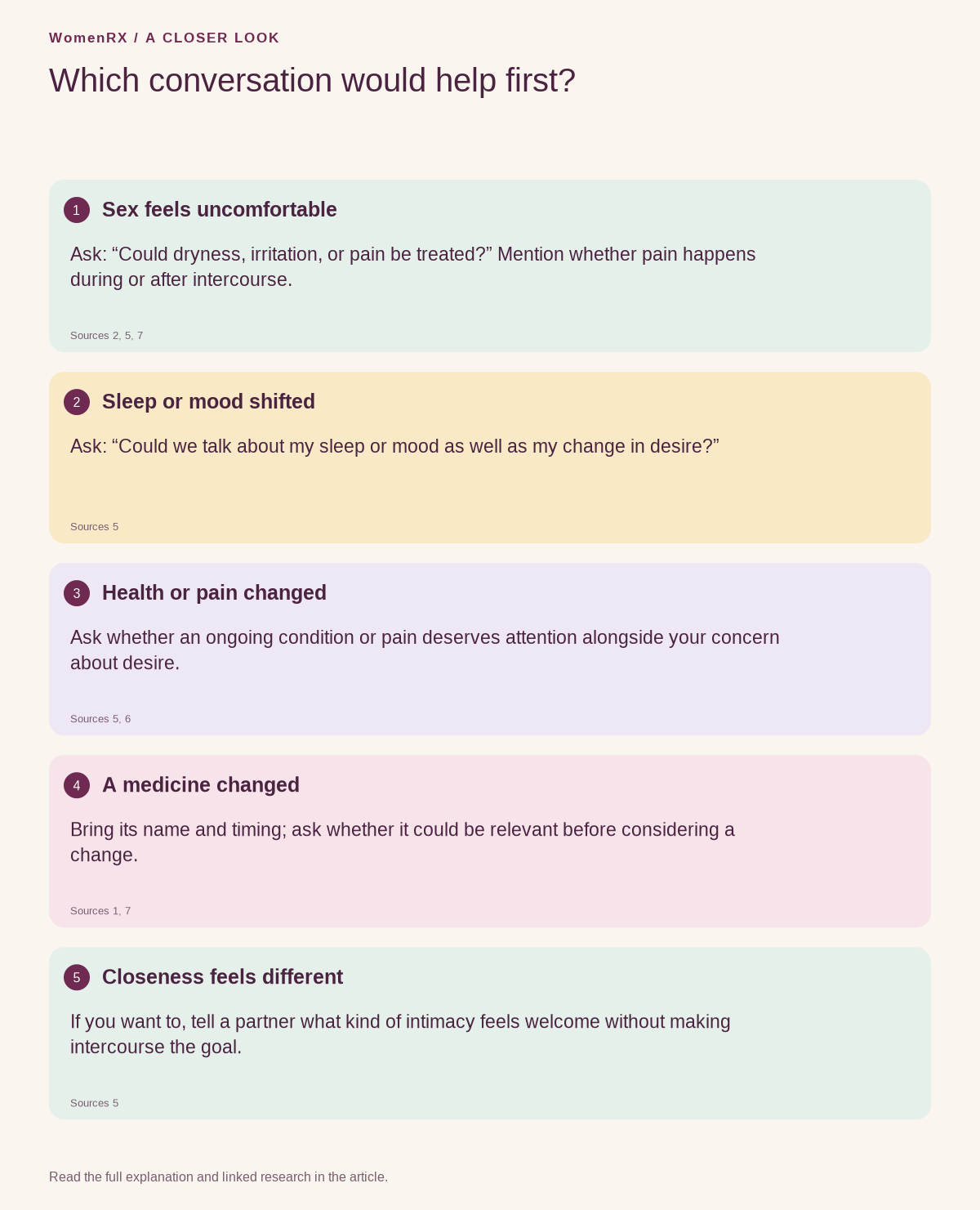
Which conversation would help first?
Sex feels uncomfortable: Ask: “Could dryness, irritation, or pain be treated?” Mention whether pain happens during or after intercourse.257
Sleep or mood shifted: Ask: “Could we talk about my sleep or mood as well as my change in desire?”5
Health or pain changed: Ask whether an ongoing condition or pain deserves attention alongside your concern about desire.56
A medicine changed: Bring its name and timing; ask whether it could be relevant before considering a change.17
Closeness feels different: If you want to, tell a partner what kind of intimacy feels welcome without making intercourse the goal.5
Read the figure as text
Pick the prompt closest to what you want to change. These are conversation starters, not a diagnostic score.- Sex feels uncomfortable: Ask: “Could dryness, irritation, or pain be treated?” Mention whether pain happens during or after intercourse.257
- Sleep or mood shifted: Ask: “Could we talk about my sleep or mood as well as my change in desire?”5
- Health or pain changed: Ask whether an ongoing condition or pain deserves attention alongside your concern about desire.56
- A medicine changed: Bring its name and timing; ask whether it could be relevant before considering a change.17
- Closeness feels different: If you want to, tell a partner what kind of intimacy feels welcome without making intercourse the goal.5
More questions, answered
Does vaginal estrogen directly increase sexual desire?
It’s used to treat menopause-related vaginal symptoms such as dryness and irritation, not as a guaranteed treatment for low desire. If discomfort is part of why intimacy feels less appealing, treating that symptom may still be worth discussing. 24
What if my desire is lower but I’m not bothered by it?
A change in desire doesn’t automatically mean you need treatment. Research distinguishes low desire from distress about it; what matters is whether you want help with the change or with a related concern, such as pain. 57
Sources you can check
- Sexual Health | MedlinePlusAccessed 2026-09-25Return to first citation
- About vaginal oestrogen - NHSAccessed 2026-09-25Return to first citation
- Common questions about vaginal oestrogen - NHSAccessed 2026-09-25Return to first citation
- The 2022 hormone therapy position statement of The North American Menopause Society.“The 2022 Hormone Therapy Position Statement of The North American Menopause Society” Advisory Panel. · Menopause (New York, N.Y.) · 2022Return to first citation
- A scoping review of the biopsychosocial factors influencing sexual desire in menopause.Metcalfe KB, Meston CM. · Sexual medicine reviews · 2026Return to first citation
- Sexual Desire and Related Factors in Middle-Aged and Elderly Married Women: A Cross-Sectional Study in Iran.Tabatabaeichehr M, Mortazavi H, Abadi MH, Moayed L. · Open access Macedonian journal of medical sciences · 2018Return to first citation
- Prevalence and Predictors of Low Sexual Desire, Sexually Related Personal Distress, and Hypoactive Sexual Desire Dysfunction in a Community-Based Sample of Midlife Women.Worsley R, Bell RJ, Gartoulla P, Davis SR. · The journal of sexual medicine · 2017Return to first citation