Low Sexual Desire Around Menopause: What Might Help?
Pain, dryness, medicines, and personal circumstances can shape desire, so the most useful option depends on what you want to change.
If dryness or pain is making sex less appealing, lubricant, vaginal moisturizer, and attention to arousal may improve comfort without necessarily resolving low desire. If a change in desire troubles you, you can ask for an assessment and bring up physical symptoms, medicines, or personal concerns you want to discuss. Testosterone is a distinct treatment discussion for some postmenopausal women with confirmed hypoactive sexual desire disorder, not a general menopause remedy. 2 5 6
Start by separating discomfort from desire
Sex can feel different around menopause for more than one reason. Vaginal dryness may cause soreness or pain during sex, while desire itself may also change. Those are related concerns, but they don’t call for exactly the same support. It’s reasonable to seek help if a change bothers you or you want something to change; a lower level of desire by itself doesn’t tell you what treatment, if any, is right. 2 6
A practical first question is: Would sex feel more appealing if it were more comfortable, or is low desire still the main concern? You may have both concerns. Menopause is one possible cause of vaginal dryness, but dryness can also relate to arousal or other health conditions. 2
What non-drug steps can, and can’t, do
For dryness, water-based lubricant during sex and vaginal moisturizers are self-care options. If you’re not feeling aroused, trying different kinds of foreplay may help. These steps address dryness, comfort, or arousal; they may make sex more appealing without necessarily resolving low desire. 2
If self-care isn’t enough for menopause-related vaginal symptoms, a clinician can discuss options including low-dose vaginal estrogen. Guidance also lists vaginal DHEA or oral ospemifene for some people whose genitourinary symptoms aren’t relieved by over-the-counter therapies. These options address vaginal symptoms, not low desire on its own. 4
Vaginal estrogen is local treatment for symptoms such as vaginal dryness and irritation. That makes it different from treatment intended to address desire itself. If vaginal symptoms are the main barrier, ask about those symptoms directly rather than assuming a desire-focused treatment is the answer. 3
Bleeding after menopause or after sex, unusual discharge, or dryness that persists despite self-care warrants medical evaluation. These symptoms shouldn’t automatically be attributed to menopause. 2
When desire itself is the concern
A useful assessment looks at the whole situation, not just a hormone test. You can describe what sex feels like physically, whether the change bothers you, and whether a medicine might be affecting you. You can also raise any mood or relationship concerns you want to discuss. Medicines are one recognized factor that can affect sexual desire. 1 6
The details help point toward different next steps. For example, if you want sex but anticipate pain, addressing discomfort may be the place to start. If desire changed around the time you started a medicine, bring up that timing and the medicine with its prescriber rather than assuming menopause explains everything. If mood or relationship tension feels more relevant, say so. Those concerns are worth discussing rather than assuming one treatment is the answer. 1 2 6
Testosterone isn’t a general menopause remedy or a response to a low desire level alone. A review of clinical studies found improved desire and sexual function in some postmenopausal women with hypoactive sexual desire disorder, or HSDD, compared with placebo. That evidence doesn’t mean testosterone will help everyone, and the review notes that more research is needed on long-term effects. Evidence for premenopausal women is more limited. 5
A 2025 position statement recommends considering testosterone only for postmenopausal women whose HSDD is confirmed through a formal biopsychosocial evaluation. Unlike vaginal estrogen, which treats local dryness and irritation, this is a discussion about HSDD confirmed through formal evaluation. The statement favors transdermal testosterone and advises against pellets and compounded testosterone because of dosing concerns and insufficient evidence. It also calls for a baseline level before treatment and monitoring during treatment. This is a Latin American professional association’s position, so it shouldn’t be mistaken for a US guideline. A testosterone blood level alone doesn’t diagnose HSDD; the statement advises against routine measurement for diagnosis. 3 6
Match the next step to what you want to change
If pain or dryness is the main issue, focus first on comfort and on whether menopause-related vaginal treatment fits your situation. If a change in desire troubles you, ask for an assessment and share any physical symptoms, medicine changes, or personal concerns you want to discuss before settling on a treatment. And if you’re not distressed by the change, you don’t have to pursue treatment just because your desire differs from what you think it should be.
You might put it simply: “I want help with the part that’s affecting me most: discomfort, desire, or both.” That helps keep vaginal symptom treatment and desire-focused assessment in their proper lanes.
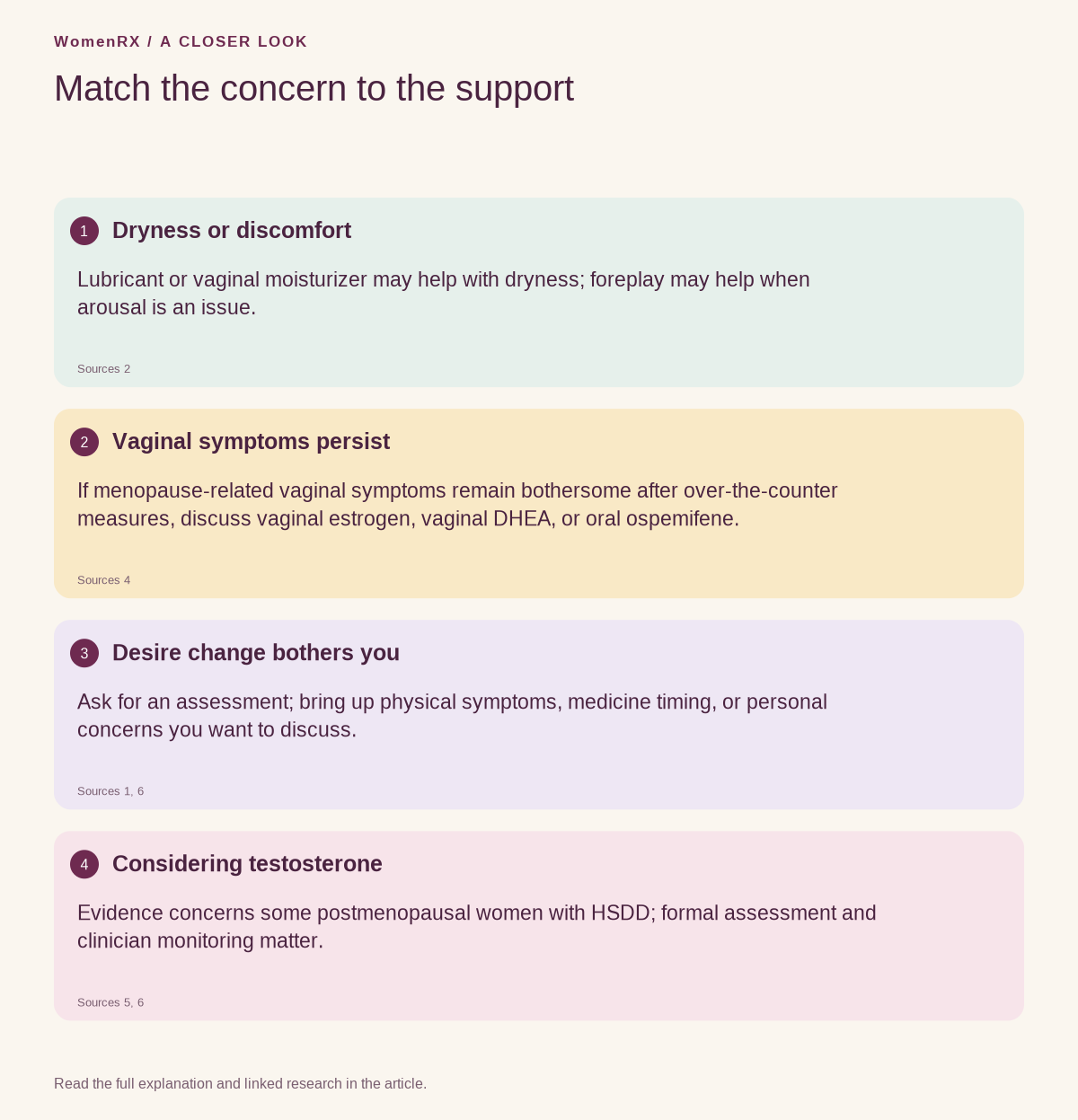
Match the concern to the support
Dryness or discomfort: Lubricant or vaginal moisturizer may help with dryness; foreplay may help when arousal is an issue.2
Vaginal symptoms persist: If menopause-related vaginal symptoms remain bothersome after over-the-counter measures, discuss vaginal estrogen, vaginal DHEA, or oral ospemifene.4
Desire change bothers you: Ask for an assessment; bring up physical symptoms, medicine timing, or personal concerns you want to discuss.16
Considering testosterone: Evidence concerns some postmenopausal women with HSDD; formal assessment and clinician monitoring matter.56
Read the figure as text
These paths separate comfort measures, treatment for persistent menopause-related vaginal symptoms, and assessment when a change in desire bothers you.- Dryness or discomfort: Lubricant or vaginal moisturizer may help with dryness; foreplay may help when arousal is an issue.2
- Vaginal symptoms persist: If menopause-related vaginal symptoms remain bothersome after over-the-counter measures, discuss vaginal estrogen, vaginal DHEA, or oral ospemifene.4
- Desire change bothers you: Ask for an assessment; bring up physical symptoms, medicine timing, or personal concerns you want to discuss.16
- Considering testosterone: Evidence concerns some postmenopausal women with HSDD; formal assessment and clinician monitoring matter.56
More questions, answered
Does a testosterone blood test explain low desire?
Not by itself. A position statement advises against using routine testosterone measurements to diagnose HSDD. The assessment considers the person’s experience and wider circumstances; the statement describes a baseline measurement before treatment as a separate step. 6
Sources you can check
- Sexual Health | MedlinePlusAccessed 2026-09-25Return to first citation
- Vaginal dryness - NHSAccessed 2026-09-25Return to first citation
- About vaginal oestrogen - NHSAccessed 2026-09-25Return to first citation
- The 2022 hormone therapy position statement of The North American Menopause Society.“The 2022 Hormone Therapy Position Statement of The North American Menopause Society” Advisory Panel. · Menopause (New York, N.Y.) · 2022Return to first citation
- The clinical management of testosterone replacement therapy in postmenopausal women with hypoactive sexual desire disorder: a review.Uloko M, Rahman F, Puri LI, Rubin RS. · International journal of impotence research · 2022Return to first citation
- Androgen therapy in midlife and older women: a position statement of the Latin American Association of Gynecological Endocrinology (ALEG).Pilnik S, Belardo A, Marchesan LB, Camero-Lascano A, Acuña-San Martín M, Elizalde-Cremonte A, Ojeda E, Manzur A, Chedraui P. · Climacteric : the journal of the International Menopause Society · 2025Return to first citation