Low Desire After Menopause: What Would You Like to Change?
The most useful option depends on whether you want more interest, more comfort, or a different experience of arousal.
You don’t need to change your level of desire unless you want to. If the change bothers you, start by identifying whether the main concern is low interest, discomfort, or arousal that feels different. Menopause-related vaginal symptoms have treatments, but treating dryness isn’t the same as treating desire. Testosterone is a possible discussion for some postmenopausal women with distressing low desire, not a universal solution. 2 4 5
Start with the part you want to change
A change in sexual desire after menopause isn’t automatically a problem to fix. Your goal might be to enjoy intimacy without pain, to feel more interested in sex, or simply to understand why arousal feels different. Those goals can overlap, but they don’t point to exactly the same options.
One way to sort them out is to ask: If one thing changed, what would make the biggest difference to me? For example, wanting closeness but dreading penetration because it hurts is different from feeling comfortable during sex but rarely wanting it. You don’t have to fit neatly into one category. Start with the concern that matters most to you.
If discomfort is getting in the way
Lower estrogen during and after menopause can contribute to vaginal dryness and irritation. Discomfort may make sex less appealing even when you’d like the intimacy. Vaginal lubricants or moisturizers may help vaginal symptoms. Low-dose vaginal estrogen treats menopause-related dryness and irritation locally; it isn’t intended to treat hot flashes or every other menopause symptom. 2 3
If over-the-counter options don’t relieve bothersome vaginal symptoms, menopause guidance lists low-dose vaginal estrogen and other options, including vaginal dehydroepiandrosterone (DHEA). Prasterone is a vaginal DHEA option described as an alternative when vaginal estrogen isn’t helping. These are conversations about vaginal symptoms, not promises to increase sexual desire. 3 4
If interest is there, but arousal feels different
Try to describe the change without calling all of it “low libido.” Are you interested in intimacy but finding that lubrication or comfort has changed? Or does the sense of engagement feel different even when sex isn’t painful? That distinction helps keep a discussion focused on what you’re experiencing rather than assuming a desire treatment is the answer.
A change in health or medication may be relevant, too. Chronic conditions and medicines that affect desire or sexual performance are among the factors that can affect sexual health. If the change began around a new health problem or medicine, bring up the connection rather than changing a prescribed medicine on your own. 1
If low desire itself is upsetting
Distress matters. Having less interest than you used to, or less than a partner would like, doesn’t by itself tell you that you need treatment. If you want more desire, it’s worth looking at possible contributors, including medicines and mental health or relationship concerns, before deciding whether a specialized treatment fits. Considering those factors doesn’t mean the experience is imaginary or has just one cause. 1 5
Testosterone sometimes comes up in this discussion. A 2024 review reported moderate benefit from systemic transdermal testosterone for postmenopausal women with hypoactive sexual desire disorder when the low desire was not primarily related to modifiable factors or other concerns such as relationship or mental health problems. The studies reviewed varied in treatment methods and how they measured sexual outcomes, and long-term safety data were lacking. That makes testosterone an individualized treatment discussion for distressing low desire, not a general-purpose libido booster or a risk-free first step. 5
Why a better sexual-function score isn’t the whole answer
You may see headlines saying estrogen improves sexual function. The detail is in which part of sexual function changed. A Cochrane review of 36 studies involving 23,299 women found that estrogen alone probably slightly improved an overall sexual-function score in women with menopause symptoms or in early postmenopause. The findings were especially relevant to lubrication, pain, and satisfaction. None of the studies enrolled only women with sexual dysfunction, and only seven made sexual function a primary outcome. An overall score therefore shouldn’t be read as a promise that estrogen will raise your desire. 6
A trial in healthy women who were recently postmenopausal makes the same distinction useful: transdermal estrogen modestly improved an overall sexual-function score compared with placebo, with improvements in lubrication and pain, but the study did not assess distress about sexual function. Its findings don’t establish that this approach treats distressing low desire. 7
The practical takeaway is to match an option to your goal. If comfort is the barrier, start with comfort. If desire itself is the change you want to address, include the rest of your health and life context in that conversation. And if your current level of desire feels fine to you, there’s no requirement to pursue more.
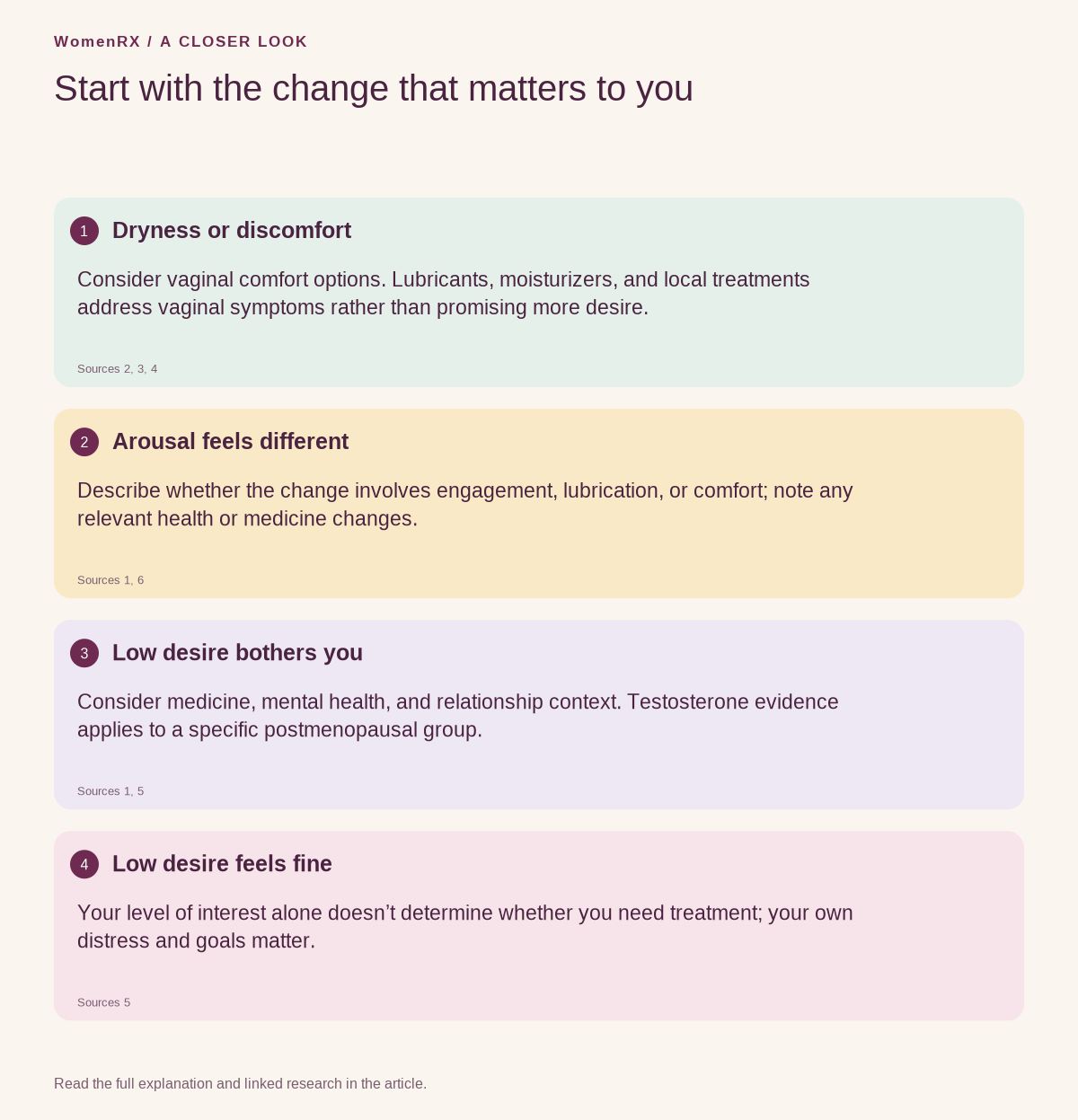
Start with the change that matters to you
Dryness or discomfort: Consider vaginal comfort options. Lubricants, moisturizers, and local treatments address vaginal symptoms rather than promising more desire.234
Arousal feels different: Describe whether the change involves engagement, lubrication, or comfort; note any relevant health or medicine changes.16
Low desire bothers you: Consider medicine, mental health, and relationship context. Testosterone evidence applies to a specific postmenopausal group.15
Low desire feels fine: Your level of interest alone doesn’t determine whether you need treatment; your own distress and goals matter.5
Read the figure as text
These paths help separate symptoms that overlap, without treating low desire as a problem everyone needs to solve.- Dryness or discomfort: Consider vaginal comfort options. Lubricants, moisturizers, and local treatments address vaginal symptoms rather than promising more desire.234
- Arousal feels different: Describe whether the change involves engagement, lubrication, or comfort; note any relevant health or medicine changes.16
- Low desire bothers you: Consider medicine, mental health, and relationship context. Testosterone evidence applies to a specific postmenopausal group.15
- Low desire feels fine: Your level of interest alone doesn’t determine whether you need treatment; your own distress and goals matter.5
Sources you can check
- Sexual Health | MedlinePlusAccessed 2026-09-25Return to first citation
- About vaginal oestrogen - NHSAccessed 2026-09-25Return to first citation
- Common questions about vaginal oestrogen - NHSAccessed 2026-09-25Return to first citation
- The 2022 hormone therapy position statement of The North American Menopause Society.“The 2022 Hormone Therapy Position Statement of The North American Menopause Society” Advisory Panel. · Menopause (New York, N.Y.) · 2022Return to first citation
- Systemic testosterone for the treatment of female sexual interest and arousal disorder (FSIAD) in the postmenopause.Ribera Torres L, Anglès-Acedo S, López Chardi L, Mension Coll E, Castelo-Branco C. · Gynecological endocrinology : the official journal of the International Society of Gynecological Endocrinology · 2024Return to first citation
- Hormone therapy for sexual function in perimenopausal and postmenopausal women.Lara LA, Cartagena-Ramos D, Figueiredo JB, Rosa-E-Silva ACJ, Ferriani RA, Martins WP, Fuentealba-Torres M. · The Cochrane database of systematic reviews · 2023Return to first citation
- Effects of Oral vs Transdermal Estrogen Therapy on Sexual Function in Early Postmenopause: Ancillary Study of the Kronos Early Estrogen Prevention Study (KEEPS).Taylor HS, Tal A, Pal L, Li F, Black DM, Brinton EA, Budoff MJ, Cedars MI, Du W, Hodis HN, Lobo RA, Manson JE, Merriam GR, Miller VM, Naftolin F, Neal-Perry G, Santoro NF, Harman S... · JAMA internal medicine · 2017Return to first citation