Does Vaginal Estrogen Help Dryness After Menopause?
Vaginal estrogen can relieve menopause-related dryness, while moisturizers and lubricants help with different parts of the problem.
Yes. Low-dose vaginal estrogen can ease dryness and irritation related to menopause, particularly when nonhormonal products haven’t helped enough. It treats local symptoms, not hot flashes. A vaginal moisturizer can help with ongoing dryness, while a lubricant reduces friction during sex. If you have bleeding after menopause or unusual discharge, get assessed rather than assuming dryness is the cause. 1 2 4
First, notice when the discomfort happens
Falling estrogen levels during and after menopause can change vaginal moisture. You may notice dryness between sexual activity, irritation or soreness, or discomfort during sex. These symptoms can be part of genitourinary syndrome of menopause, often called GSM. They deserve attention whether or not you’re having sex. 1 2
When discomfort happens mainly with friction during sex, a lubricant may meet the immediate need. If you feel dry at other times, a vaginal moisturizer is an option for ongoing relief. Both are nonhormonal, but they do different jobs: lubricant is used before sex, while moisturizer is used inside the vagina to help keep it moist. 1
What vaginal estrogen adds
Vaginal estrogen is placed inside the vagina. Forms include tablets, creams, gels and rings. It supplies estrogen locally to treat menopause-related dryness and irritation, with relatively little of the medicine entering the rest of the body. It isn’t the same treatment decision as systemic hormone therapy, and it won’t treat hot flashes or sleep problems. 2 3
If over-the-counter products haven’t relieved bothersome vaginal symptoms and you don’t otherwise need systemic hormone therapy, the North American Menopause Society recommends low-dose vaginal estrogen as one treatment option. You don’t have to choose between putting up with persistent dryness and taking hormones for symptoms throughout your body. 4
The full effect may take up to three months. If you’re still uncomfortable after that, revisit both the treatment and the possible cause rather than assuming that every form will work the same way for you. 3
Local or systemic treatment?
If vaginal dryness is your main menopause symptom, local treatment targets the area that bothers you. If you also have troublesome hot flashes, that’s a separate reason to discuss broader menopause treatment: vaginal estrogen won’t relieve them. The benefits and risks of systemic hormone therapy depend on factors including the type, route and timing of treatment, as well as your health history. It isn’t simply a stronger version of a vaginal moisturizer or local estrogen product. 2 4
A history of breast cancer deserves a specific conversation before choosing vaginal estrogen, especially if you take an aromatase inhibitor. In one randomized trial, 23 postmenopausal breast cancer survivors taking aromatase inhibitors used either vaginal estrogen or a nonhormonal moisturizer for 24 weeks. Dryness and pain with sex improved more in the estrogen group, but a study that small and brief cannot settle long-term safety for someone in cancer treatment. 5
When an examination is worth considering
Menopause isn’t the only possible reason for dryness. Cancer treatments, reduced arousal during sex, diabetes and Sjögren’s syndrome are among other possible contributors. That’s why an assessment, which may include an examination, can be useful if symptoms persist despite self-care or interfere with daily life: it gives you a chance to check the cause before trying another treatment. 1
Don’t attribute unusual discharge or bleeding after menopause to dryness on your own. Bleeding after sex also warrants assessment. Those symptoms call for a closer look, even if menopause-related dryness seems like a plausible explanation. 1
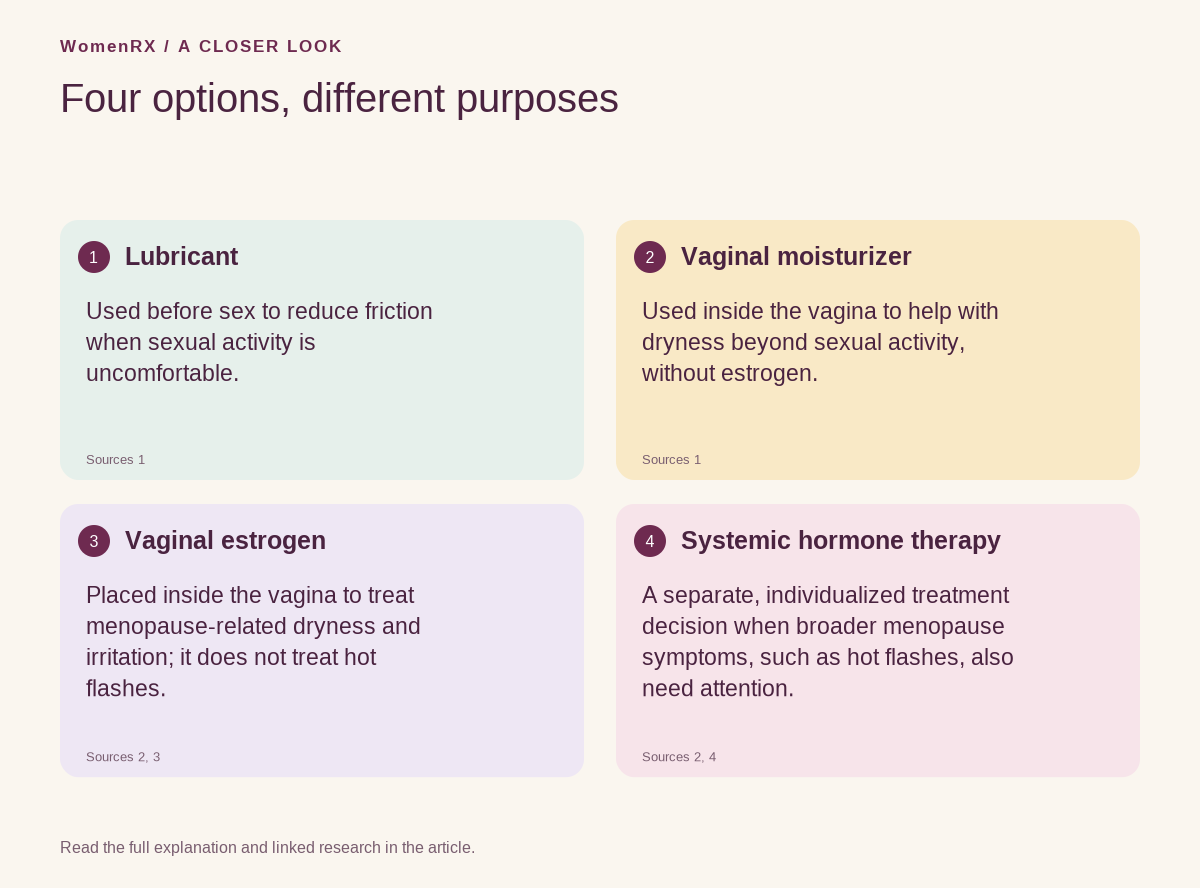
Four options, different purposes
Lubricant: Used before sex to reduce friction when sexual activity is uncomfortable.1
Vaginal moisturizer: Used inside the vagina to help with dryness beyond sexual activity, without estrogen.1
Vaginal estrogen: Placed inside the vagina to treat menopause-related dryness and irritation; it does not treat hot flashes.23
Systemic hormone therapy: A separate, individualized treatment decision when broader menopause symptoms, such as hot flashes, also need attention.24
Read the figure as text
Match the approach to when dryness bothers you and whether you have symptoms beyond the vagina.- Lubricant: Used before sex to reduce friction when sexual activity is uncomfortable.1
- Vaginal moisturizer: Used inside the vagina to help with dryness beyond sexual activity, without estrogen.1
- Vaginal estrogen: Placed inside the vagina to treat menopause-related dryness and irritation; it does not treat hot flashes.23
- Systemic hormone therapy: A separate, individualized treatment decision when broader menopause symptoms, such as hot flashes, also need attention.24
More questions, answered
Will dryness return if I stop using vaginal estrogen?
It can. Menopause-related symptoms may return after treatment stops, so a return of dryness doesn’t necessarily mean the treatment failed. If you’re thinking of stopping because of side effects or inconvenience, discuss what other approaches might suit you. 3
Sources you can check
- Vaginal dryness - NHSAccessed 2026-09-25Return to first citation
- About vaginal oestrogen - NHSAccessed 2026-09-25Return to first citation
- Common questions about vaginal oestrogen - NHSAccessed 2026-09-25Return to first citation
- The 2022 hormone therapy position statement of The North American Menopause Society.“The 2022 Hormone Therapy Position Statement of The North American Menopause Society” Advisory Panel. · Menopause (New York, N.Y.) · 2022Return to first citation
- VEMORA: Vaginal Estrogen versus non-hormonal MOisturizer in women Receiving Aromatase inhibitors: a randomized, controlled trial.Niravath P, Rimawi M, Sun K, Mai H, Puri A, Vyas A, Nangia J, Brock A, Foreman C, Adnan H, Shafer M, Anand A, Moges A, Al Najjar E, Mathur S, Antosh D, High R, Zaid T, Chang J, Osb... · Breast cancer research and treatment · 2026Return to first citation