Why Vaginal Dryness Can Change Around Menopause
Falling estrogen can affect vaginal tissue and lubrication, but it isn’t the only reason dryness or irritation may happen.
During the menopause transition and after menopause, lower estrogen can contribute to vaginal dryness by changing estrogen-sensitive tissue: it may become thinner, less elastic, and less well lubricated. These changes can help explain discomfort, but symptoms alone don’t prove that hormones are the cause. Irritating products, low arousal, some treatments, and certain health conditions can also contribute. 123
What estrogen has to do with vaginal tissue
Estrogen helps support tissues in and around the vagina. As estrogen levels fall during and after menopause, those tissues can become thinner and less elastic, with less lubrication and greater fragility. This pattern is often called genitourinary syndrome of menopause, or GSM. It can contribute to dryness, irritation, itching, and pain during sex or an exam. 23
The change isn’t simply a matter of having less natural fluid on a particular day. Tissue changes can make the area more sensitive to friction, so sex, a pelvic exam, or everyday movement may feel uncomfortable. That’s one reason a hormone shift can affect comfort as well as lubrication. 3
A possible link, not a diagnosis
Dryness can fit with menopause-related tissue changes, but it doesn’t identify the cause by itself. Some people have symptoms and others don’t; symptoms such as soreness, itching, or pain can have more than one explanation. Low arousal during sex, perfumed washes or douches, some cancer treatments, diabetes, and Sjögren’s syndrome are among other possible contributors. 1
It may help to notice the pattern without treating it as proof: for example, whether discomfort is mainly during sex, started after a new product, or appeared alongside other menopause changes. This can help you describe what’s happening, but no single pattern confirms that estrogen is responsible.
What you can try, and what treatment means
If friction during sex is the main problem, a water-based lubricant may help. Vaginal moisturizers are another nonhormonal option for dryness, and avoiding perfumed products around the vagina may reduce irritation from those products. These steps can ease symptoms for some people; they don’t establish what caused them. 1
For bothersome menopause-related vaginal symptoms, vaginal estrogen is a local treatment: it’s used in the vagina to address symptoms such as dryness and irritation. It’s different from systemic hormone therapy used for symptoms elsewhere, such as hot flashes; vaginal estrogen doesn’t treat those other symptoms. Whether it’s a suitable choice depends on the person and the reason for treatment, so it’s a decision to make with a clinician who knows your circumstances. 24
If you have other menopause symptoms, that doesn’t automatically mean you need systemic hormones for vaginal dryness. The North American Menopause Society’s position statement distinguishes bothersome genitourinary symptoms from indications for systemic hormone therapy and describes low-dose vaginal estrogen and other options for certain people whose symptoms aren’t relieved by over-the-counter treatments. 4
When to get the symptoms checked
Arrange an assessment if dryness lasts for weeks despite things you’ve tried, affects daily life, or comes with unusual discharge. Bleeding after sex, between periods, or after menopause should also be assessed rather than assumed to be a hormone effect. 1
The useful distinction is this: lower estrogen can explain a recognizable kind of tissue change, but the same symptom can have other causes. A check-in can help sort out whether menopause-related changes, irritation, another health condition, or more than one factor is involved.
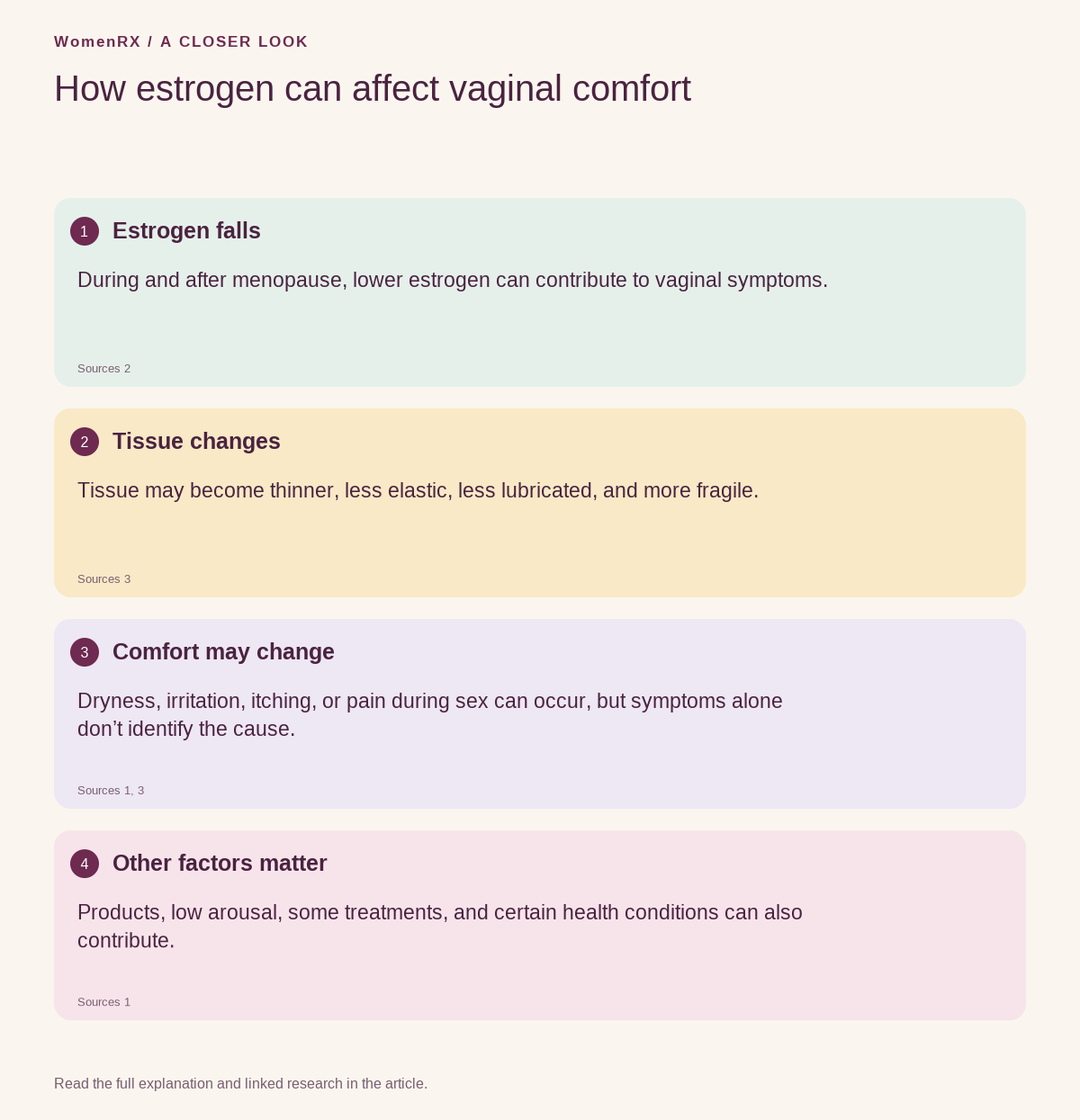
How estrogen can affect vaginal comfort
Estrogen falls: During and after menopause, lower estrogen can contribute to vaginal symptoms.2
Tissue changes: Tissue may become thinner, less elastic, less lubricated, and more fragile.3
Comfort may change: Dryness, irritation, itching, or pain during sex can occur, but symptoms alone don’t identify the cause.13
Other factors matter: Products, low arousal, some treatments, and certain health conditions can also contribute.1
Read the figure as text
Menopause-related estrogen changes can alter vaginal tissue, while other contributors may produce similar symptoms.- Estrogen falls: During and after menopause, lower estrogen can contribute to vaginal symptoms.2
- Tissue changes: Tissue may become thinner, less elastic, less lubricated, and more fragile.3
- Comfort may change: Dryness, irritation, itching, or pain during sex can occur, but symptoms alone don’t identify the cause.13
- Other factors matter: Products, low arousal, some treatments, and certain health conditions can also contribute.1
More questions, answered
Does vaginal dryness mean my estrogen is low?
Not necessarily. Lower estrogen around menopause can contribute to dryness, but other factors, including irritating products, low arousal, some treatments, and certain health conditions, can also play a role. Symptoms alone don’t establish the cause. 12
Does vaginal estrogen treat hot flashes too?
No. Vaginal estrogen is used locally for vaginal symptoms such as dryness and irritation; it doesn’t treat other menopause symptoms such as hot flashes. 2
Sources you can check
- Vaginal dryness - NHSAccessed 2026-09-25Return to first citation
- About vaginal oestrogen - NHSAccessed 2026-09-25Return to first citation
- Vaginal dilator therapy for pelvic cancer patients: a review.Nair N, Brenner S, Rivera A, Norquist B, Rimel BJ. · Gynecologic oncology reports · 2026Return to first citation
- The 2022 hormone therapy position statement of The North American Menopause Society.“The 2022 Hormone Therapy Position Statement of The North American Menopause Society” Advisory Panel. · Menopause (New York, N.Y.) · 2022Return to first citation