Vaginal Dryness Has More Than One Possible Cause
Menopause and breastfeeding can both affect vaginal moisture, but irritation or pain can also come from other causes.
Menopause and breastfeeding are two low-estrogen contexts that can contribute to vaginal dryness and pain with sex. Cancer treatments that change hormone levels, including some hormonal therapies, can also play a role. But dryness, itching, soreness, or burning doesn’t prove that tissue changes are the cause: arousal, diabetes, Sjögren’s syndrome, or another issue may need consideration. 1 4 5
Similar symptoms, different settings
Vaginal dryness can show up as soreness or itching around the vagina, discomfort during sex, or less lubrication than you expect. Burning and irritation can also occur with genitourinary syndrome of menopause (GSM), a term used for genital and urinary symptoms associated with estrogen deprivation. These symptoms overlap, so how they feel alone may not reveal the cause. 1 4
The context can offer clues. Menopause involves lower hormone levels, and the resulting drop in estrogen can contribute to vaginal dryness and irritation. GSM is one name for this pattern of menopause-related symptoms; it may involve urinary symptoms as well as vaginal symptoms. Vaginal estrogen is a local treatment option for menopause-related dryness and irritation, but it doesn’t treat other menopause symptoms such as hot flashes. 2
Breastfeeding is another situation in which vaginal dryness or pain with sex may occur. A systematic review of 65 studies of postpartum lactating people estimated vaginal dryness in 53.6% (95% confidence interval, 33.6-72.5%) and vaginal atrophy in 63.9% (95% confidence interval, 55.3-71.6%). These are pooled estimates across studies; they describe a group, not what any one person is experiencing. A separate review linked breastfeeding-related changes in estrogen and prolactin with reduced lubrication and pain during intercourse, while also describing fatigue and psychological and social factors that can affect sexual function. 5 6
Similar symptoms can also follow cancer treatment. Chemotherapy, radiotherapy, hormonal treatment, or surgery may change hormone levels. Some cancer treatments can bring on menopause suddenly or worsen GSM symptoms. That history matters when choosing treatment, especially after a hormone-sensitive cancer. 1 3
Dryness isn’t always a hormone problem
Less lubrication during sex can be related to not being aroused. Diabetes and Sjögren’s syndrome are other conditions associated with vaginal dryness. Irritation can also have causes that aren’t simply a lack of estrogen, which is why persistent symptoms or unusual discharge deserve attention rather than an automatic assumption of atrophy. 1
The word “atrophy” can sound like a diagnosis based on one symptom, but dryness by itself doesn’t establish that tissue has changed. The lactation review reported dryness and atrophy as separate outcomes, and the menopause and cancer-treatment sources describe several possible symptoms and causes. A useful way to think about it is: symptoms are a reason to consider the context, not a way to diagnose the cause on your own. 1 3 6
What you can try, and when to get checked
If dryness is mainly uncomfortable during sex, a water-based lubricant may reduce friction. Vaginal moisturizers are another option for ongoing dryness. Choose products made for vaginal use, and avoid perfumed washes or douches; products not intended for vaginal use can worsen irritation. These measures can help with symptoms, but they don’t identify or treat every underlying cause. 1
If symptoms fit a menopause-related pattern, vaginal estrogen may be an option. For someone with a history of hormone-sensitive cancer or currently receiving endocrine cancer treatment, the decision needs individualized discussion with the cancer care team. A 2026 review describes nonhormonal treatments as the usual first approach in this setting and emphasizes weighing symptom relief and safety together. 2 3
Arrange an evaluation if dryness lasts for weeks despite self-care, affects daily life, or comes with unusual discharge. Bleeding after sex, between periods, or after menopause should also be checked. Those symptoms don’t point to one diagnosis by themselves; they’re reasons not to assume dryness is simply hormonal. 1
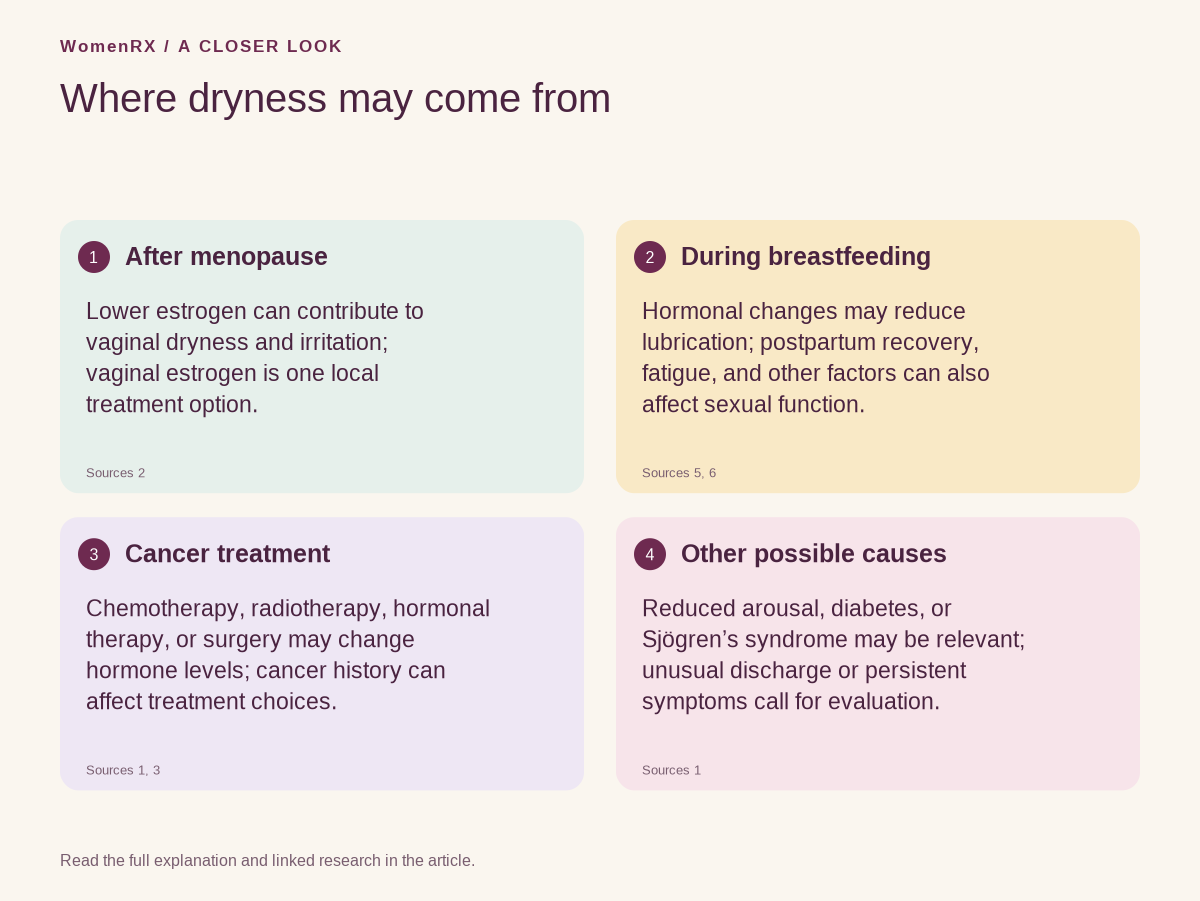
Where dryness may come from
After menopause: Lower estrogen can contribute to vaginal dryness and irritation; vaginal estrogen is one local treatment option.2
During breastfeeding: Hormonal changes may reduce lubrication; postpartum recovery, fatigue, and other factors can also affect sexual function.56
Cancer treatment: Chemotherapy, radiotherapy, hormonal therapy, or surgery may change hormone levels; cancer history can affect treatment choices.13
Other possible causes: Reduced arousal, diabetes, or Sjögren’s syndrome may be relevant; unusual discharge or persistent symptoms call for evaluation.1
Read the figure as text
The same symptom can arise in different contexts. This comparison shows clues to consider, not a diagnostic test.- After menopause: Lower estrogen can contribute to vaginal dryness and irritation; vaginal estrogen is one local treatment option.2
- During breastfeeding: Hormonal changes may reduce lubrication; postpartum recovery, fatigue, and other factors can also affect sexual function.56
- Cancer treatment: Chemotherapy, radiotherapy, hormonal therapy, or surgery may change hormone levels; cancer history can affect treatment choices.13
- Other possible causes: Reduced arousal, diabetes, or Sjögren’s syndrome may be relevant; unusual discharge or persistent symptoms call for evaluation.1
More questions, answered
Does breastfeeding-related dryness mean I have menopause?
No. Breastfeeding is a separate postpartum context in which hormonal changes can be associated with reduced lubrication and pain with sex. Similar symptoms don’t establish the same cause or diagnosis. 5 6
Is vaginal estrogen appropriate for anyone with dryness?
No. It’s used for menopause-related dryness and irritation, but symptoms can have other causes. For people with hormone-sensitive cancer or cancer treatment, treatment choices need individualized discussion with the oncology team. 1 2 3
Sources you can check
- Vaginal dryness - NHSAccessed 2026-09-25Return to first citation
- About vaginal oestrogen - NHSAccessed 2026-09-25Return to first citation
- Genitourinary syndrome of menopause in women with cancer - a narrative review.Ryan HM, Brennan DJ. · Maturitas · 2026Return to first citation
- Fractional CO₂ vaginal laser therapy for genitourinary syndrome of menopause in breast cancer survivors: a scoping review.Jacobsen S, Eliasen EK, Stokvad JK, Bor P. · Lasers in medical science · 2026Return to first citation
- Sexual function in breastfeeding women: a systematic review.Adeli M, Shamaeian-Razavi N, Irani M. · BMC women's health · 2026Return to first citation
- Postpartum and Lactation-Related Genitourinary Symptoms: A Systematic Review.Perelmuter S, Stokes C, Chapalamadugu M, Drian A, Zusman GL, Berdugo J, Davide M, Andy C, Grant R, Drew T, Burns R, Meurer J, Shah A, Contractor S, Messafi A, Thompson A, Krapf J, ... · Obstetrics and gynecology · 2025Return to first citation