Vaginal Dryness in Your 40s: Could It Be Perimenopause?
Dryness can be part of perimenopause, but your period pattern and any accompanying symptoms offer better clues than age alone.
Yes, perimenopause could play a part in vaginal dryness in your 40s, especially if your periods are changing or you’re also having hot flashes or night sweats. But dryness alone can’t establish the cause. Irritation, changes in arousal, certain health conditions, and cancer treatments are other possibilities. Unusual discharge, bleeding, or dryness that persists despite self-care calls for an evaluation. 1 4 5
Start with your periods, not your birthday
Vaginal dryness can happen during the menopause transition. It can also happen for other reasons, so turning 40 and noticing dryness doesn’t, by itself, mean you’re in perimenopause. A review of studies in women aged 40 and older found that no single symptom or test could reliably confirm or rule out perimenopause. Age and menstrual history were more useful starting points. 5
Think about whether the frequency of your periods has changed. Are they coming more or less often than they used to? That pattern helps put symptoms in context because changes in cycle frequency are used to stage the menopause transition. Hot flashes or night sweats add another clue, though they don’t prove what’s causing the dryness. 4 5
There’s a reason to consider the connection. In a large Australian cross-sectional study of women aged 40 to 69, vaginal dryness distinguished late perimenopause from premenopause more than other sexual symptoms measured. That finding shows an association across groups, not a way to identify the cause of one person’s dryness. 4
Notice where and when it bothers you
Dryness or discomfort mainly during sex can have a different immediate explanation from dryness that bothers you at other times: not being aroused can contribute to vaginal dryness. Irritation from perfumed washes or douches is another possibility. Diabetes and Sjögren’s syndrome can be associated with dryness, while cancer treatments, including chemotherapy and hormonal therapy, can affect hormone levels and vaginal fluid. 1
Pay attention to whether the discomfort feels internal or whether the skin around the vaginal opening feels sore or itchy. Soreness and itching can accompany a dryness complaint, but those sensations don’t identify a cause on their own. If the area looks or feels irritated, especially when symptoms keep returning, it’s worth describing exactly where the discomfort is rather than assuming it’s hormonal. 1
The same goes for a new medicine or treatment. If symptoms began around a treatment change, bring its name and the timing to a visit. Cancer treatments are a documented possible contributor; timing alone isn’t enough to blame another medicine. 1
Choose relief without overlooking a reason to be seen
For discomfort during sex, a water-based lubricant is an option. For dryness that continues outside sex, a product specifically made as a vaginal moisturizer may help. Avoid perfumed washes and douches, and don’t put ordinary skin creams or lotions inside the vagina; products not made for vaginal use can cause further irritation or infection. 1
Arrange a clinical review if dryness has lasted a few weeks and self-care isn’t helping, or if it’s affecting daily life. Unusual discharge also deserves review. Bleeding after sex, between periods, or after menopause shouldn’t be written off as dryness or perimenopause. These are reasons to get the symptom assessed rather than keep trying products on your own. 1
If the overall picture points to menopause-related vaginal symptoms and over-the-counter measures haven’t relieved them, low-dose vaginal estrogen is one treatment to discuss. It treats vaginal dryness and irritation locally; it won’t address hot flashes or sleep symptoms. That distinction matters if you’re dealing with both vaginal discomfort and symptoms elsewhere in your body. 2 3
You don’t need to settle whether the cause is hormonal before taking a useful next step. Your cycle pattern helps you weigh perimenopause, while the timing, location, and accompanying symptoms help you decide whether simple relief is enough or the cause needs a closer look.
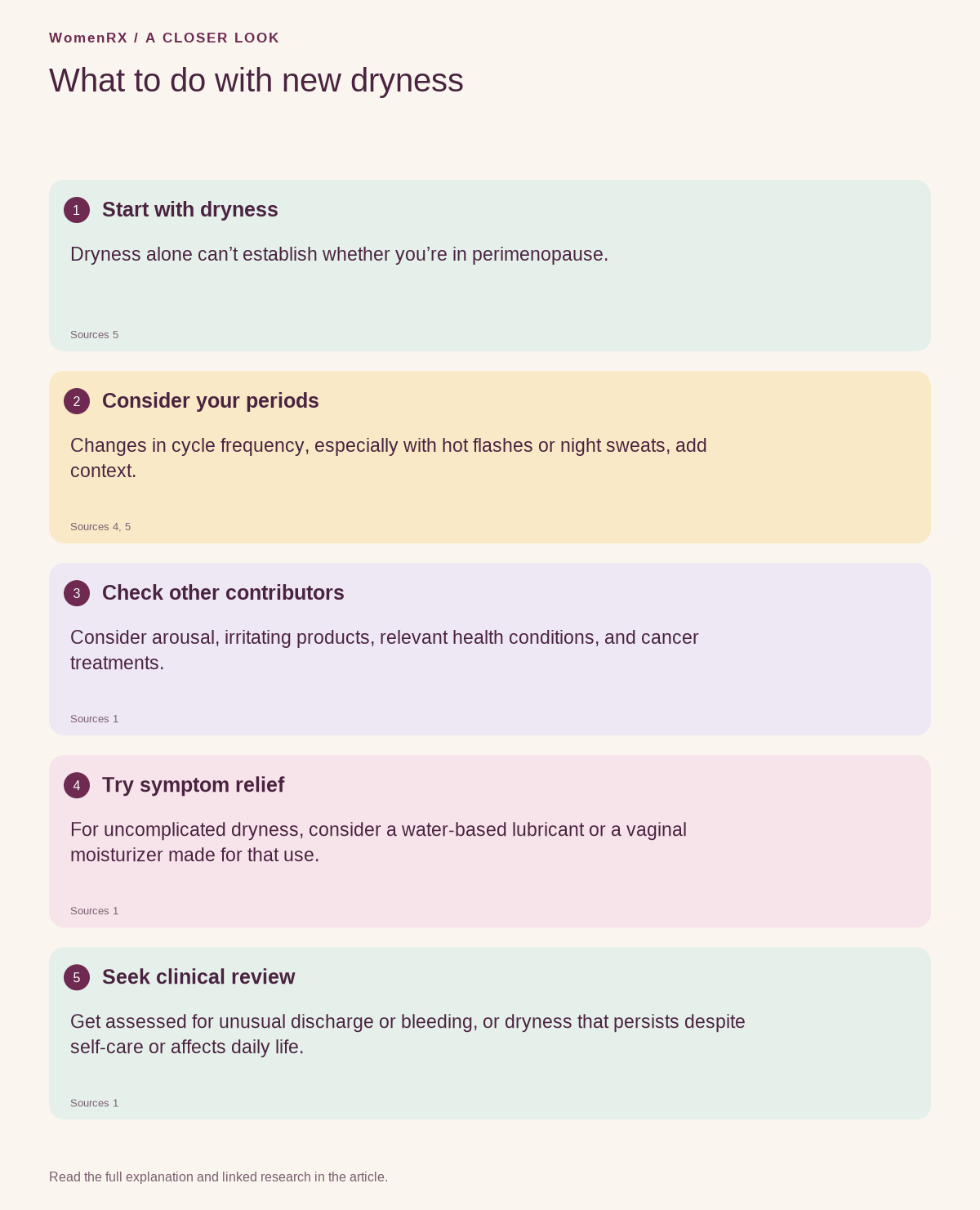
What to do with new dryness
Start with dryness: Dryness alone can’t establish whether you’re in perimenopause.5
Consider your periods: Changes in cycle frequency, especially with hot flashes or night sweats, add context.45
Check other contributors: Consider arousal, irritating products, relevant health conditions, and cancer treatments.1
Try symptom relief: For uncomplicated dryness, consider a water-based lubricant or a vaginal moisturizer made for that use.1
Seek clinical review: Get assessed for unusual discharge or bleeding, or dryness that persists despite self-care or affects daily life.1
Read the figure as text
Use your period pattern and accompanying symptoms to choose a next step, without treating dryness as a diagnosis.- Start with dryness: Dryness alone can’t establish whether you’re in perimenopause.5
- Consider your periods: Changes in cycle frequency, especially with hot flashes or night sweats, add context.45
- Check other contributors: Consider arousal, irritating products, relevant health conditions, and cancer treatments.1
- Try symptom relief: For uncomplicated dryness, consider a water-based lubricant or a vaginal moisturizer made for that use.1
- Seek clinical review: Get assessed for unusual discharge or bleeding, or dryness that persists despite self-care or affects daily life.1
More questions, answered
What if my periods are still regular?
Dryness can still deserve attention, but it doesn’t establish perimenopause. Changes in cycle frequency are a useful clue to the transition, and no single symptom can confirm or rule it out. Consider other contributors and seek a review if dryness persists or affects daily life. 1 4 5
Sources you can check
- Vaginal dryness - NHSAccessed 2026-09-25Return to first citation
- About vaginal oestrogen - NHSAccessed 2026-09-25Return to first citation
- The 2022 hormone therapy position statement of The North American Menopause Society.“The 2022 Hormone Therapy Position Statement of The North American Menopause Society” Advisory Panel. · Menopause (New York, N.Y.) · 2022Return to first citation
- Prevalence and severity of symptoms across the menopause transition: cross-sectional findings from the Australian Women's Midlife Years (AMY) Study.Islam RM, Bond M, Ghalebeigi A, Wang Y, Walker-Bone K, Davis SR. · The lancet. Diabetes & endocrinology · 2025Return to first citation
- Is this woman perimenopausal?Bastian LA, Smith CM, Nanda K. · JAMA · 2003Return to first citation