Vaginal Dryness During Menopause: What Can Help?
Moisturizers help with ongoing dryness, lubricants help with friction during sex, and persistent symptoms may call for a different treatment.
If dryness bothers you between sexual activity, a vaginal moisturizer may help. If discomfort happens mainly during sex, a lubricant can reduce friction. You can use both for different reasons. When symptoms persist or affect daily life, low-dose vaginal estrogen or another medical treatment may be worth discussing. The right choice depends on your symptoms and health history. 1 4 6
First, notice when the discomfort happens
Dryness can start during the menopause transition or continue after your final period. As estrogen falls, the vagina may produce less moisture. But menopause isn't the only possible explanation: perfumed washes or douching, not being aroused during sex, and certain health conditions can also contribute. 1 2 6
That distinction helps you choose what to try. If you feel dry or irritated during ordinary activities, a vaginal moisturizer is intended for symptom relief between sexual activity. If the problem is friction during sex, a lubricant is used before or during sexual activity. One doesn't have to replace the other. If arousal is part of the issue, spending more time on what feels pleasurable may help alongside a lubricant. 1 6
Products aren't interchangeable just because they're sold for vaginal dryness. Formulations vary, and some may irritate vaginal tissue. Choose a product intended for vaginal use, follow its directions, and stop using it if it makes irritation worse. Avoiding perfumed washes and douches may also remove a source of irritation. 1 6
What to expect from a moisturizer
Moisturizers are a reasonable option for ongoing dryness, but they won't work equally well for everyone. In a 2024 review of randomized trials involving postmenopausal women, vaginal moisturizers may have improved dryness compared with placebo; the researchers rated that evidence low certainty. The finding supports trying a moisturizer, not a promise that a particular product will work. The trials don't directly tell us how well moisturizers work during perimenopause. 5
When it makes sense to discuss treatment
If dryness has lasted a few weeks despite what you've tried, or it's affecting daily life, you don't have to keep cycling through products. Unusual discharge also deserves assessment. Bleeding after sex, between periods, or after menopause shouldn't simply be put down to dryness. 1
For bothersome menopause-related vaginal symptoms that haven't improved with over-the-counter approaches, low-dose vaginal estrogen is one medical option. It treats vaginal dryness and irritation locally; it isn't meant to treat hot flashes or sleep problems. Menopause guidance recommends considering it, or other treatments, when over-the-counter measures haven't relieved symptoms and treatment for whole-body menopause symptoms isn't otherwise needed. 2 4
Vaginal estrogen may improve dryness and pain during sex, according to the same review of trials in postmenopausal women. Vaginal dehydroepiandrosterone (DHEA) and oral ospemifene may improve some symptoms too. The evidence for these benefits was rated low certainty, and most studies were short. Few included women with a history of cancer, so those results offer less guidance for someone with that history. 5
The useful question isn't whether you should choose a “natural” or “medical” fix. It's whether you need help with day-to-day dryness, friction during sex, or symptoms that haven't responded to either approach. That answer, along with your medical history, can guide a conversation about what to try next. 1 4 6
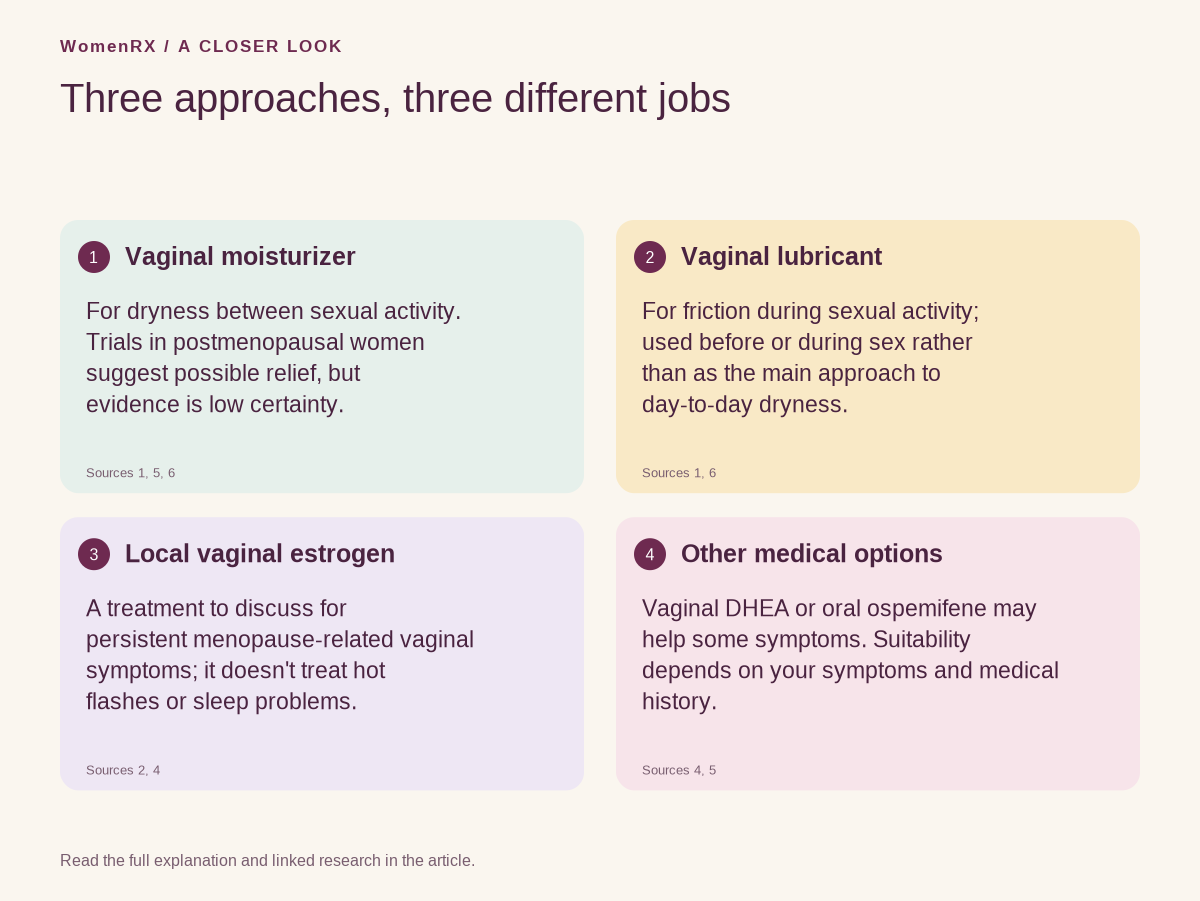
Three approaches, three different jobs
Vaginal moisturizer: For dryness between sexual activity. Trials in postmenopausal women suggest possible relief, but evidence is low certainty.156
Vaginal lubricant: For friction during sexual activity; used before or during sex rather than as the main approach to day-to-day dryness.16
Local vaginal estrogen: A treatment to discuss for persistent menopause-related vaginal symptoms; it doesn't treat hot flashes or sleep problems.24
Other medical options: Vaginal DHEA or oral ospemifene may help some symptoms. Suitability depends on your symptoms and medical history.45
Read the figure as text
Match the option to when you notice discomfort and what you need it to do.- Vaginal moisturizer: For dryness between sexual activity. Trials in postmenopausal women suggest possible relief, but evidence is low certainty.156
- Vaginal lubricant: For friction during sexual activity; used before or during sex rather than as the main approach to day-to-day dryness.16
- Local vaginal estrogen: A treatment to discuss for persistent menopause-related vaginal symptoms; it doesn't treat hot flashes or sleep problems.24
- Other medical options: Vaginal DHEA or oral ospemifene may help some symptoms. Suitability depends on your symptoms and medical history.45
More questions, answered
Can vaginal estrogen be used with a moisturizer or lubricant?
They have different purposes, and a lubricant or moisturizer may still be useful when you're using menopause hormone therapy. Check the specific products you use: some vaginal estrogen creams and gels can damage condoms or diaphragms. 3 6
Sources you can check
- Vaginal dryness - NHSAccessed 2026-09-25Return to first citation
- About vaginal oestrogen - NHSAccessed 2026-09-25Return to first citation
- How and when to use vaginal oestrogen - NHSAccessed 2026-09-25Return to first citation
- The 2022 hormone therapy position statement of The North American Menopause Society.“The 2022 Hormone Therapy Position Statement of The North American Menopause Society” Advisory Panel. · Menopause (New York, N.Y.) · 2022Return to first citation
- Hormonal Treatments and Vaginal Moisturizers for Genitourinary Syndrome of Menopause : A Systematic Review.Danan ER, Sowerby C, Ullman KE, Ensrud K, Forte ML, Zerzan N, Anthony M, Kalinowski C, Abdi HI, Friedman JK, Landsteiner A, Greer N, Nardos R, Fok C, Dahm P, Butler M, Wilt TJ, Die... · Annals of internal medicine · 2024Return to first citation
- Vaginal lubricants and moisturizers: a review into use, efficacy, and safety.Potter N, Panay N. · Climacteric : the journal of the International Menopause Society · 2021Return to first citation