Painful Sex During Perimenopause: What Might Help
Dryness may be part of the picture, but the kind of pain and any accompanying symptoms can point toward different kinds of care.
Painful sex during perimenopause may involve vaginal dryness or irritation, but tenderness at the vaginal entrance, pelvic floor muscle guarding, inflammation, or a deeper pelvic condition can also contribute. Notice where it hurts and whether you have dryness, itching, unusual discharge, bleeding, or urinary symptoms. A lubricant may help friction; unusual discharge or persistent pain needs a closer look, not more effort to push through it. 1 3
Start with the pain, not an assumption about hormones
Estrogen changes during the menopause transition can affect vaginal moisture. Dryness or irritation may make sexual touch uncomfortable, particularly when there’s friction. But pain that starts during perimenopause isn’t automatically caused by hormones. Pain at the vaginal entrance, pelvic floor muscle tenderness, skin or inflammatory conditions, and deeper pelvic problems can overlap with menopause-related vaginal changes. 1 3
You don’t need to keep doing anything that hurts. Pausing, changing what feels comfortable, or choosing sex without penetration are all options while you work out what’s going on. Penetration doesn’t have to be the goal.
Where does it hurt, and what comes with it?
At the opening or with initial touch: Burning, stinging, or soreness can occur with dryness or irritated tissue. Pain centered around the vaginal entrance may also involve the sensitive tissue there or pelvic floor muscles that tighten or feel tender. The location is a clue for an assessment, not a way to diagnose yourself. 1 3
Deeper in the pelvis: This pattern calls for a broader look than vaginal dryness alone. If you’re still having periods, mention whether you also have severe period pain, ongoing pelvic pain, or bowel or urinary symptoms that change with your cycle. Endometriosis is one possible cause associated with deep pain during sex and those other symptoms; the pattern doesn’t prove you have it. 3 5
With symptoms outside sex: Itching, soreness, urinary frequency, or repeated urinary tract infections can occur alongside vaginal dryness. Urinary frequency alone doesn’t tell you whether you have an infection. If you have unusual discharge, ask whether an infection or another cause needs checking rather than assuming dryness explains it. Bleeding after sex or between periods also shouldn’t simply be attributed to perimenopause. 1 3
It also helps to notice whether pain happens only with touch or penetration, or at other times. Dryness can be affected by arousal as well as hormone changes, and scented washes or douches can irritate the area. None of these details is a test of whether you’re doing sex “right.” They help narrow down what might need attention. 1 3
Choose help that fits the likely contributor
If dryness or friction seems to be involved, a water-based lubricant during sexual activity may make touch more comfortable. A vaginal moisturizer is another option for dryness beyond the moment of sex. Avoiding perfumed washes and douches may help if the area is irritated. These steps address dryness or irritation; they won’t treat every reason sex hurts. 1 3
If vaginal dryness and irritation remain bothersome despite over-the-counter options, ask whether genitourinary syndrome of menopause, or GSM, fits your symptoms. Low-dose vaginal estrogen is one treatment recommended for bothersome GSM symptoms when over-the-counter care hasn’t helped and systemic hormone therapy isn’t otherwise indicated. Other prescription options may be considered in selected situations. Vaginal estrogen targets local symptoms such as dryness and irritation; it won’t treat hot flashes or sleep problems. 2 4
If the muscles around the vaginal entrance feel tender or seem to guard against penetration, a clinician can assess the pelvic floor rather than assuming more lubricant is the answer. Pelvic floor physical therapy may be considered when an examination finds tenderness, guarding, or difficulty with penetration. Evidence specific to peri- and postmenopausal women is limited, so it’s an option to discuss based on what an assessment finds, not a guaranteed fix. 3
If pain feels deep, or if discharge, bleeding, skin changes, or urinary symptoms are part of the picture, the next step may be a different evaluation rather than a dryness treatment alone. An assessment may include looking at the vulva and vaginal entrance, checking for pelvic floor tenderness, and considering broader pelvic causes when the pain is deep. You can ask whether an infection needs checking, what an examination involves, and say when you need to pause. 1 3
When to arrange an assessment
Get the pain checked if it persists, interferes with your life, or isn’t improving with steps aimed at dryness. Arrange an assessment for unusual discharge or bleeding after sex, between periods, or after menopause, even if dryness is also present. 1
A useful way to start is specific: “It burns at the opening when touched,” or “It hurts deeper, and I’ve also had pelvic pain around my periods.” Then ask which possible contributors the assessment can check and whether the proposed treatment is aimed at vaginal tissue, pelvic floor muscles, or another cause. That distinction matters because more than one contributor can be present at the same time. 3
Where the pain points next
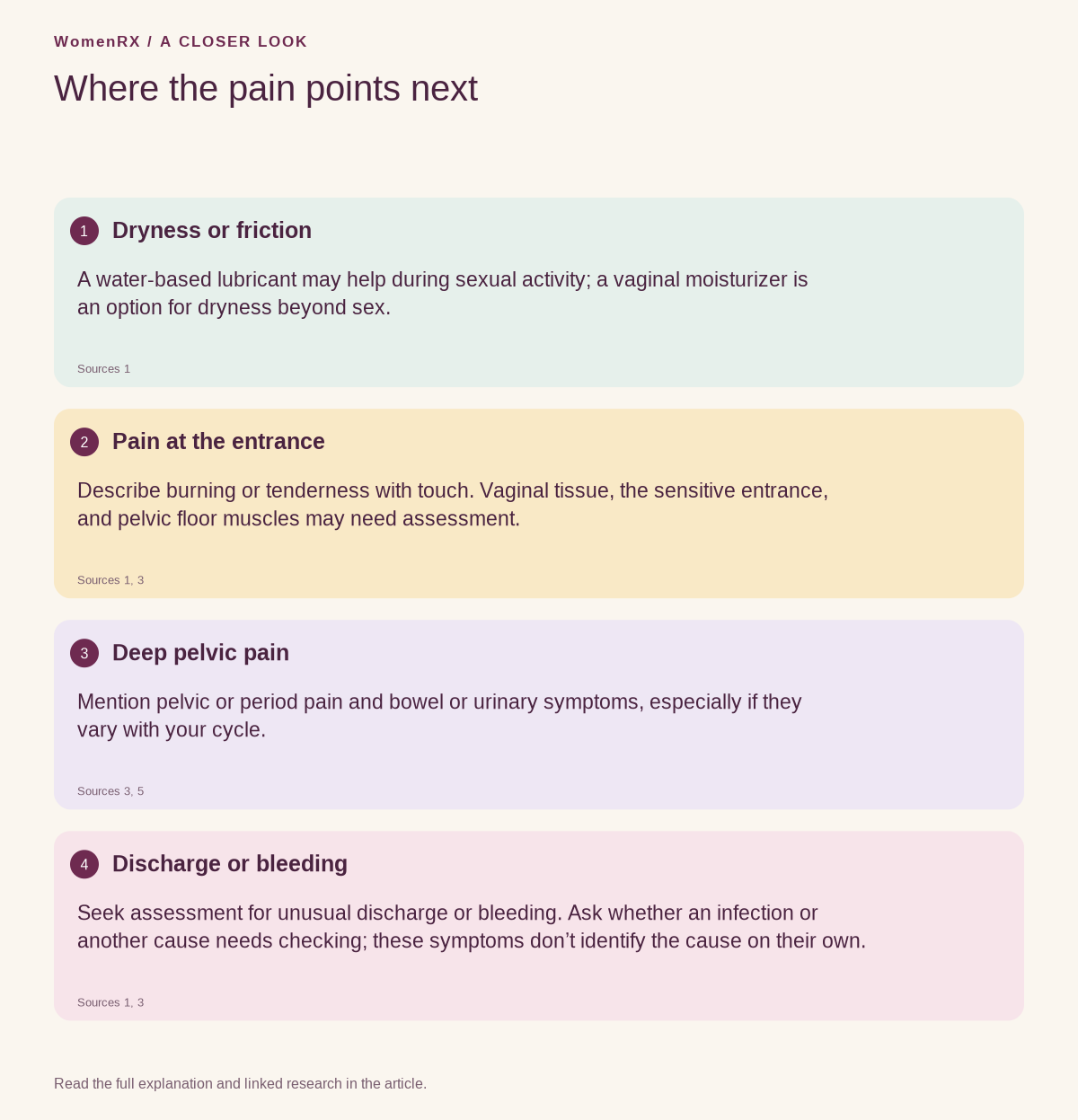
Dryness or friction: A water-based lubricant may help during sexual activity; a vaginal moisturizer is an option for dryness beyond sex.1
Pain at the entrance: Describe burning or tenderness with touch. Vaginal tissue, the sensitive entrance, and pelvic floor muscles may need assessment.13
Deep pelvic pain: Mention pelvic or period pain and bowel or urinary symptoms, especially if they vary with your cycle.35
Discharge or bleeding: Seek assessment for unusual discharge or bleeding. Ask whether an infection or another cause needs checking; these symptoms don’t identify the cause on their own.13
Read the figure as text
Start with the pattern that sounds most familiar, then consider the accompanying symptoms. These branches guide a conversation, not a self-diagnosis.- Dryness or friction: A water-based lubricant may help during sexual activity; a vaginal moisturizer is an option for dryness beyond sex.1
- Pain at the entrance: Describe burning or tenderness with touch. Vaginal tissue, the sensitive entrance, and pelvic floor muscles may need assessment.13
- Deep pelvic pain: Mention pelvic or period pain and bowel or urinary symptoms, especially if they vary with your cycle.35
- Discharge or bleeding: Seek assessment for unusual discharge or bleeding. Ask whether an infection or another cause needs checking; these symptoms don’t identify the cause on their own.13
Sources you can check
- Vaginal dryness - NHSAccessed 2026-09-25Return to first citation
- About vaginal oestrogen - NHSAccessed 2026-09-25Return to first citation
- Assessment and management of dyspareunia in peri- and postmenopausal women: A phenotype-based gynecologic approach.Broul M, Vančo M, Banýrová J, Hujová A. · International journal of gynaecology and obstetrics: the official organ of the International Federation of Gynaecology and Obstetrics · 2026Return to first citation
- The 2022 hormone therapy position statement of The North American Menopause Society.“The 2022 Hormone Therapy Position Statement of The North American Menopause Society” Advisory Panel. · Menopause (New York, N.Y.) · 2022Return to first citation
- Reframing endometriosis care in low-resource settings: a pragmatic 5R framework for recognition, rule-out, relief, referral and review.Ken-Amoah S, Agbeno EK, Agyeman S, Mensah EPY, Anane-Fenin B, Boateng GO. · Frontiers in reproductive health · 2026Return to first citation