Painful Sex During Menopause: Find the Cause, Then Relief
Dryness is one common cause, but where and when it hurts can point to other treatable problems.
Pain with sex during perimenopause or after menopause can come from menopause-related vaginal dryness and irritation, but pelvic floor tension, skin conditions, infection, or deeper pelvic problems can also play a part. Don’t push through pain. Notice whether it’s at the opening or deeper, try a lubricant or vaginal moisturizer if dryness seems involved, and seek an assessment if pain persists or its cause isn’t clear. 457
Painful sex can be discouraging, especially when it seems to appear out of nowhere. Menopause-related changes are a common explanation, but they’re not the only one. A useful first step is to notice the kind of pain you’re having, because that can help guide what to try next and what to discuss with a clinician.
Start with where and when it hurts
If pain is mostly at the vaginal opening or feels like burning, rubbing, or soreness with penetration, dryness and irritation may be contributing. Lower estrogen during and after menopause can cause these symptoms, sometimes alongside urinary discomfort or urgency. These changes can start during perimenopause, not only after periods have stopped. 47
Pain can also come from sensitive tissue around the opening, a skin or inflammatory condition, or pelvic floor muscles that tighten or guard during penetration. Pain felt deeper in the pelvis may need a broader assessment rather than being assumed to be dryness. More than one cause can be present at the same time. 45
You don’t need to keep having penetration that hurts. Pause, stop, or choose another kind of intimacy while you work out what’s going on. Pain is useful information, not something you have to endure.
If dryness or friction seems likely
A vaginal lubricant can help reduce friction during sexual activity. Vaginal moisturizers are another nonhormonal option for menopause-related vaginal symptoms. They’re different product types, so check the label or ask a pharmacist how a specific product is meant to be used. These options may help, but persistent pain deserves attention rather than an endless cycle of trying products. 27
Notice whether the pain improves when friction is reduced. That can be a helpful clue, but it doesn’t prove dryness is the only cause. If penetration still hurts, or you also have urinary symptoms, itching, burning, or skin changes, arrange an assessment. 45
When to discuss prescription treatment
If vaginal dryness or irritation continues despite nonhormonal products, ask whether genitourinary syndrome of menopause (GSM) could be contributing. GSM is the name for genital, urinary, and sexual changes linked to low estrogen. The North American Menopause Society recommends considering low-dose vaginal estrogen or other prescription options for bothersome GSM symptoms not relieved by over-the-counter treatments, when systemic hormone therapy isn’t otherwise indicated. 37
Vaginal estrogen is a local treatment aimed at vaginal symptoms; it isn’t a treatment for hot flashes or other whole-body menopause symptoms. It may take time to improve symptoms, and symptoms can return if treatment is stopped. A clinician can help weigh whether it fits your situation and discuss alternatives, including vaginal DHEA or ospemifene for selected people. 123
Your health history matters when choosing treatment. If you’ve had breast cancer or are receiving cancer treatment, mention that before starting a hormone-related treatment; options for GSM in breast cancer survivors require careful consideration, and longer-term evidence remains limited. 6
If the pain doesn’t fit a dryness pattern
A clinician can ask whether the pain is superficial or deep, happens only with penetration or also at other times, and comes with urinary, skin, or other pelvic symptoms. An examination may help identify tissue irritation, pelvic floor tenderness, or another cause. If pelvic floor muscles are tender or overly tense, pelvic floor physical therapy may be considered; evidence specific to menopause-related pain is limited, so it isn’t a one-size-fits-all answer. 45
Seek an assessment if pain persists, worsens, or is deep, spontaneous, or accompanied by urinary or skin symptoms. The goal isn’t simply to label the pain as menopause. It’s to find the likely contributors and match relief to them.
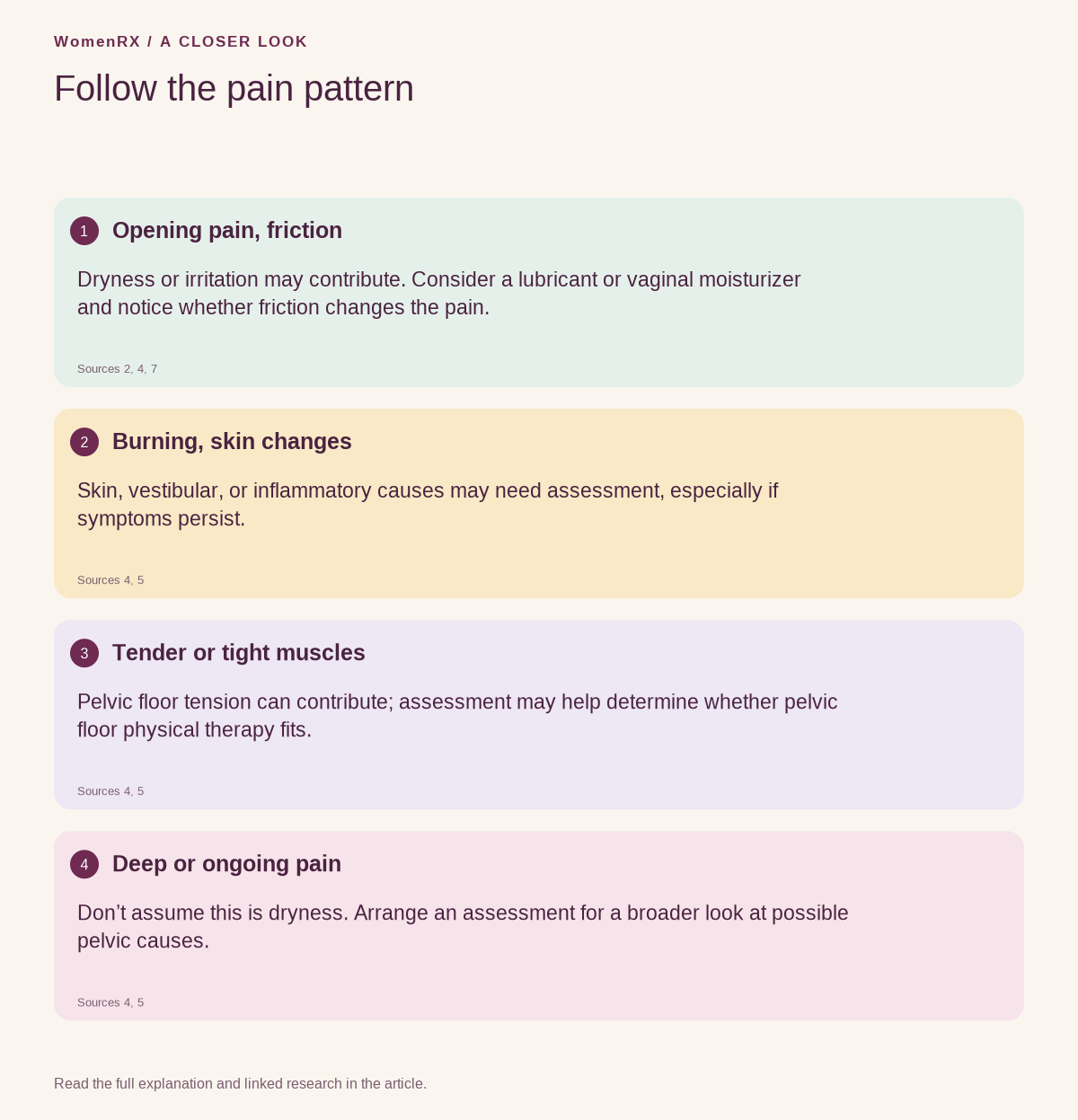
Follow the pain pattern
Opening pain, friction: Dryness or irritation may contribute. Consider a lubricant or vaginal moisturizer and notice whether friction changes the pain.247
Burning, skin changes: Skin, vestibular, or inflammatory causes may need assessment, especially if symptoms persist.45
Tender or tight muscles: Pelvic floor tension can contribute; assessment may help determine whether pelvic floor physical therapy fits.45
Deep or ongoing pain: Don’t assume this is dryness. Arrange an assessment for a broader look at possible pelvic causes.45
Read the figure as text
Use the location and accompanying symptoms as clues. This flow helps you choose a reasonable next step without assuming dryness is the only cause.- Opening pain, friction: Dryness or irritation may contribute. Consider a lubricant or vaginal moisturizer and notice whether friction changes the pain.247
- Burning, skin changes: Skin, vestibular, or inflammatory causes may need assessment, especially if symptoms persist.45
- Tender or tight muscles: Pelvic floor tension can contribute; assessment may help determine whether pelvic floor physical therapy fits.45
- Deep or ongoing pain: Don’t assume this is dryness. Arrange an assessment for a broader look at possible pelvic causes.45
More questions, answered
Is vaginal estrogen the same as systemic hormone therapy?
No. Vaginal estrogen is used locally for vaginal symptoms such as dryness and irritation; it doesn’t treat hot flashes or other general menopause symptoms. Whether it’s suitable depends on your health history and the symptoms you want to treat. 13
Can pelvic floor tension cause pain even if I’m not dry?
Yes. Pelvic floor tenderness or muscles that tighten during penetration can contribute to pain, and may occur alongside menopause-related tissue symptoms. An assessment can help distinguish these causes; pelvic floor physical therapy may be considered when muscle tenderness or tension is present. 45
Sources you can check
- About vaginal oestrogen - NHSAccessed 2026-09-25Return to first citation
- Common questions about vaginal oestrogen - NHSAccessed 2026-09-25Return to first citation
- The 2022 hormone therapy position statement of The North American Menopause Society.“The 2022 Hormone Therapy Position Statement of The North American Menopause Society” Advisory Panel. · Menopause (New York, N.Y.) · 2022Return to first citation
- Assessment and management of dyspareunia in peri- and postmenopausal women: A phenotype-based gynecologic approach.Broul M, Vančo M, Banýrová J, Hujová A. · International journal of gynaecology and obstetrics: the official organ of the International Federation of Gynaecology and Obstetrics · 2026Return to first citation
- Diagnosis, causes, and treatment of dyspareunia in postmenopausal women.Streicher LF. · Menopause (New York, N.Y.) · 2023Return to first citation
- Therapeutic Choices for Genitourinary Syndrome of Menopause (GSM) in Breast Cancer Survivors: A Systematic Review and Update.Merlino L, D'Ovidio G, Matys V, Piccioni MG, Porpora MG, Senatori R, Viscardi MF, Vitale A, Della Rocca C, On Behalf Of Policlinico Umberto I Collaborators. · Pharmaceuticals (Basel, Switzerland) · 2023Return to first citation
- Female Pelvic Conditions: Genitourinary Syndrome of Menopause.Brady PH, Gin GT, Rosenblum E, Wilkinson LD. · FP essentials · 2022Return to first citation